
Two everyday health problems hold the biggest slices of dementia risk you can act on: hearing loss and high LDL cholesterol. Each carries a 7% share. Neither sounds like a brain problem.
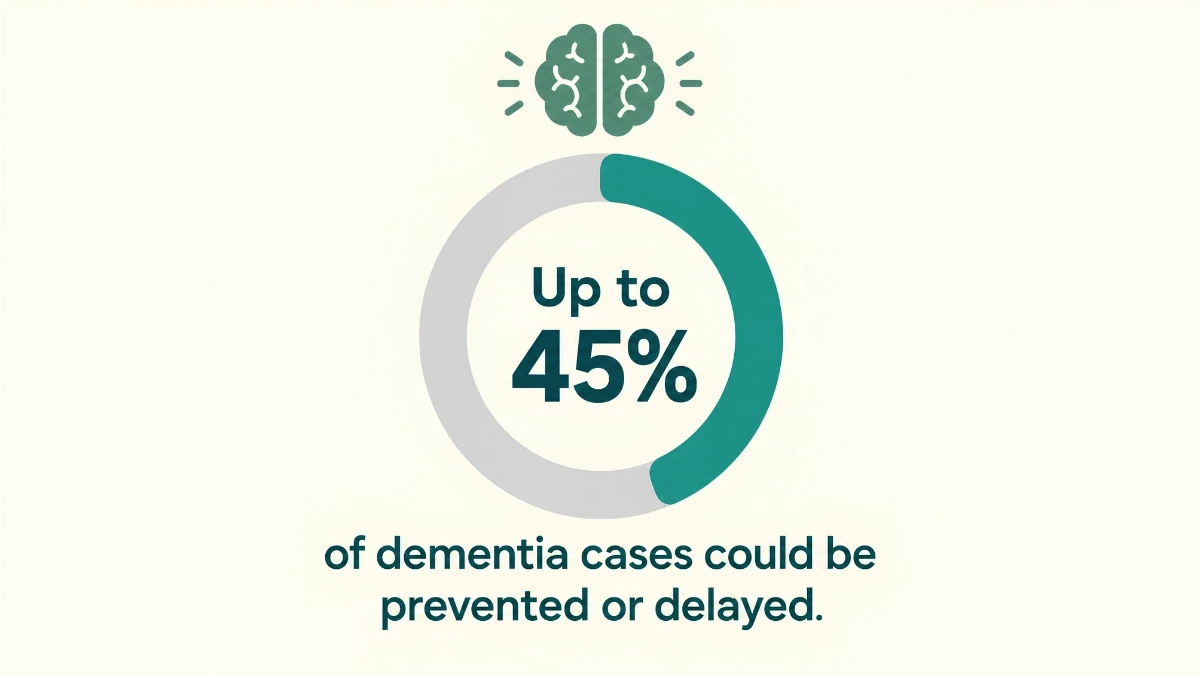
If you worry that dementia is mostly out of your hands, the 2024 Lancet Commission offers a more hopeful picture. It named 14 modifiable dementia risk factors. Addressing all of them could prevent or delay up to 45% of cases worldwide.
That figure describes whole populations, and it makes no promise about any one person. You can change some factors this month. Others need a doctor, and a few sit partly outside your control. This checklist covers all 14 and shows which is which, so you know where to start.
What “Modifiable” Really Means (and What 45% Does Not Promise)
The 2024 report from the Lancet standing Commission on dementia prevention listed 14 modifiable risk factors. The Commission estimated that tackling all of them could prevent or delay up to 45% of dementia cases worldwide. It gave each factor a share of that total.
The Commission adds a caution. Its estimates assume each factor causes dementia, and some links may be only partly causal. Some factors may also be early symptoms, not only causes. Treating them still improves your health.
Genes do not settle the matter. The Commission says its estimate applies whether or not a person carries the APOE gene, which people often call the Alzheimer’s gene.
The 14 differ in how much you can change them. Some need a doctor’s check. Some are habits you can change. A few you can only partly control.
The Commission also groups them by life stage: one in early life, ten in midlife and three in late life. Midlife comes first because it holds the biggest shares.
Midlife, Part One: The Medical Checks (Hearing, LDL, Blood Pressure, Diabetes, Weight)
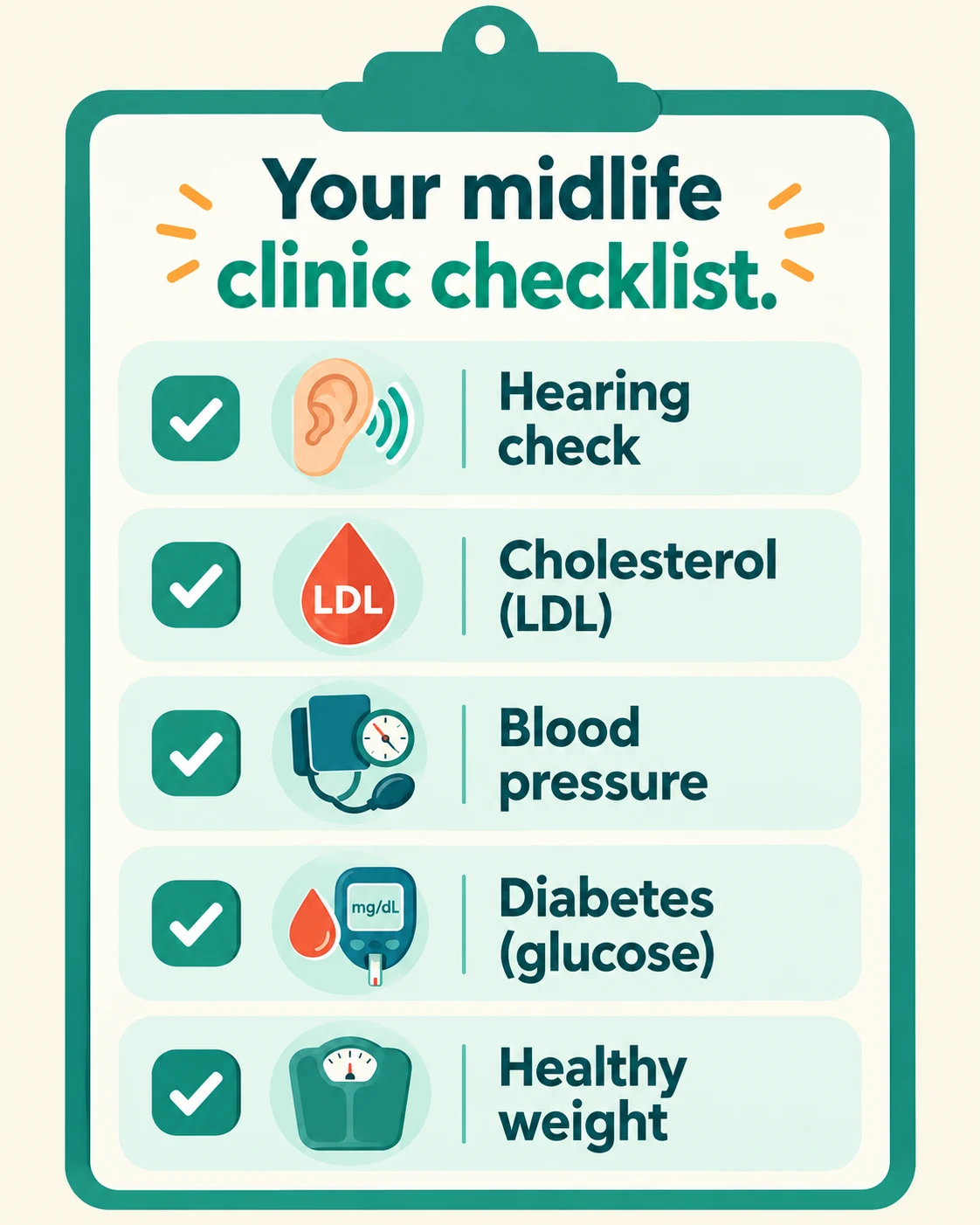
The Commission places hearing loss and high LDL cholesterol in midlife. Each holds a 7% share, the largest on the list. LDL cholesterol joined the list in 2024.
Hearing loss often creeps in over many years. Many people with early loss insist they hear fine. They just avoid noisy restaurants and ask others to repeat things. A hearing test gives a clear answer.

The 2023 ACHIEVE trial in The Lancet tested hearing aids and counseling in adults aged 70 to 84 with hearing loss. It found no clear benefit in the full group. In a higher-risk subgroup of 238 people, cognitive decline slowed by 48% over three years.
Commission lead Gill Livingston and Sergi Costafreda wrote in The Lancet that the 48% gain could be a false signal. I read the result as promising, not proven. Better hearing also makes daily conversation easier.
High Cholesterol
Ask your doctor to check your level.
No Symptoms
The CDC says high cholesterol causes no symptoms, and only a blood test shows your level.
Recommendation
The Commission recommends finding and treating high LDL cholesterol in midlife.
Next Visit
Ask your doctor to check your level at your next visit.
The Commission links part of this risk to damage in blood vessels. It notes that treating high blood pressure and cutting smoking may have helped lower dementia rates. High blood pressure carries a 2% share. Ask your doctor to check your numbers at every visit, and follow the plan you agree on together.
Diabetes (2%) and obesity (1%) complete the medical group. The Commission’s evidence review linked diabetes to higher dementia risk, and the earlier it starts, the higher the risk. That is why the Commission moved diabetes into the midlife group. Diabetes later in life and poor blood sugar control also add risk
The Commission also links obesity to dementia partly through diabetes and high blood pressure. Ask your doctor to check your blood sugar and weight. Those five need a clinic visit. The next five depend more on daily habits and mood.
Midlife, Part Two: Habits, Mood and Head Injury (Depression, Inactivity, Smoking, Alcohol, TBI)
Note: With a heart condition, joint pain or another health issue, ask your doctor before changing your activity or drinking.
Depression carries a 3% share. The Commission recommends treating it. If low mood lasts for weeks, tell your doctor. Good care also helps you feel better now.
Traumatic brain injury also carries a 3% share. The Commission advises appropriate head protection. Wear a helmet when you cycle. Clear loose rugs and clutter to prevent falls.
Physical inactivity, smoking and excessive alcohol carry shares of 2%, 2% and 1%. Those shares look small. They are also the habits you can start changing today.

The Commission’s evidence review linked heavy drinking to higher dementia risk and changes in brain structure. The Commission counts more than 21 UK units a week, about 12 US drinks, as heavy drinking.
The Commission also says it is never too early or too late to reduce dementia risk. Some people see their routines slip after retirement. Walks stop, evening drinks creep up, and mood dips. Pick one fix, not three. A short walk after lunch is a fine start.
That covers the midlife ten. The last four factors sit at the two ends of life.
The Bookends: Education, Social Connection, Air Quality and Vision
Lower education sits in early life and carries a 5% share. You cannot rewind your school years. You can keep learning. The Commission urges staying active in body, mind and social life. Take a class, learn a language or pick up a new skill.
Social isolation carries a 5% share and ties with education for third-largest. Set a standing weekly plan, such as coffee with a friend or a class at the library.
After a retirement, a move or a loss, a calendar can empty out slowly. Nobody sends an alert. Notice it early, and add one regular plan before the gap grows.

Air pollution carries a 3% share. Much of this risk sits outside your control. The Commission notes that some risks start with society as a whole and need large policy changes. At home, you can ventilate when you cook and check local air quality reports before outdoor exercise.
Untreated vision loss is new in 2024 and carries a 2% share. The Commission added it after reviewing evidence from two large reviews of earlier studies. Book an eye exam. New glasses or cataract surgery can fix many causes of vision loss.
That completes the list of 14. The next question is whether acting on them works.
Do the Trials Back This Up? What Recent Evidence Shows
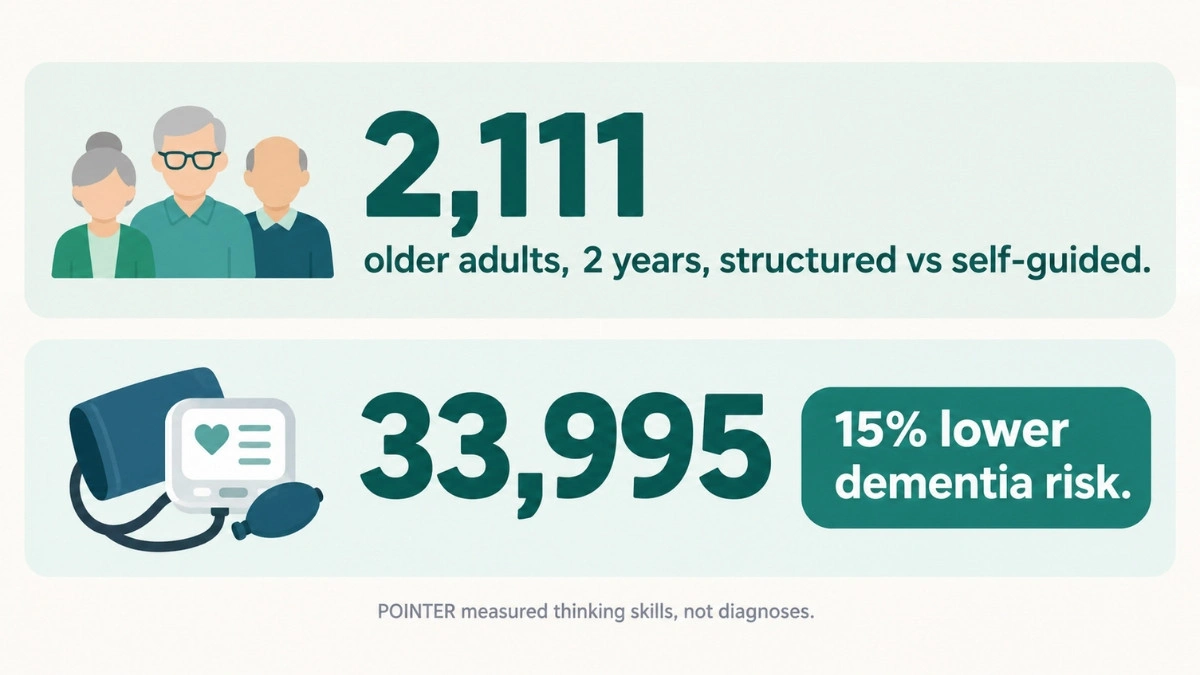
Links between risk factors and dementia do not prove cause and effect, so trials matter. The U.S. POINTER trial enrolled 2,111 older adults at risk of cognitive decline. The results appeared in JAMA in July 2025.
The Alzheimer’s Association and Wake Forest’s newsroom describe two programs. One was structured, with exercise, nutrition, brain and social challenges, and health checks. The other was self-guided: people chose their own changes and attended six peer meetings.
Both groups improved. The structured group improved more. The gap was modest, and the trial measured thinking skills over two years, not dementia diagnoses.
A 2025 trial in Nature Medicine tested a blood pressure program in rural China. It enrolled 33,995 adults with uncontrolled high blood pressure. Village health providers who were not physicians led the program. After four years, dementia risk ran 15% lower than with usual care.
The program set a firm goal and added medicines in steps. Your own goal depends on your health, so your doctor sets it.
I take two lessons from these trials. First, ACHIEVE found gains only in a higher-risk subgroup, so the hearing result still needs confirming. Second, support helps: the structured POINTER program beat the self-guided one. Find a walking partner, a class or a clinic program to help you stay on track.
The checklist below turns all of this into three steps.
Your Starting Checklist: Check, Change, Connect
Start small. Pick the steps that fit your life now, and add more later. Here are all 14 factors in three steps.
- Check (6 factors): Book one visit. Ask about blood pressure, LDL cholesterol, blood sugar, weight, hearing and vision.
- Change (4 factors): Pick one habit. Move more, quit smoking, cut back on alcohol, or protect your head.
- Connect (4 factors): Put one standing plan with another person on your calendar. Keep learning. Tell your doctor if your mood has dipped for weeks. Check local air quality before you exercise outside.

The Lancet Commission’s advice for individuals matches this list. It recommends treating depression, high blood pressure, high midlife LDL cholesterol, obesity and diabetes. It also urges quitting smoking, cutting alcohol, and staying active in body, mind and social life.
You do not need to do all of it at once.
Conclusion
Worrying about your memory can feel like waiting for bad news. You can do something with that worry. This week, call your doctor and book the check-up from your list. Then tell a friend you made the call. Brain health is easier with company, and you have just given yourself a head start.
References
- Livingston G, et al. Dementia prevention, intervention, and care: 2024 report of the Lancet standing Commission. The Lancet. 2024;404(10452):572-628. https://doi.org/10.1016/S0140-6736(24)01296-0
- The Lancet Commission on Dementia Prevention, Intervention, and Care (hub page): https://www.thelancet.com/commissions/dementia-prevention-intervention-care
- University College London. Nearly half of dementia cases could be prevented or delayed by tackling 14 risk factors (2024): https://www.ucl.ac.uk/news/2024/jul/nearly-half-dementia-cases-could-be-prevented-or-delayed-tackling-14-risk-factors
- Alzheimer Europe. 2024 Lancet Commission underscores the potential for dementia risk reduction: https://www.alzheimer-europe.org/news/2024-lancet-commission-underscores-potential-dementia-risk-reduction-identifying-14-modifiable
- Alzheimer’s Association. Hearing aids slow cognitive decline in older adults with hearing loss and at risk for cognitive decline (ACHIEVE, 2023): https://aaic.alz.org/releases_2023/hearing-aids-slow-cognitive-decline.asp
- Audiology Worldnews. What has ACHIEVE achieved? (summary of The Lancet commentary by Livingston and Costafreda): https://www.audiology-worldnews.com/world-news/research/4908-what-has-achieve-achieved/
- Alzheimer’s Association. U.S. POINTER study results (JAMA, 2025, doi:10.1001/jama.2025.12923): https://alz.org/us-pointer/study-results
- Wake Forest newsroom. Groundbreaking study shows lifestyle changes significantly improve brain health (2025): https://newsroom.wakehealth.edu/news-releases/2025/07/groundbreaking-study-shows-lifestyle-changes-significantly-improve-brain-health
- Nature Medicine. Blood pressure reduction and all-cause dementia in people with uncontrolled hypertension (2025): https://www.nature.com/articles/s41591-025-03616-8
- CDC. Testing for Cholesterol (2024): https://www.cdc.gov/cholesterol/testing/index.html