

Every year, millions of families sit in a hospital room and face the same question. “Should we move to hospice, or keep going with palliative care?” Most of them don’t know the real difference between the two.
That moment is scary. You’re tired. You’re emotional. Your doctor used words you’re not sure about. And you’re terrified that choosing the wrong option means failing your loved one.
You’re not alone in feeling that way. And you’re not failing anyone.
This article will explain what palliative care and hospice care actually mean. It will show you the warning signs that it’s time to shift. It will bust the 5 myths that cause families to wait too long. And it will give you the exact questions to ask your doctor this week.
No medical jargon. No guessing. Just clear, honest answers when you need them most.
What Is Palliative Care, Really? (Not What You Think)

Most people hear “palliative care” and quietly think, “Oh, that means he’s dying.” That is not what it means.
Palliative care starts the moment someone gets a serious diagnosis. Cancer, heart failure, COPD, dementia — it doesn’t matter. The goal is to manage pain, nausea, anxiety, and stress while your loved one is still actively getting treatment.
Think of it as a second team working alongside the regular doctors. Your oncologist handles the cancer. The palliative care team handles how your loved one feels during that fight.
A 58-year-old woman going through chemotherapy can have a palliative care nurse helping her manage fatigue and nausea at the same time. Two separate teams. Two separate jobs. One patient getting much better care.

Despite this, close to 60% of patients who need palliative care never get it. By 2025, palliative care teams worldwide were still only reaching about 14% of the people who need them.
Palliative care walks alongside you during the fight. Hospice enters when the fight changes direction.
Quick Tip:
- Palliative care does not replace your current treatment. It adds to it. Don’t wait for a crisis to ask.
What Hospice Care Actually Is (And What It Is Not)
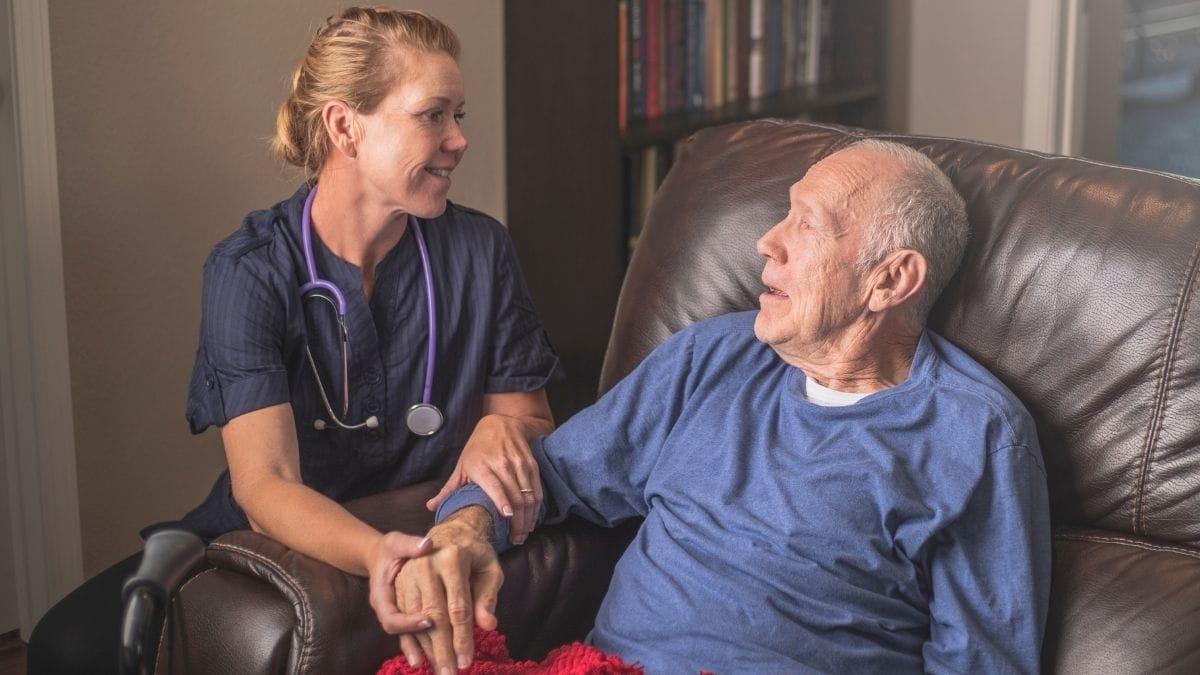
When most people picture hospice, they picture a cold, clinical room in a facility. That picture is almost always wrong.
Hospice is care that happens mostly at home. In fact, 80% of hospice care is delivered in the patient’s own house. The team comes to you.
Hospice is for people with a prognosis of six months or less, where the goal has shifted from curing the illness to keeping the person comfortable. Two doctors must confirm that prognosis for Medicare to cover it.
Once a patient enters hospice, a full team shows up. Nurses, aides, chaplains, social workers, grief counselors, and volunteers. All of them coordinating care together. And here’s what most families don’t know: Medicare, Medicaid, and most private insurance cover hospice 100%. That includes medications, medical equipment, and even bereavement support for the family after their loved one passes.
In 2024, 1.61 million Medicare patients enrolled in hospice. For the first time ever, 53.1% of all Medicare patients who died that year had been in hospice care.
Hospice is not the end of care. For most families, it is the beginning of the most meaningful care their loved one ever received.
Quick Tips:
- Call your insurance provider today. Ask if the Medicare Hospice Benefit applies to your loved one.
- Visit Medicare.gov/care-compare to look up and compare certified hospice providers in your area.
The Real Difference (Palliative or Hospice) — A Side-By-Side Breakdown

Here is the simplest way to remember the difference. Palliative care means you are still trying to treat the illness. Hospice means comfort is now the only goal.
| Palliative Care | Hospice Care | |
|---|---|---|
| When it starts | At any diagnosis, any stage | Prognosis of 6 months or less |
| Who qualifies | Anyone with serious illness | Terminal illness, treatment stopped |
| Treatment goal | Manage symptoms + continue treatment | Comfort only |
| Coverage | Covered like specialist visits, co-pays may apply | 100% covered by Medicare/Medicaid |
| Who leads care | Works alongside your existing doctors | Hospice team takes over coordination |
One phrase worth remembering: “All hospice care involves palliative care. But not all palliative care takes place in hospice.”
Palliative care can last years. Hospice is for the final chapter. Both are acts of love. Neither one is giving up.
The 5 Myths That Delay Families From Making the Right Call

Myth 1: “Choosing hospice means giving up.” It does not. Research shows hospice patients sometimes live longer than those who continue aggressive treatment. Hospice adds comfort, reduces pain, and gives families real support.
Myth 2: “Hospice is only for cancer patients.” Wrong. In 2024, circulatory conditions made up 27.8% of hospice stays. Cancer was only 22.3%. Hospice is for anyone with a terminal illness.
Myth 3: “We can’t afford hospice.” Hospice is the only Medicare benefit that covers medications, equipment, and 24/7 support all at once. For most families, the out-of-pocket cost is zero.
Myth 4: “Hospice means going to a facility.” Most hospice care happens at home. The team comes to the patient.
Myth 5: “It’s too early to think about this.” 40% of hospice patients received less than 14 days of service. 30% received less than 7 days. Most families wait far too long. As Dr. Ritzau of HopeHealth says directly: “Most people tell us that they wish they had called hospice sooner.”
The Real Reason Families Struggle — It’s Not Confusion, It’s Emotion

Here’s the truth most care guides skip. Families don’t delay hospice because they lack information. They delay it because they cannot emotionally accept what the choice represents.
And that is completely human.
Research from published caregiver studies confirms it. Families feel guilt, fear, self-doubt, and deep denial during this process. One caregiver in a real research study said exactly this: “Just simply with the word ‘terminal’, one gets nervous. You start to imagine the worst.”
Even doctors struggle with this. Studies show that clinicians sometimes avoid having the hospice conversation because they fear it will take away the patient’s hope.
Family members often disagree with each other too. One sibling wants to keep fighting. Another sees their parent suffering. That conflict delays a decision that could bring real relief.
This struggle does not mean you are failing. It means you love someone deeply. But here is what the data keeps showing: waiting longer does not help. It only shortens the time your loved one could be comfortable, at home, with the people they love.
The most loving thing you can do is get the facts and act on them.
Quick Tip:
- Ask the care team for a social worker. Their entire job is to help families through exactly this moment.
How to Know When It’s Time to Make the Switch
You do not need to wait for a crisis to ask the question. These are the five warning signs families often miss.

Warning Sign 1: Your loved one has been hospitalized two or more times in the last six months.
Warning Sign 2: Current treatments are no longer working, or your loved one is struggling to tolerate them.
Warning Sign 3: There has been noticeable weight loss and a decline in basic daily tasks like eating, walking, or dressing.
Warning Sign 4: Your loved one is sleeping most of the day and is rarely alert.
Warning Sign 5: Your loved one is saying they want to stop treatment.
If you see any of these, it’s time to talk to the doctor. Use these exact questions:
- “Given what we’re seeing, what is a realistic prognosis?”
- “Are we treating to cure, or treating to manage symptoms?”
- “Would a hospice consultation make sense right now?”
- “What would change day-to-day if we shifted to hospice care?”
One more thing: starting hospice is not permanent. Patients can revoke hospice enrollment and return to curative treatment at any time.
How to Have the Conversation With Your Family
This conversation is hard. Here is how to start it without triggering a fight.
First, get the right people together. That includes the patient, if they are able to participate. Their voice matters most. It includes immediate family, and ideally one member of the care team — a nurse, social worker, or chaplain.
Start by asking about wishes, not decisions. Dr. Atul Gawande, a surgeon and widely respected voice in end-of-life care, suggests four questions to ask a seriously ill person:
- “What is your understanding of where things stand with your health?”
- “What are your biggest fears and concerns right now?”
- “What goals matter most to you?”
- “How do you want to spend your time if things get harder?”
These are not morbid questions. They are the most loving questions you can ask someone.
If family members disagree, do not force a decision in that room. Ask the hospice or palliative care team to hold a formal family meeting. Social workers facilitate these regularly.
The goal is not to win the argument. The goal is to honor what your loved one actually wants.
Final Thought;
Understanding palliative care vs hospice care is not about accepting death. It is about choosing the best possible life, for as long as it lasts.