

By the time most people feel back pain, their spine has already been changing for years.
That’s the part nobody tells you. Spinal degeneration doesn’t start with pain. It starts quietly, slowly, and long before you notice anything wrong.
26% of people aged 40 already show signs of disc degeneration. By age 80, that number jumps to 80%.
The good news? You can slow this down. These five habits, backed by current research, can protect your spine starting today. Just simple, daily action.
Point 1: Build Core Strength to Stabilize Your Spine
Most people think the core is just about abs. It’s not.
Your core includes your abdominal muscles, the muscles along your spine, and your pelvic muscles. Together, they act like a natural brace for your back.
When they’re strong, your spine stays aligned and load is spread evenly. When they’re weak, your discs and joints absorb all that pressure alone — and that speeds up wear and tear.
Think about picking up a grocery bag. With a strong core, your muscles share the load. Without it, your lower back takes the hit every single time.
The fix doesn’t have to be complicated. Start with planks, bridges, bird-dogs, and dead bugs.

These are beginner-friendly moves that directly train the muscles your spine needs. Pilates and yoga also work well because they build both strength and flexibility at the same time.
Three to four sessions a week, 15 to 20 minutes each, is enough to make a real difference. You don’t need a gym. You just need to start.
One action step: Do a 30-second plank today. That’s your starting point.
Point 2: Fix Your Posture Before Your Phone Wrecks Your Neck
Look at how you’re sitting right now.
If your shoulders are hunched forward and your chin is jutting out, your cervical spine is already under stress. A head position just 2 to 3 inches forward can double the effective weight your neck carries. Do that for eight hours a day, and the damage adds up fast.
Slouching at a desk does the same thing to your lower back. It compresses lumbar discs unevenly. Over time, that uneven pressure weakens the discs and can lead to herniation.
Good posture isn’t complicated. Your ears should sit over your shoulders. Your shoulders should sit over your hips. That’s it.
Practical tools that actually help include lumbar support cushions, monitor risers to bring your screen to eye level, and adjustable desks. These aren’t luxuries — they’re protective equipment.
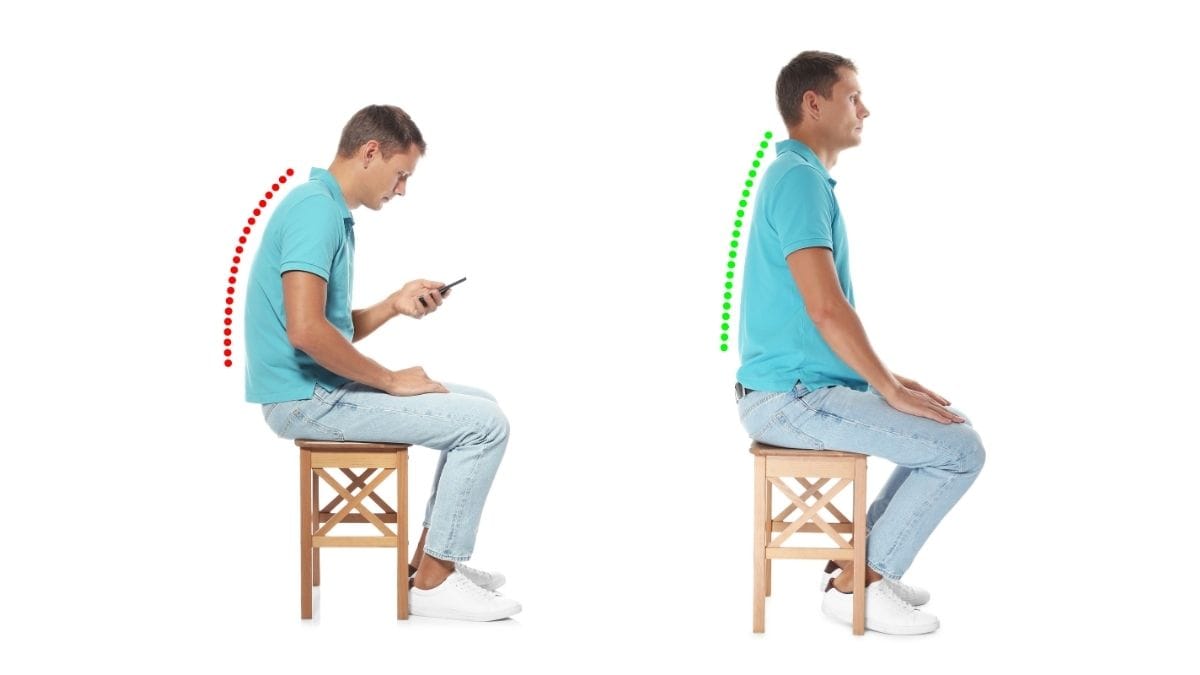
Use the 30-minute rule. Set a timer. Every 30 minutes, stand up, reset your posture, and move for one minute. That single habit takes the pressure off your spine throughout the day.
One action step: Raise your screen to eye level today — it costs nothing and fixes everything.
Point 3: Eat and Drink for Your Discs and Bones
Your spinal discs are mostly water. When you’re well-hydrated, they stay flexible and absorb shock well. When you’re dehydrated, they flatten and stiffen. It really is that direct.
Aim for at least 8 glasses of water a day. And if you drink a lot of coffee or soda, those fluids work against you — swap one for water and you’ll already be ahead.
Beyond water, two nutrients matter most: calcium and Vitamin D. Calcium keeps your vertebrae strong. Vitamin D helps your body actually absorb that calcium.
Without Vitamin D, even a calcium-rich diet won’t fully protect your bones. The National Osteoporosis Foundation recommends 800 to 1,000 IU of Vitamin D daily for adults over 50.

Eat fatty fish like salmon and sardines twice a week. Add leafy greens, nuts, and seeds. Cut back on processed food and refined sugar — both increase inflammation that wears down discs faster.
A simple spine-friendly day of eating: Eggs and spinach for breakfast. Salmon with greens for lunch. Walnuts as a snack. That’s it.
Point 4: Move More, Sit Less Every Single Day
Here’s something most people don’t know. Your spinal discs don’t have their own blood supply. They get their nutrients through movement. When you sit all day, your discs slowly starve.
Movement isn’t optional for spine health. It’s the delivery system for the nutrients your discs need to stay healthy.
Walking is one of the best things you can do. It’s low-impact, supports posture, builds conditioning, and puts just enough load on your spine to keep it strong. Swimming does the same thing, with even less compression because the water supports your weight.
Yoga is worth adding too. It builds flexibility, improves balance, and trains your posture — all in one routine.
The goal is 150 minutes of moderate movement per week. That sounds like a lot, but it breaks down to 30 minutes, five days a week.

Here’s a beginner weekly plan that costs nothing: Walk on Monday, Wednesday, and Friday. Do 20 minutes of gentle yoga or stretching on Tuesday and Thursday. Rest on weekends or stay active if you feel up to it.
One action step: Go for a 20-minute walk today. That’s all. Start there.
Point 5: Manage Your Weight and Quit Smoking
Two habits cause more spine damage than almost anything else. And both are reversible.
Think about this: carrying a 20-pound backpack all day, every day, for years. That’s what excess body weight does to your lumbar discs.
Every extra pound adds multiplied pressure to the discs and joints in your lower back. Research from the Global Burden of Disease study confirms that high BMI is one of the top risk factors for low back pain — peaking in damage for people in their early 70s.
Smoking is just as damaging, but for a different reason. It cuts blood flow to your spinal discs.
Less blood flow means fewer nutrients reaching the discs, which makes them break down faster than normal. Smokers develop disc degeneration earlier and more severely than non-smokers.
Even losing 5 to 10% of your body weight reduces measurable pressure on your spine.

And when you quit smoking, circulation starts improving within weeks.
You don’t have to tackle both at once. Pick one. Small, consistent progress beats trying to change everything overnight.
One action step: If you smoke, talk to your doctor this week about a quit plan. If weight is the issue, start with one food swap per day.
Conclusion
Your spine doesn’t have to fall apart as you age. Strengthen your core. Fix your posture. Eat and drink for disc health. Keep moving. And cut out the two habits that quietly accelerate damage.
Start with one change today. Your spine at 70 is being built right now.