Say you count 11 stands in 30 seconds. For a woman aged 65 to 69, the CDC calls that average. For a woman aged 60 to 64, it calls the same score below average. Same chair, same legs, different label. That small gap can feel unfair, or scary.
Those lines came from real studies of real people, and they have clear limits. The 30 second chair stand test works as a quick screen. It cannot judge your health on its own.
Below, I show you the CDC scores for each age group and who set them. Then you can judge what your own number tells you, and how to raise it safely.
Note: Do this test with someone nearby, and stop if you feel dizzy or unsteady. If you had recent hip or knee surgery, or you have balance problems, check with your doctor first.
How the 30 Second Chair Stand Test Works
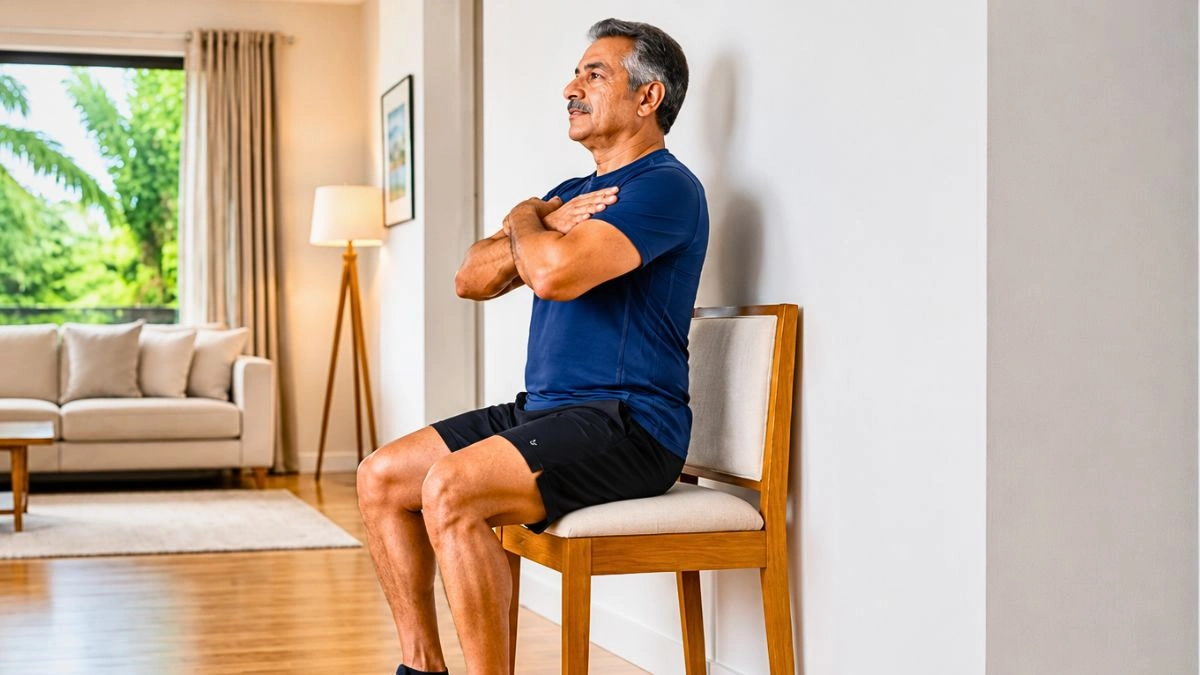
The CDC uses this test in STEADI, its program that helps clinicians screen older adults for fall risk. The CDC form calls for a straight-backed chair with no arms and a stopwatch. Place the chair against a wall so it cannot slide.
Sit in the middle of the chair. Cross your arms over your chest, with your hands on opposite shoulders. Keep your feet flat on the floor. On “go,” stand all the way up, then sit back down again. Repeat for 30 seconds.
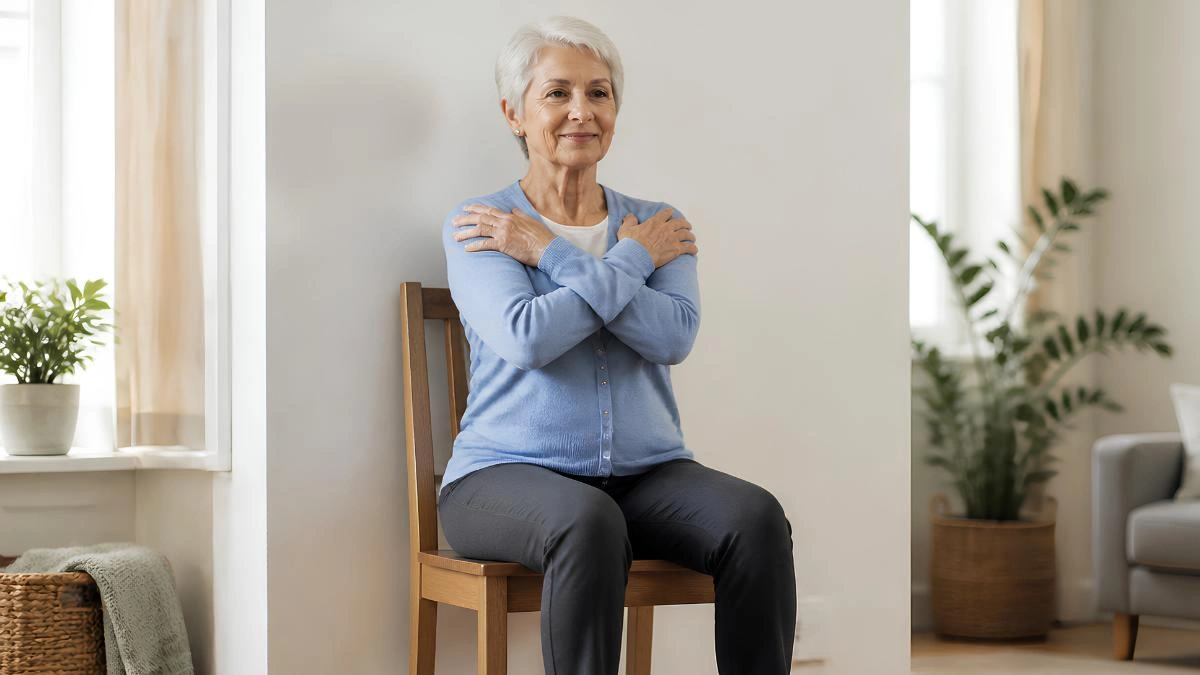
Count every full stand. If you must use your arms to push up, the CDC says to stop and record a score of zero. Once you have a count, you can check it against the CDC chart.
Chair Stand Scores by Age and Sex
The CDC lists a below-average score for each age band from 60 to 94. According to the CDC’s STEADI scoring sheet, a score under the line signals a higher risk of falls.
Here are the cutoffs. A score under the number puts you below average.
| Age | Men: below average | Women: below average |
|---|---|---|
| 60 to 64 | under 14 | under 12 |
| 65 to 69 | under 12 | under 11 |
| 70 to 74 | under 12 | under 10 |
| 75 to 79 | under 11 | under 10 |
| 80 to 84 | under 10 | under 9 |
| 85 to 89 | under 8 | under 8 |
| 90 to 94 | under 7 | under 4 |
These cutoffs cover ages 60 to 94 only. Men and women have different lines, so check the right column. The chart starts at 60. If you are younger, use your count as a personal baseline and compare it with your own retests.
A 68-year-old woman with 12 stands is average. A 64-year-old man with 12 stands is below average.
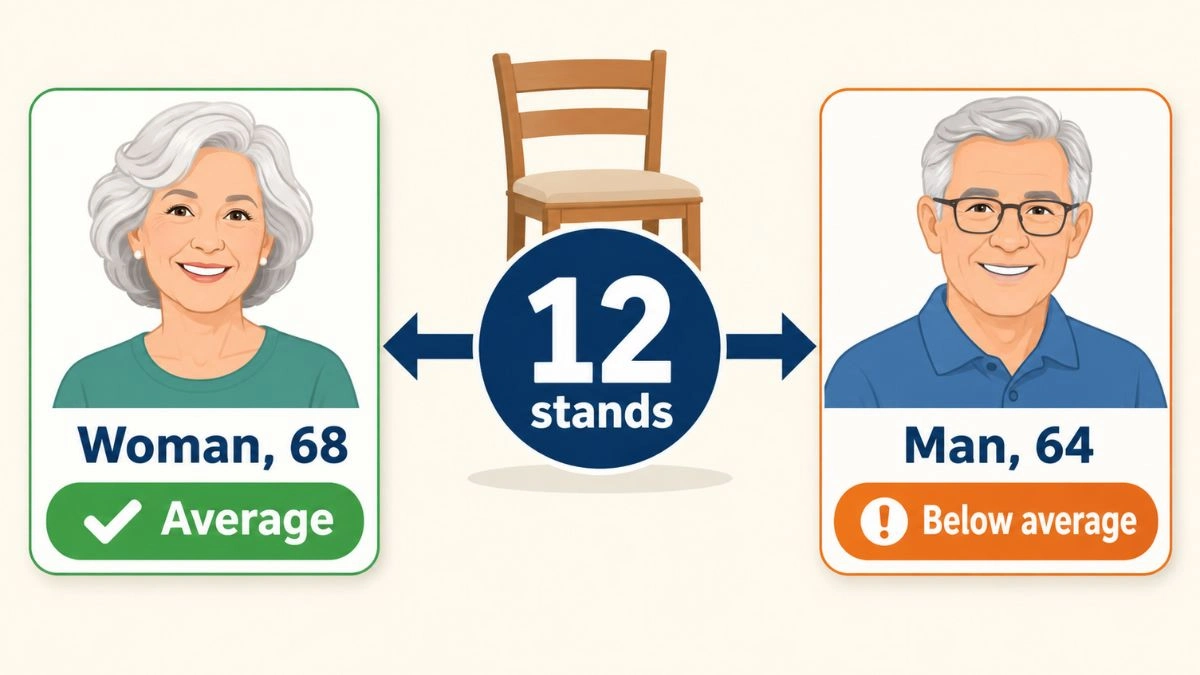
The same count earns two labels, so who drew these lines?
Who Decided “Normal”? What the Cutoffs Can and Cannot Tell You
Roberta Rikli and Jessie Jones of California State University, Fullerton, introduced the test in 1999. Their paper ran in the Journal of Aging and Physical Activity. It belonged to their Fullerton Functional Fitness Test, which they later renamed the Senior Fitness Test.
In a second 1999 paper in the same journal, they published norms. Those scores came from 7,183 adults aged 60 to 94 at 267 sites in 21 states. The team sorted results by sex and into 5-year age groups.
The CDC chart builds on those ranges. It sets each below-average line where the average range begins. So “normal” here means typical for community-living older Americans in that study.

Other countries may differ. A Brazilian study of 1,783 women aged 60 to 84 compared their Senior Fitness Test scores with US norms and found differences. Those authors warn that foreign norms can overstate or understate limits.
The next question is how well the test itself predicts falls. A 2020 study in the Annals of Physical and Rehabilitation Medicine followed 73 Thai adults aged 65 and up for six months. Its sample was small and not random.
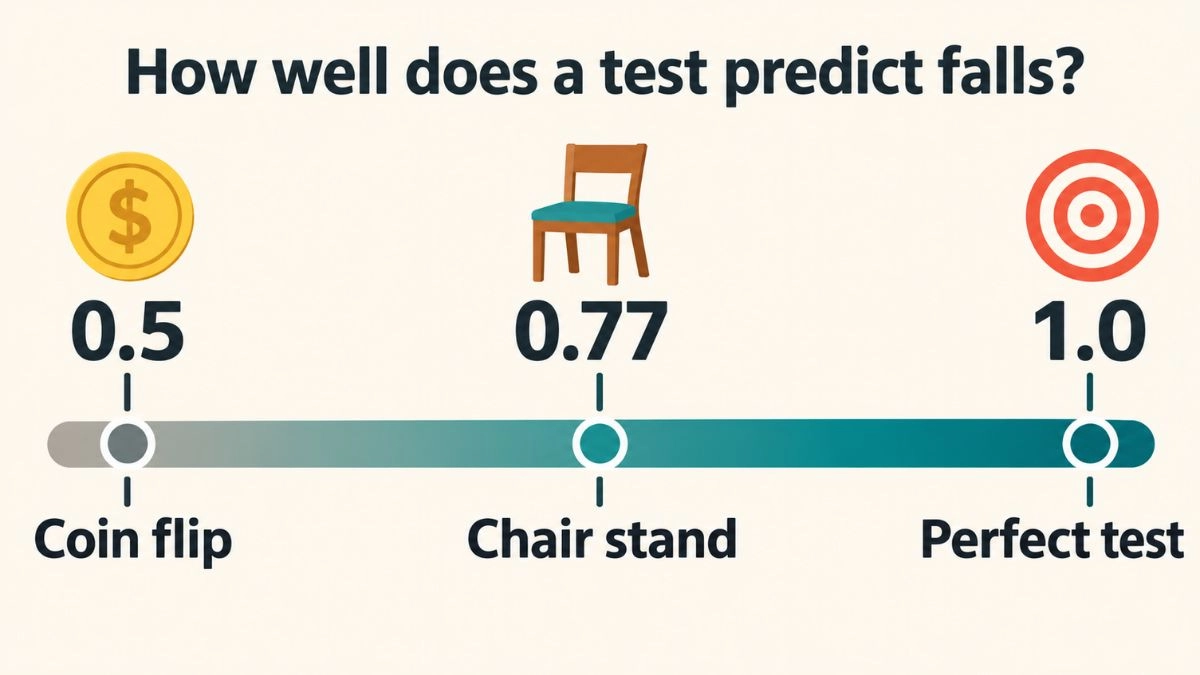
AUC rates how well a test separates people who fall from people who do not. A perfect test scores 1.0. A coin flip scores 0.5.
A 2025 paper in Archives of Allied Health Sciences cites an AUC of 0.77 for the standard chair stand. It calls that moderate accuracy. The 2020 authors called AUCs of 0.77 to 0.91 excellent, but the top figure came from a harder version done with eyes closed on a foam pad.
The same 2025 paper tested only 26 older adults with higher body weight (BMI above 25, using Asian cutoffs). It found the chair stand reliable and moderately valid against other balance tests, but it did not test how well it predicts falls in that group. If that fits you, trust your own trend more than the chart.
A 2025 study in the Journal of Cachexia, Sarcopenia and Muscle used data on 1,475 Spanish adults aged 65 to 98. The team used a formula to turn each person’s test into a leg-power number. Low power, by their cutoffs, tracked with frailty. A rep count alone cannot give you that number.
You may have seen “longevity test” videos online. A 2014 study in the European Journal of Preventive Cardiology followed 2,002 adults aged 51 to 80. It tied a different move, the floor sitting-rising test, to survival. That study did not test the chair stand. It was also observational, so it shows a link, not cause.
Treat your score as a screening signal and a baseline. It diagnoses nothing. Strength can change, and the next section shows how.

How to Raise Your Score Safely
Chair stands train the muscles the test measures. Your thighs and hips lift you off the seat, so every rep works them.
The CDC says adults need muscle-strengthening activity at least 2 days a week. It advises 8 to 12 repetitions per activity. Push until one more rep is hard without help.
For chair stands, try one set of slow stands on two or three days a week. Use your hands on the seat if you need them. Add a second set as it gets easier. Work toward crossed arms over several weeks.
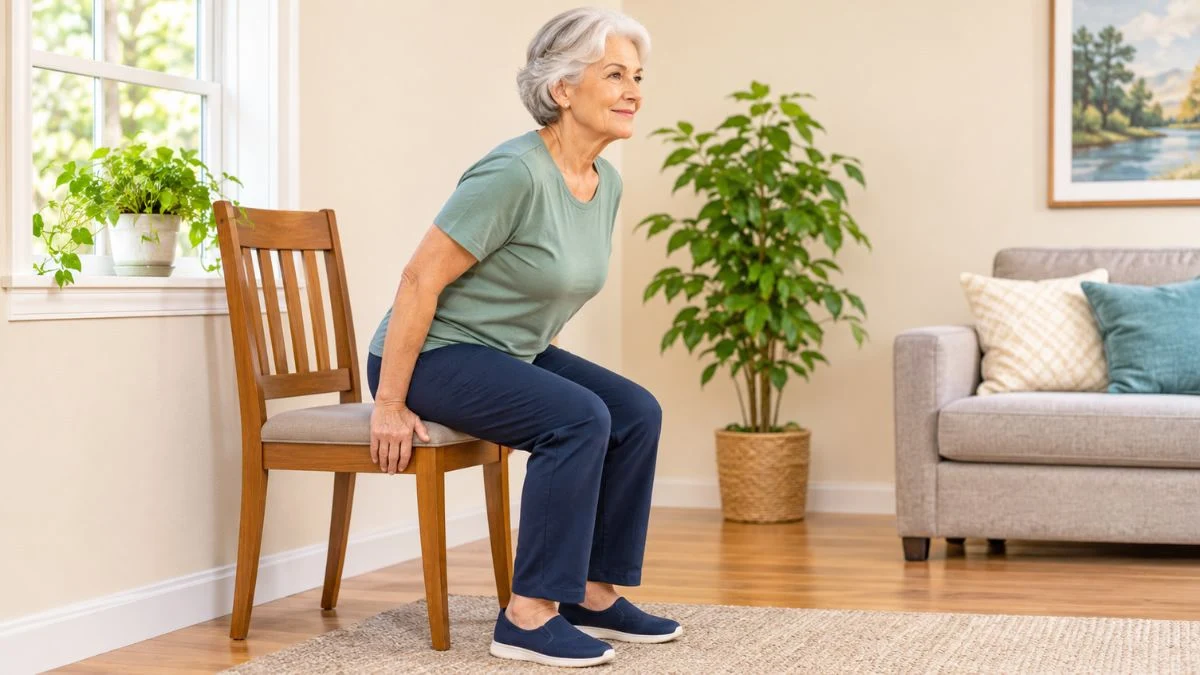
The CDC also lists standing from a seated position as an example of a balance activity. So the same move trains your legs and your balance.
Retest once a month. Use the same chair, the same time of day, and the same method. Write down each count and the date.
Say that 64-year-old man scores 12, two short of his 14. He trains three mornings a week and retests monthly. His own trend, not a table, shows whether his legs are getting stronger.
Strong legs help you stand, climb, and catch yourself. I cannot promise a higher score prevents a fall. See your doctor if you score well below your line, have fallen, or feel unsteady.
Your number is a starting point, and you decide how far past it you go. This week, pick one morning, find a sturdy chair, and count your stands. That is the whole task. You now know what the number means and who set the bar. I am glad you are paying attention to your strength.
References
- CDC, STEADI (Stopping Elderly Accidents, Deaths and Injuries): https://www.cdc.gov/steadi
- CDC, STEADI 30-Second Chair Stand assessment and scoring sheet: https://stacks.cdc.gov/view/cdc/157303/cdc_157303_DS1.pdf
- Rikli RE, Jones CJ. Development and validation of a functional fitness test for community-residing older adults. Journal of Aging and Physical Activity. 1999;7(2):129-161. https://doi.org/10.1123/japa.7.2.129
- Rikli RE, Jones CJ. Functional fitness normative scores for community-residing older adults, ages 60-94. Journal of Aging and Physical Activity. 1999;7(2):162-181. https://doi.org/10.1123/japa.7.2.162
- Study of Senior Fitness Test normative scores in 1,783 older women from southern Brazil, SciELO Brasil: https://scielo.br/j/rbcdh/a/WpBTnmnqKVHdMCNgy3s6cPQ/?lang=en
- Roongbenjawan N, Siriphorn A. Accuracy of modified 30-s chair-stand test for predicting falls in older adults. Annals of Physical and Rehabilitation Medicine. 2020;63(4):309-315. https://doi.org/10.1016/j.rehab.2019.08.003
- Vajaradesa T, Chaiparinya P, Suriyaamarit D. Validity and reliability of 30-second chair-stand test and modified 30-second chair-stand test in obese older adults. Archives of Allied Health Sciences. 2025: https://he01.tci-thaijo.org/index.php/ams/article/view/278724
- Garcia-Aguirre M, et al. Cut-off points for low relative 30-s sit-to-stand power and their associations with adverse health conditions (Toledo Study for Healthy Aging). Journal of Cachexia, Sarcopenia and Muscle. 2025;16(1):e13676. https://doi.org/10.1002/jcsm.13676
- Brito LBB, et al. Ability to sit and rise from the floor as a predictor of all-cause mortality. European Journal of Preventive Cardiology. 2014;21(7):892-898. https://www.pubmed.gov/23242910/
- CDC, Older Adult Activity: An Overview: https://www.cdc.gov/physical-activity-basics/guidelines/older-adults.html
- CDC, What Counts as Physical Activity for Older Adults: https://www.cdc.gov/physical-activity-basics/adding-older-adults/what-counts.html