Both groups improved. That surprised me when I first read the results. The U.S. POINTER study tested two lifestyle programs on 2,111 older adults. Even the lighter, self-guided group scored higher on thinking tests after two years.
I have spent years helping adults in their 60s protect their memory, so this result stopped me. I had expected the lighter group to fall well behind. After all, those volunteers received far less coaching. Then I read the details of their program.
The self-guided group had something most of us never get. That missing piece is simple, and you can copy it. I will show you what it was and how to start this week.
What the U.S. POINTER Study Actually Tested
The Alzheimer’s Association led the U.S. POINTER study, and JAMA published the results on July 28, 2025. Researchers enrolled 2,111 adults aged 60 to 79 at five US sites. Everyone lived a sedentary life, ate a lower-quality diet, and carried added risk factors for cognitive decline.
Chance decided which of two programs each person joined. Both programs aimed at the same four areas: physical activity, the MIND diet, mental and social challenge, and health checks. The Alzheimer’s Association says the MIND diet stresses leafy greens, berries, nuts, whole grains, olive oil, and fish.
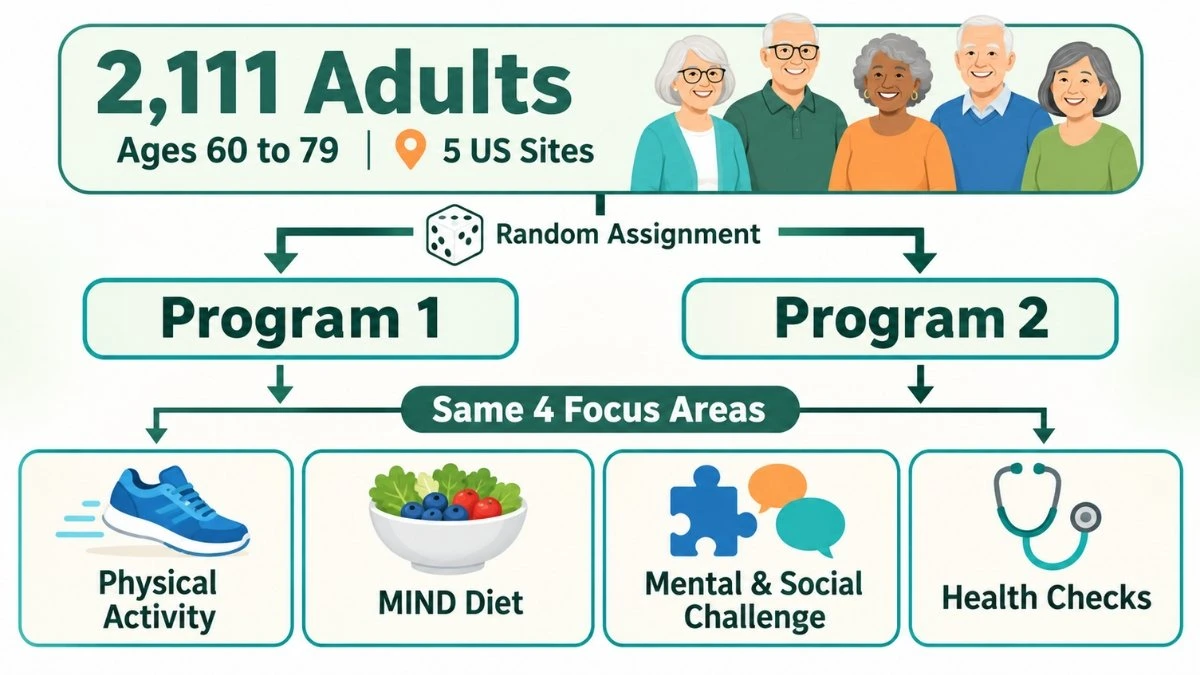
UC Davis Health, a study site, reports that the structured group met 38 times over two years. Facilitators led those peer teams. That group also followed a set plan with measurable goals. The plan covered aerobic exercise, strength and stretching, brain training, and regular health checks.
The JAMA abstract reports a mean age of 68 and an 89% completion rate at the two-year mark. The Alzheimer’s Association reports that both programs improved cognition across sex, ethnicity, heart health, and APOE e4 gene status. Now look at the group with the lighter plan.
What the Self-Guided Group Had That Most of Us Lack
The self-guided group did not get a coach or a workout plan. They did attend six peer team meetings over the two years. At those meetings, they chose lifestyle changes that fit their lives, according to UC Davis Health. Study staff gave general encouragement, but no goal-directed coaching.
Self-Guided Group Attendance
Noted by Ellen Feldman, MD, of Altru Health System
Attendance
Ellen Feldman, MD, of Altru Health System, noted that the self-guided group showed more than 90% attendance despite having fewer meetings.
What It Tells Us
That is strong follow-through for a group with a light program.
It also tells me these were motivated volunteers, not a typical group.
Three Things Most of Us Lack
In my reading, this group had three things most of us lack at home: a peer group, a date on the calendar, and a study team that expected them.
Not Tested
The trial did not test which of these mattered most. This is my interpretation, not a proven finding.
A fixed date removes the daily decision. You stop asking yourself whether to walk today. You just show up. A peer also notices when you skip, and that quiet pressure helps a habit stick.
In my conversations with adults in their late 60s, a pattern repeats. Many start a walking plan alone, and many drop it. Those who walk with a neighbor or join a class tend to stick with it. Someone waiting for them changes the outcome.

The structured group had far more of this support. The next question is how much that extra support added.
How Big Was the Gap Between the Two Groups?
The July 2025 JAMA paper reports that global cognition rose in both groups over two years. The score blended executive function, memory, and processing speed. The structured group gained 0.243 standard deviations per year. The self-guided group gained 0.213. A standard deviation is a common unit for comparing test scores.
The gap between the groups was 0.029 standard deviations per year. The 95% confidence interval runs from 0.008 to 0.050. The gap is statistically significant, which means chance alone is an unlikely cause. It is also small. Both groups improved, and the extra structure added a modest edge.
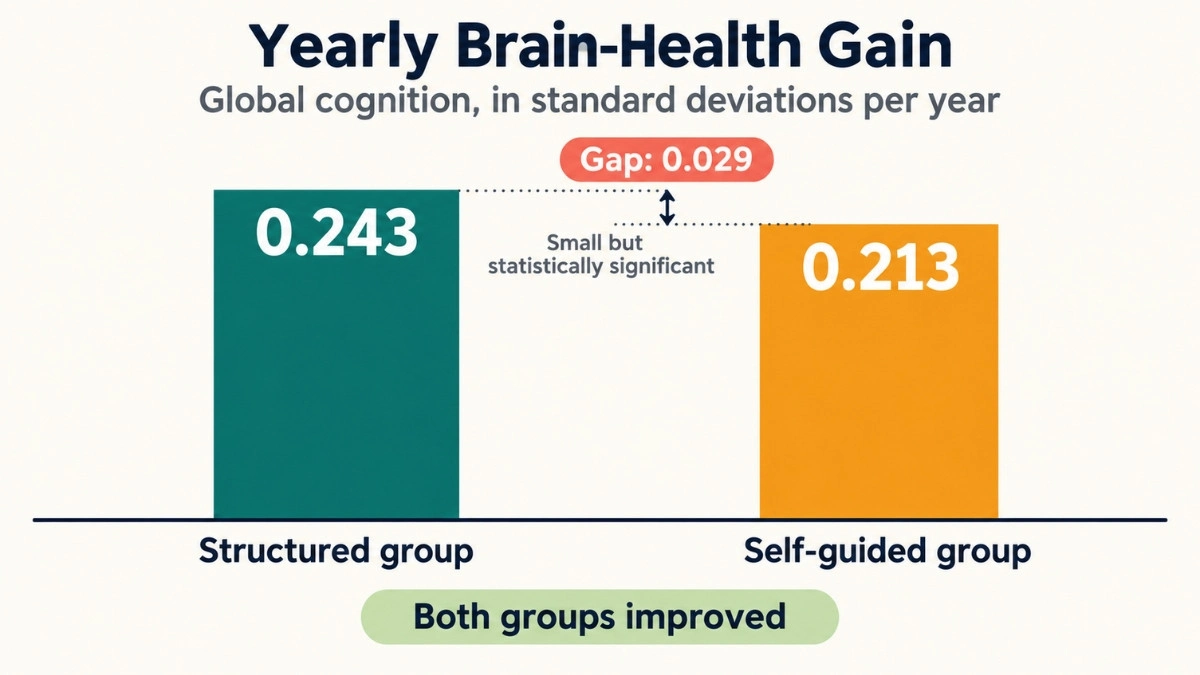
By my math, the self-guided group’s yearly gain was about 88% of the structured group’s. It got that with about one sixth as many meetings.
Principal investigator Laura Baker, PhD, said in the Alzheimer’s Association results summary that not everyone can follow intensive programs. She said even modest changes may protect the brain. Her message fits what the self-guided group showed.
Ellen Feldman, MD, noted that this effect size aligns with the one seen in Finland’s FINGER trial. A 2015 paper by Ngandu and colleagues in The Lancet reported the results of that earlier trial. FINGER’s yearly gap was 0.022, measured against a group that got only general health advice.
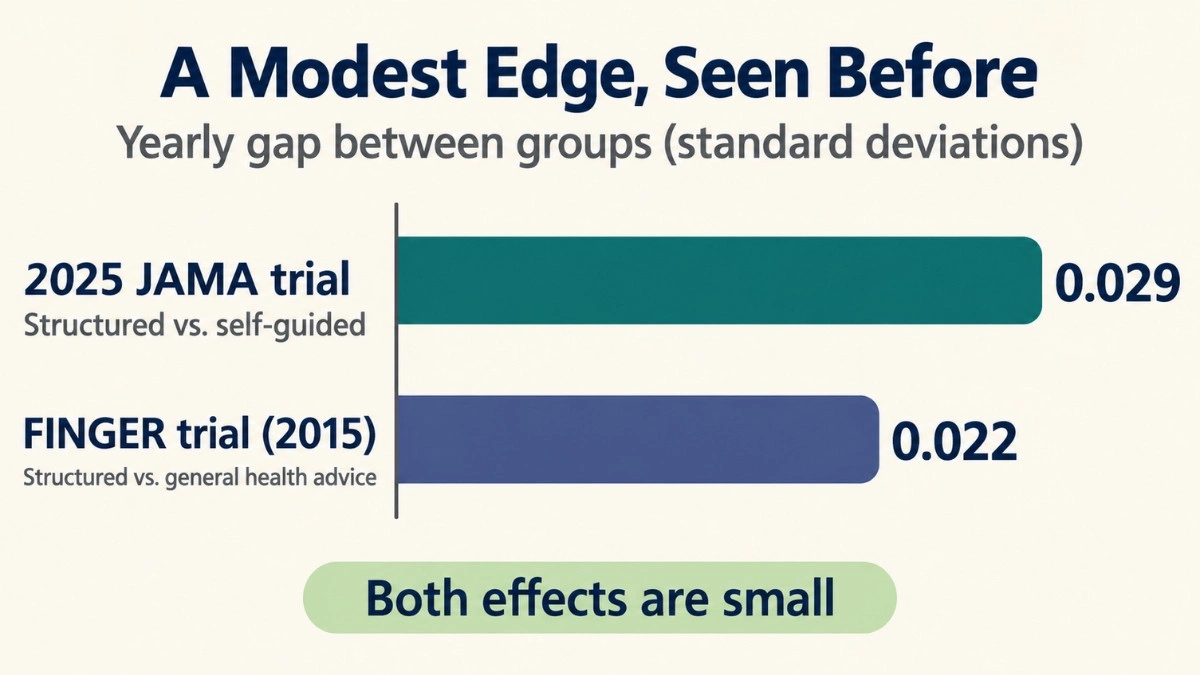
ACP Internal Medicine Matters summarized the editorial that ran with the JAMA paper. The editorial said most of the benefit came from executive function. That skill covers planning, focus, and mental flexibility. It also called the clinical value of the gap uncertain. That doubt brings us to what the study cannot show.
What the Study Cannot Tell Us Yet
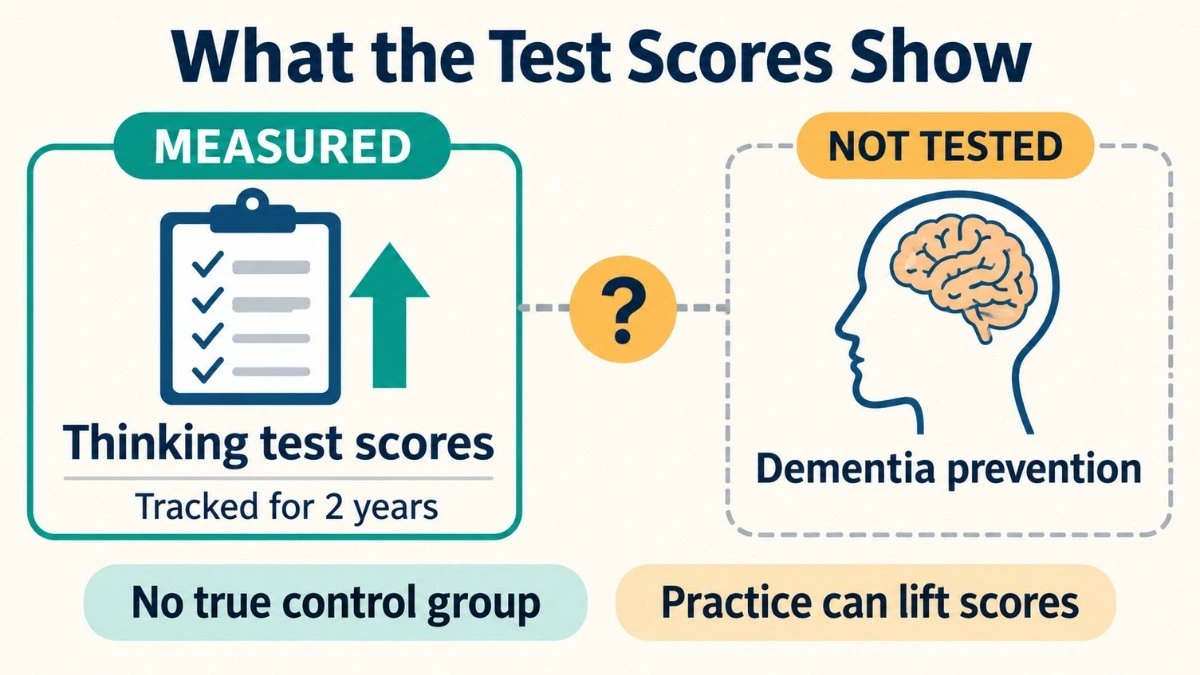
The trial had no true control group. Every participant got some kind of program. ACP Internal Medicine Matters noted this gap in its summary of the editorial. Retaking the same tests can also lift scores through practice. So the gains in both groups need careful reading.
Test scores are not dementia diagnoses. The trial tracked thinking skills for two years. It did not test whether the programs prevent dementia.
The Alzheimer’s Association says most participants agreed to join an extension with a four-year follow-up. That follow-up will assess longer-term effects on cognitive health and dementia risk.
The program also bundled many habits together. The design cannot show whether exercise, diet, brain training, or the group itself did the most work. No single habit can take the credit.
The JAMA abstract also counts serious adverse events: 151 in the structured group and 190 in the self-guided group. Your own health history still matters more than any group count.
The results also apply to a specific group. Participants were 60 to 79, sedentary, and at higher risk. Younger or already active readers may see a different picture. The findings still matter. Here is how I would borrow the ideas with care.
What I Would Borrow for My Own Routine
Start with the missing piece. Pick one person or group and set a weekly time to meet. A walking partner, a community class, and a standing phone call all fit the idea. The self-guided group had scheduled peer meetings, and you can build your own version.
From what I have seen in practice, people keep promises to others better than promises to themselves. A date with a friend turns a vague goal into a plan. That is why I put this step first.
Use your weekly date well. Move together first, then name one small goal for the coming week. At the next meeting, say how it went. The self-guided peer meetings aimed to encourage changes people picked for themselves, according to UC Davis Health. This copies that idea.
The trial combined four habits. You can start with one. Pick the easiest one and tie it to your weekly date.
For movement, the Alzheimer’s Association says the structured group did aerobic exercise four times a week. Each session ran 30 to 35 minutes at a moderate to intense pace. They added strength and flexibility work twice a week. You do not need to match that on day one. Start with two brisk walks this week.
For food, add MIND-style foods to meals you already eat. Add berries to your breakfast. Add a leafy green to dinner. Keep nuts nearby for snacks. Cook with olive oil, and eat fish more often. These swaps follow the MIND pattern the Alzheimer’s Association describes.

For health tracking, the Alzheimer’s Association says the structured group had regular reviews of blood pressure, weight, and lab results. You can copy part of that at home. Ask your doctor how often to check your blood pressure, and keep a simple log. For your mind, join a class or play cards with others.
Your memory deserves the kind of support those volunteers had. This week, text one friend or neighbor and set a day and time to walk together. Pick someone who makes you laugh. Keep that date, even if the walk is short or slow. I am rooting for you, and for that first walk.
References
- Baker LD, Espeland MA, Whitmer RA, et al. Structured vs Self-Guided Multidomain Lifestyle Interventions for Global Cognitive Function: The US POINTER Randomized Clinical Trial. JAMA. 2025;334(8):681-691. https://doi.org/10.1001/jama.2025.12923
- Alzheimer’s Association. U.S. POINTER Study Results. https://www.alz.org/us-pointer/study-results
- UC Davis Health. Lifestyle changes boost brain health. https://health.ucdavis.edu/research/news/headlines/lifestyle-changes-boost-brain-health/2025/09
- ACP Internal Medicine Matters. Structured lifestyle intervention improved global cognition in at-risk older adults, trial finds. https://immattersacp.org/weekly/archives/2025/08/05/4.htm
- Feldman E. Mind Matters: Diet, Exercise, and Engagement in Cognitive Health. Clinician. https://www.clinician.com/articles/mind-matters-diet-exercise-and-engagement-in-cognitive-health
- Ngandu T, Lehtisalo J, Solomon A, et al. A 2 year multidomain intervention of diet, exercise, cognitive training, and vascular risk monitoring versus control to prevent cognitive decline in at-risk elderly people (FINGER). Lancet. 2015;385(9984):2255-2263. https://doi.org/10.1016/S0140-6736(15)60461-5 and https://pubmed.ncbi.nlm.nih.gov/25771249/