
Fourteen extra years. That is the number Harvard researchers attached to five everyday habits for women, and 12 years for men. It sounds like a promise. I read it with caution, and I think you should too.
Behind that headline sit two large studies, a careful set of definitions, and some honest limits. Those limits matter most if you are building healthy habits after 50 and wondering whether it is too late. Some of the numbers hold up well. Some get stretched in the retelling.
Here is what the researchers measured, what they found, and what they could not show. Then we will turn it into a plan you can start this week.
What the Harvard Researchers Actually Measured
The 2018 study appeared in the journal Circulation. Yanping Li and senior author Frank Hu led the team at the Harvard T.H. Chan School of Public Health. They used data from the Nurses’ Health Study, which followed 78,865 women for 34 years. They also used the Health Professionals Follow-up Study, which followed 44,354 men for 27 years.
Low-Risk Habit Levels
Each habit had a low-risk level.
Smoking
Never smoking qualified as low risk.
Body Mass Index
A body mass index of 18.5 to 24.9 qualified.
Exercise
So did 30 or more minutes of daily moderate to vigorous exercise.
Diet
The diet score had to land in the top 40 percent.
Moderate Drinking
The study defined moderate drinking as up to about one 5-ounce glass of wine a day for women and up to two for men.
This is the study’s definition, not a recommendation. If you do not drink, this study gives you no reason to start.
A second paper in the BMJ followed in 2020. It measured years lived free of type 2 diabetes, cardiovascular disease, and cancer. Few people meet every goal. A 2018 CBS News report said that, according to Hu’s team, only 8 percent of U.S. adults in recent years had met all five goals. Now to the numbers.
What the Numbers Showed at Age 50
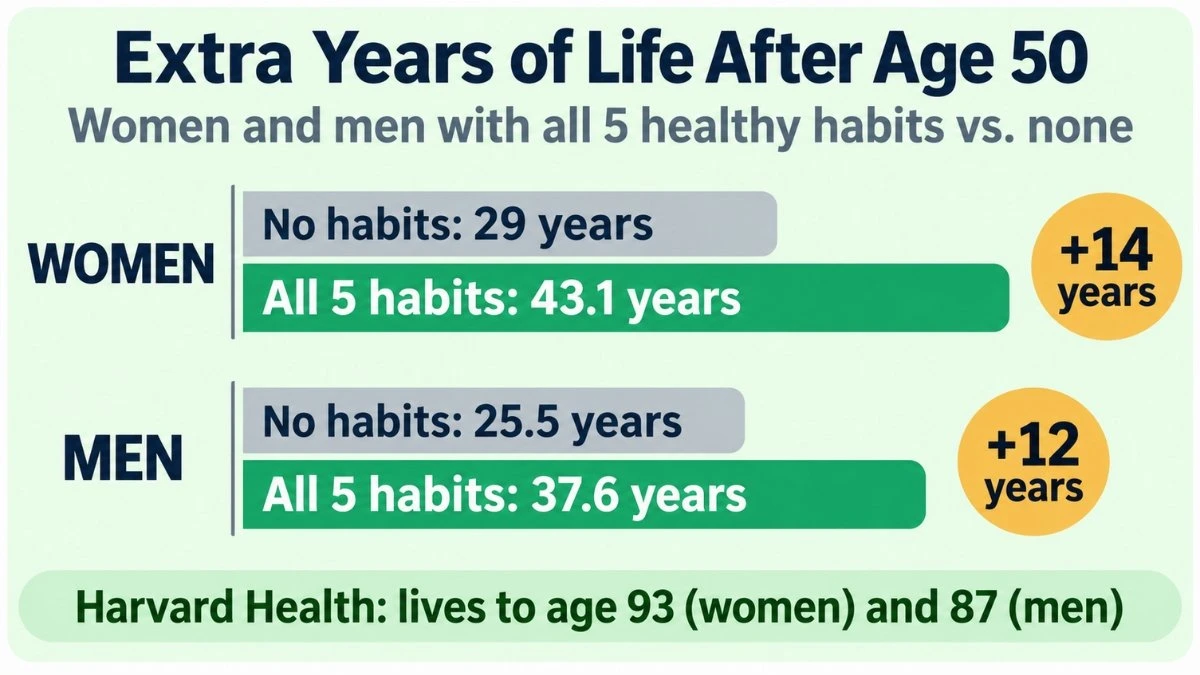
Start with total life expectancy. The 2018 Circulation paper estimated that a 50-year-old woman with none of the five habits could expect 29 more years. A man could expect 25.5. With all five habits, those figures rose to 43.1 for women and 37.6 for men.
That gap equals 14 years for women and 12 for men. Harvard Health Publishing states the same data another way, as an age: 93 for women and 87 for men. Both versions describe one result.
The Circulation paper also reported a 74 percent lower risk of death for people with all five habits. The comparison group kept none. Their risk of dying from cardiovascular disease (heart disease or stroke) was 82 percent lower, and from cancer, 65 percent lower.
The Harvard Chan School also reported that each habit alone linked to a lower risk of early death. More habits meant more benefit.
The 2020 BMJ paper measured healthy years. Women who kept four or five habits at 50 lived 34.4 more years free of those three diseases. Women who kept none had 23.7 years. Men with four or five habits reached 31.1 years, against 23.5 for men with none.

The BMJ paper singled out two groups. Disease-free years made up the smallest share of life expectancy for heavy male smokers and for people with obesity. Those numbers are striking. The limits on them matter just as much.
What This Study Can’t Prove
Harvard Health Publishing states that the study is observational. It does not prove that healthy habits extend life. Researchers watched what people did and what happened next. They did not assign people to different habits.
People who keep five healthy habits may differ in other ways, such as income, care, or support at home. The Circulation paper adjusted its results for other factors. Some influence always slips through. Statisticians call that residual confounding.
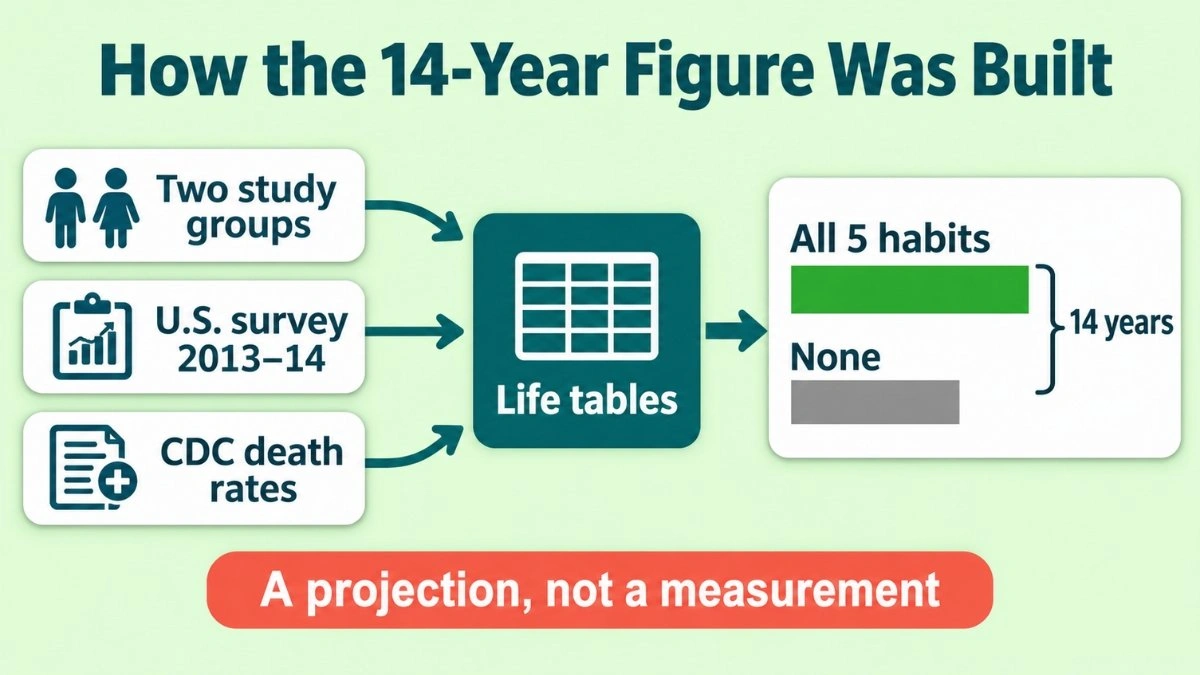
The 14-year figure is also a projection, not a measurement. Li and colleagues took death risks from the two study groups. They combined those with 2013 to 2014 U.S. national survey data and CDC death rates for Americans. Then they built life tables, which estimate how long people live. The headline compares two extremes: all five habits against none.
The study groups have limits too. Participants were nurses and other health professionals. They reported diet, exercise, and weight on questionnaires, the BMJ paper states. Results may not match every group.
The biggest gap matters most for readers over 50. The BMJ conclusion links healthy habits at midlife to longer disease-free life. CBS News added that the 2018 work cannot say whether a 50-year-old who changes habits will add years.
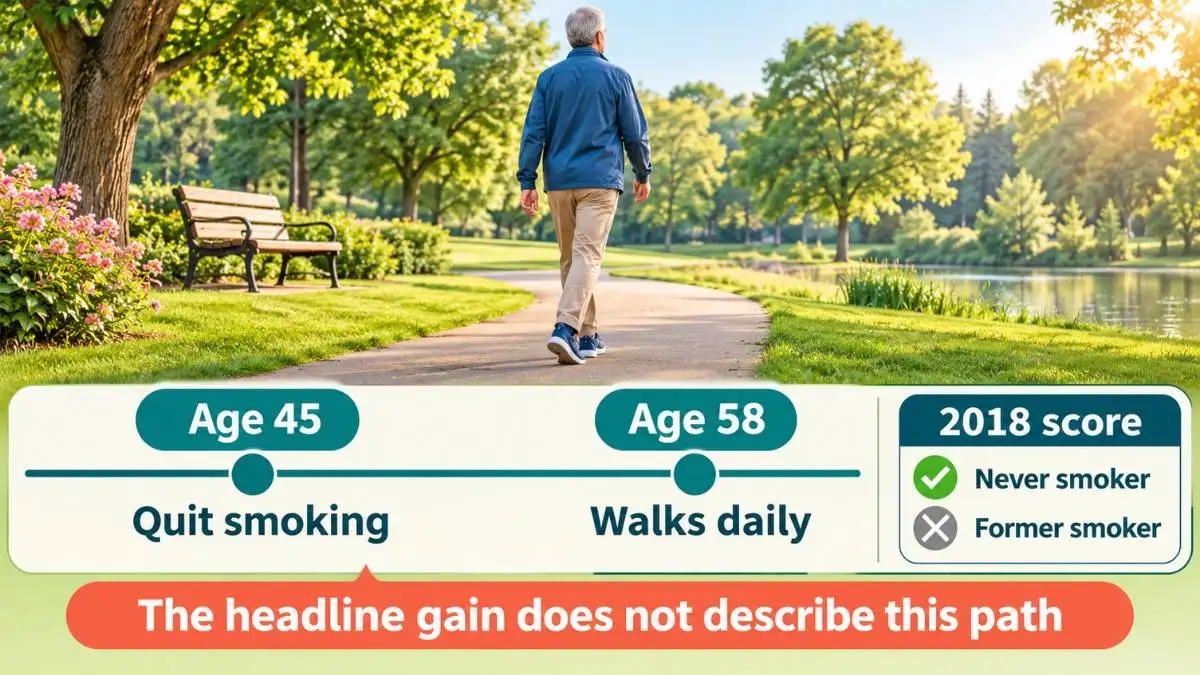
Take a 58-year-old who quit smoking at 45 and now walks daily. The 2018 score counted only never smokers as low risk. So the headline gain does not describe that person’s path.
None of this makes the findings useless. It means we should use them with care.
How to Use This at 50 and Beyond
Note: If you have a health condition or take medication, speak with your doctor before changing your exercise, eating, or drinking habits.
Harvard Health Publishing quoted Frank Hu, the senior author, on starting late. He said people 70 or older can still gain years from healthy eating and activity. That is an expert’s view, not a finding from the study groups.
Yanping Li, the first author, told MedicalResearch.com that each habit linked to about two to three added years of life expectancy. So start with one habit. Pick the one closest to reach. If you smoke, a talk with your doctor about quitting support comes first.
For exercise, the study’s benchmark was 30 minutes a day. That is a goal, not a starting line. Consider a 62-year-old who walks twice a week. Thirty straight minutes feels like a wall. A 10-minute walk after dinner feels like a step. Add it on three more days.
For diet, the study scored quality, not perfection. Add one vegetable to dinner this week. Swap one sugary drink for water.
Weight and drinking call for a talk with your doctor. Ask what a healthy weight means for your body. If you drink, ask what amount fits your health and your medicines. Small steps add up, and the next one takes minutes.
No study can say whether it is too late for you. You can still choose a next step. This week, pick one habit and give it a day and a time on your calendar. Keep it small enough to say yes to. Then do it once, and see how it feels. I am rooting for you.
References
- Li Y, Pan A, Wang DD, et al. Impact of Healthy Lifestyle Factors on Life Expectancies in the US Population. Circulation, 2018;138(4):345-355. https://doi.org/10.1161/CIRCULATIONAHA.117.032047
- Li Y, Schoufour J, Wang DD, et al. Healthy lifestyle and life expectancy free of cancer, cardiovascular disease, and type 2 diabetes: prospective cohort study. BMJ, 2020;368:l6669. https://doi.org/10.1136/bmj.l6669
- Feldscher K (Harvard Chan School Communications). Five healthy habits to live by. Harvard Gazette, April 30, 2018: https://news.harvard.edu/gazette/story/2018/04/5-healthy-habits-may-increase-life-expectancy-by-decade-or-more/
- Harvard Health Publishing, “Harvard researchers say healthy habits may add years to your life”: https://www.health.harvard.edu/staying-healthy/harvard-researchers-say-healthy-habits-may-add-years-to-your-life
- CBS News, “5 habits that could help you live 10 years longer”: https://www.cbsnews.com/news/5-habits-that-could-help-you-live-10-years-longer
- MedicalResearch.com, interview with Yanping Li: https://medicalresearch.com/?p=41367