

The bottle says “supports memory.” The biggest trials of popular ingredients mostly found no benefit. That gap leaves many adults over 50 standing in a pharmacy aisle, label in hand, unsure what to believe.
A forgotten name or a parent’s diagnosis can make any promise sound worth a try. That worry is normal, and so is the urge to act. You deserve a clear answer before you spend more money.
The short answer: most memory supplements have no proven benefit. A basic multivitamin looks promising, but the evidence is still early. This guide covers five mistakes to avoid, plus an honest look at why fish oil studies disagree. The first mistake is the easiest one to make.
Mistake 1: Expecting a Supplement to Treat Memory Loss
A supplement can feel like paint over a ceiling stain. It hides the worry, but it may not fix anything underneath.

A 2023 systematic review in Systematic Reviews covered herbal and nutritional products for thinking skills in adults 45 and older. It found low-quality evidence and a high risk of bias across the trials.
Trials in people with a diagnosis tell a similar story. A 2016 Cochrane review pooled three placebo-controlled trials of 632 people with mild to moderate Alzheimer’s disease. Six months of omega-3 supplements had no effect on cognition, daily function, quality of life or mental health.
Low-quality evidence means good proof is missing. It does not show that every product fails. So treat any supplement as an optional extra. It is never a substitute for care if you have mild cognitive impairment or dementia. Next, see how these products reach the shelf.
Mistake 2: Trusting the Label to Mean “Tested”
Many people assume a shelf product passed the same checks as a medicine. In the US, supplements follow different rules. Other countries set their own.
The FDA says it has no authority to approve dietary supplements before they are marketed. It also generally does not approve supplement claims or labels before use. The agency does not test supplements before they are sold.

Phrases like “supports memory” are structure/function claims. The FDA says a maker must have evidence that such a claim is truthful. The label must also say the FDA has not evaluated the claim.
Quality rules do exist. FDA rules require makers to follow good manufacturing practices that help ensure identity, purity, quality, strength and composition. Those rules cover what is in the bottle. They do not test whether a product helps memory.
So check each ingredient on NIH pages, not the product name. Then look at what a big trial found for the best-known ingredient.
Mistake 3: Betting on One Famous Ingredient
The largest trial of ginkgo for preventing dementia was the GEM study. It gave 3,069 older adults either ginkgo, 120 mg twice daily, or a placebo. A 2009 JAMA analysis found ginkgo did not slow cognitive decline over a median of 6.1 years.
NIH’s 2008 summary of the main JAMA report counted 523 dementia cases over about six years. There were 246 on placebo and 277 on ginkgo. Ginkgo showed no overall effect on dementia.

The one bright spot came from a plain product. COSMOS-Mind enrolled 2,262 adults, average age 73. For three years it tested two things: cocoa extract and a daily multivitamin.
Cocoa extract had no effect on global cognition. The multivitamin fared better. The authors called it the first evidence from a large, long-term trial to support a possible cognitive benefit from a multivitamin-mineral.
A pooled analysis of three COSMOS substudies agreed. It reported that a daily multivitamin helped global cognition and episodic memory, which is memory for events.
Treat that result as promising, not settled. The clinic substudy alone showed a modest gain, and its confidence range included zero. Rates of mild cognitive impairment and dementia did not differ between groups, though the trial had low power. Also, 89% of COSMOS-Mind participants were non-Hispanic White.
Industry supplied the study products. Mars Edge provided the cocoa extract, and Haleon provided the multivitamin.
Pieter Cohen, MD, is a Harvard-affiliated internist who studies supplements. In Harvard Health Publishing, he says no ingredient legally allowed in supplements has shown it can improve thinking or prevent memory loss. That is expert opinion, not trial data. The multivitamin finding keeps the question open.
So stop hunting for a hero ingredient. If you worry about a nutrient gap, ask your doctor whether you have one. Safety comes next.
Note: Check any supplement with your pharmacist or doctor first, especially if you take blood thinners or have a heart rhythm condition.
Mistake 4: Skipping the Safety Check
Natural does not mean harmless. The NIH Office of Dietary Supplements warns that high doses of omega-3 may cause bleeding problems with blood thinners such as warfarin. It also notes the FDA advises no more than 5 grams a day of EPA plus DHA from supplements. Those are the two main fish omega-3s.

Heart rhythm is a second concern, and the evidence is mixed. A meta-analysis of heart-outcome trials covered 81,210 patients. It linked marine omega-3 supplements to about 25% higher risk of atrial fibrillation, an irregular heartbeat.
A 2026 peer-reviewed analysis of 35 trials found the risk was greatest in people at high heart risk who take high doses (over 1,500 mg a day).
Ginkgo needs care too. The National Center for Complementary and Integrative Health (NCCIH) says some data suggest ginkgo can raise bleeding risk. The GEM trial found no extra bleeding. NCCIH also warns that too much vitamin B6 can cause serious side effects.
Bring every bottle to your pharmacist or doctor, with doses. Last, look at where your effort goes.

Note: Ask your doctor which exercise and eating changes suit your health before you start.
Mistake 5: Letting a Pill Replace Better Bets
The U.S. POINTER trial offers a different bet. It tested lifestyle programs in older adults at risk of cognitive decline over nearly two years. JAMA published the results on July 28, 2025. The structured program combined exercise, the MIND diet, brain and social challenge, and health checks.
Both programs improved cognition, but the structured one did better. It brought more structure, intensity and accountability than the self-guided version.

Consider a retired teacher in her early sixties who buys a memory supplement every month (a composite example for illustration). She could move some of that effort to a walking group and a cooking class.
The trial measured thinking scores, not dementia cases. Follow-up continues, so long-term answers are still to come.
NCCIH also advises against waiting. Do not delay seeing a provider about memory loss. Depression, medication reactions, and thyroid, liver or kidney problems can affect memory. Those treatable conditions need a checkup. Fish oil sits at the center of this debate.
The Fish Oil Puzzle: Why the Evidence Disagrees
If fish oil confuses you, that is normal. The research itself pulls in two directions. Three pieces help explain the conflict, and one piece is still missing.
Piece one is food. A 2023 meta-analysis in the American Journal of Clinical Nutrition pooled 48 long-term studies with 103,651 people. It linked higher dietary omega-3 intake to about 20% lower risk of dementia or cognitive decline. Cohort studies cannot rule out that fish eaters differ in other ways.
Piece two is capsules. A 2020 meta-analysis in the Journal of the American Medical Directors Association pooled trials lasting at least 24 weeks. Long-chain omega-3 had no or very little effect on new neurocognitive illness, such as dementia (six trials, 33,496 people). The authors rated that evidence moderate quality.
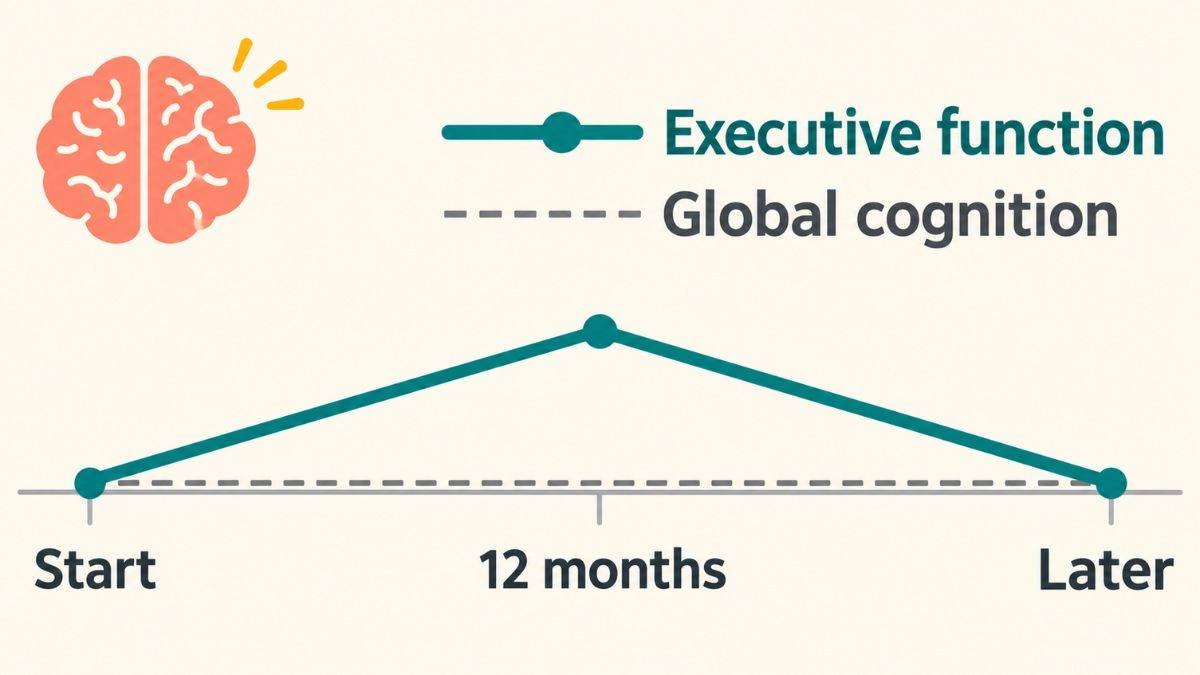
Piece three is the starting point. A 2024 analysis in BMC Medicine pooled 24 trials of adults 40 and older without dementia. Global cognition did not change. Executive function, which covers planning and focus, trended up in the first 12 months and then fell back.
The authors also sorted trials by each country’s average blood level of DHA and EPA. In countries with very low levels, such as the United States, benefits were not significant. That sorting is a rough clue, not a personal test. Treat all of it as exploratory.
The biology explains the hope. The NIH Office of Dietary Supplements says DHA is especially high in the brain. The body turns plant omega-3 (ALA) into DHA at under 15%, so fish and supplements are the practical sources.
One missing piece may be the form of DHA. A University of Cincinnati team has a planned trial, with National Institute on Aging support. It will compare standard fish oil with a DHA form that the investigators think reaches the brain better. That is a hypothesis with no results yet.
Bottom line: the question is open. NCCIH calls omega-3, which researchers often track as fish intake, the most consistent positive finding among nutritional factors. Most capsule trials have not shown that pattern. Next, a plan you can start this week.
Note: This is general information, not medical advice. Ask your doctor or pharmacist before you start, stop or combine supplements, especially with blood thinners or a heart rhythm condition.
What I’d Do This Week, and When to See a Clinician
I’d start with a supplement audit. Write down every pill, powder and gummy you take, with the dose. Bring the list to your pharmacist or doctor. Ask two questions: does this clash with your medicines, and do you have a nutrient gap?

Second, stop buying on label claims. A phrase like “supports memory” tells you what a maker may say. It does not tell you what a trial found. Look up each ingredient on NIH pages before you buy.
Third, put fish on the plate. The NIH Office of Dietary Supplements lists cold-water fatty fish as rich sources of long-chain omega-3s. Examples include salmon, mackerel, tuna, herring and sardines. The link to memory comes mostly from observational studies. Treat fish as a sensible habit, not a guarantee.
Fourth, pick one habit from the U.S. POINTER program. The Alzheimer’s Association says its structured group did 30 to 35 minutes of moderate to intense aerobic activity four times a week. Ask your doctor what level fits you. Then add a social or mental activity you enjoy.

If you want the one product with trial support, ask whether a basic multivitamin suits you. The gain in COSMOS was modest, and it still needs confirming.
Conclusion
Last, know when to get help. Book a visit if memory changes feel new, get worse, or get in the way of daily life. As NCCIH notes, treatable conditions can cause memory problems, so a supplement should never delay a checkup. If you already have a diagnosis, your care team’s plan comes first.
Your worry about memory is real, and your next step can be small. Tonight, set your bottles on the kitchen table and start that list. Nobody has to solve this in a day. Each question you ask and each healthy habit you add builds a better plan than any label can promise. You already asked the right question.
References
- Systematic Reviews, A systematic review of the safety and efficacy on cognitive function of herbal and nutritional medicines in older adults with and without subjective cognitive impairment (2023): https://pmc.ncbi.nlm.nih.gov/articles/PMC10433666/
- Cochrane Database of Systematic Reviews, Omega-3 fatty acids for the treatment of dementia (2016): https://www.cochrane.org/CD009002/DEMENTIA_omega-3-fatty-acids-for-the-treatment-of-dementia
- U.S. Food and Drug Administration, Questions and Answers on Dietary Supplements (content current as of August 27, 2026): https://www.fda.gov/food/information-consumers-using-dietary-supplements/questions-and-answers-dietary-supplements
- JAMA, Ginkgo biloba for Preventing Cognitive Decline in Older Adults: A Randomized Trial (2009): https://pmc.ncbi.nlm.nih.gov/articles/PMC2832285
- National Institutes of Health, Ginkgo Study Fails To Find Benefit in Preventing Dementia (2008): https://www.nih.gov/node/8756
- National Institutes of Health, Ginkgo Evaluation of Memory (GEM) Study Fails To Show Benefit in Preventing Dementia in the Elderly, news release (2008): https://www.nih.gov/node/24516
- Alzheimer’s & Dementia, Effects of cocoa extract and a multivitamin on cognitive function: a randomized clinical trial (2022): https://pmc.ncbi.nlm.nih.gov/articles/PMC10011015/
- Effect of multivitamin-mineral supplementation versus placebo on cognitive function: results from the clinic subcohort of the COcoa Supplement and Multivitamin Outcomes Study (COSMOS) randomized clinical trial and meta-analysis of 3 cognitive studies within COSMOS American Journal of Clinical Nutrition, 2024: https://pmc.ncbi.nlm.nih.gov/articles/PMC11103094/ and https://pubmed.ncbi.nlm.nih.gov/38244989/
- Impact of multivitamin-mineral and cocoa extract on incidence of mild cognitive impairment and dementia: Results from COSMOS-Mind: https://pubmed.ncbi.nlm.nih.gov/37035889/
- Harvard Health Publishing, Don’t buy into brain health supplements (February 20, 2026): https://www.health.harvard.edu/blog/dont-buy-into-brain-health-supplements
- NIH Office of Dietary Supplements, Omega-3 Fatty Acids: Fact Sheet for Consumers (updated July 18, 2022): https://ods.od.nih.gov/factsheets/omega3fattyacids-consumer/?print=1
- NIH Office of Dietary Supplements, Omega-3 Fatty Acids: Fact Sheet for Health Professionals: https://ods.od.nih.gov/factsheets/omega3fattyacids-HealthProfessional/
- National Center for Complementary and Integrative Health, 7 Things To Know About Dietary Supplements for Cognitive Function, Dementia, and Alzheimer’s Disease: https://www.nccih.nih.gov/health/tips/things-to-know-about-dietary-supplements-for-cognitive-function-dementia-and-alzheimers-disease
- National Center for Complementary and Integrative Health, Dietary Supplements and Cognitive Function, Dementia, and Alzheimer’s Disease: What the Science Says (2022): https://www.nccih.nih.gov/health/providers/digest/dietary-supplements-and-cognitive-function-dementia-and-alzheimers-disease-science?
- Effect of long-term marine omega-3 fatty acids supplementation on the risk of atrial fibrillation in randomized controlled trials of cardiovascular outcomes: a systematic review and meta-analysis Circulation, 2021: https://pmc.ncbi.nlm.nih.gov/articles/PMC9109217
- Circulation: Arrhythmia and Electrophysiology, Effects of Omega-3 Fatty Acid Treatment on Risk for Atrial Fibrillation: An Updated Meta-Analysis of 35 Trials including 114,592 Individuals (2026): https://ueaeprints.uea.ac.uk/id/eprint/103400/
- Alzheimer’s Association, U.S. POINTER Study Results, reporting the JAMA trial of July 28, 2025 (page content current through 2026): https://alz.org/us-pointer/study-results
- American Journal of Clinical Nutrition, The Relationship of Omega-3 Fatty Acids with Dementia and Cognitive Decline: Evidence from Prospective Cohort Studies of Supplementation, Dietary Intake, and Blood Markers (2023): https://pubmed.ncbi.nlm.nih.gov/37028557/
- Journal of the American Medical Directors Association, Omega-3, Omega-6, and polyunsaturated fat for cognition: systematic review and meta-analysis of randomized trials (2020): https://www.pubmed.gov/32305302/
- BMC Medicine, The influence of n-3 polyunsaturated fatty acids on cognitive function in individuals without dementia: a systematic review and dose-response meta-analysis (2024): https://pmc.ncbi.nlm.nih.gov/articles/PMC10929146
- University of Cincinnati, UC trial compares omega-3 supplements for elderly adults at risk for dementia (2025): https://www.uc.edu/news/articles/2025/02/uc-trial-compares-omega-3-supplements-for-elderly-adults-at-risk-for-dementia.html