
A single number traveled fast through health headlines in 2023: 48 percent. That was how much hearing aids could cut the risk of cognitive decline, the articles said. For millions of people living with untreated hearing loss, it felt like the news they had been waiting for.
Maybe you saved the article to share with a parent who keeps refusing to see an audiologist. Maybe you filed it away for yourself, half-hoping the science would hold. The good news is that the research is real and genuinely encouraging. But the 48% figure applies to a specific group of people, and most headlines never said so.
This article explains what the study actually found, who it applies to, and what an honest next step looks like.
To understand what the research is really saying, we need to go back to the trial that started it all.
What the ACHIEVE Study Actually Found

The ACHIEVE trial, Aging and Cognitive Health Evaluation in Elders, was the largest randomized controlled trial ever run on hearing aids and cognitive decline. Published in The Lancet in July 2023, it followed 977 adults aged 70 to 84, all with untreated hearing loss and no signs of cognitive impairment at the start.
Researchers recruited from two very different populations. The first group came from the long-running ARIC study, the Atherosclerosis Risk in Communities project, a heart health study that had tracked participants for decades.
These 238 people were older and carried more cardiovascular risk factors. They had lower incomes and education levels. They also showed lower baseline cognitive scores than the second group: 739 newly recruited, generally healthy community volunteers.

Both groups were randomly assigned to one of two programs. Half received a hearing intervention: hearing aids, a self-management toolkit, and ongoing audiologist counseling. The other half received a health education program focused on chronic disease prevention.
After three years, researchers measured cognitive change across the full study population. The primary result was negative. Across all 977 participants combined, there was no significant difference in cognitive decline between the hearing aid group and the health education group.
That is the part most headlines left out. The 48% figure is real. But it did not come from the study as a whole.
The Hidden Catch, and Why It Still Matters
When researchers separated the two populations and looked at the ARIC subgroup alone, the picture changed sharply.
In that group, the older adults with more health burdens and lower cognitive starting points, the hearing intervention slowed cognitive decline by 48% over three years compared to the health education control. Among participants in the top quarter of predicted dementia risk, the slowing reached 62%, according to analysis published alongside the trial data.

This was not an accidental finding buried after the fact. The ARIC subgroup comparison was pre-specified, meaning researchers planned to analyze it before the trial began. That matters. It separates this result from the kind of data-mining that produces misleading statistics.
In the healthy volunteer group, hearing aids showed no measurable cognitive benefit within the three-year window.
The catch, then, is not that the finding is false. It is that it describes a specific population: older adults who already carry meaningful dementia risk. The benefit was largest precisely where the risk was highest.
Communicating Research Findings Accurately
How We Communicate Findings
From the perspective of someone who follows this research closely, this distinction changes everything about how we should communicate these findings.
Not Wrong as a Statement
Saying “hearing aids cut dementia risk by 48%” is not wrong.
Incomplete and Potentially Misleading
It is incomplete in a way that misleads people about whether the finding applies to them.
Why Untreated Hearing Loss Is a Threat to the Brain
The 2024 Lancet Commission on Dementia Prevention, Intervention and Care identified hearing loss as the single largest modifiable risk factor for dementia, ranking above smoking, physical inactivity, depression, and social isolation. That is not a minor claim. It reflects decades of pooled data from large cohort studies across multiple countries.
The proposed mechanisms fall into three categories.
First is cognitive load: when hearing is damaged, the brain works harder to decode degraded sound. That extra effort draws resources away from memory, reasoning, and processing speed.
Second is social withdrawal. Hearing loss often leads people to pull back from conversations and social settings, and social isolation is itself a confirmed dementia risk factor.
Third, some researchers propose that hearing loss may in certain cases reflect early neurodegenerative changes already underway. The evidence most strongly supports the first two pathways.
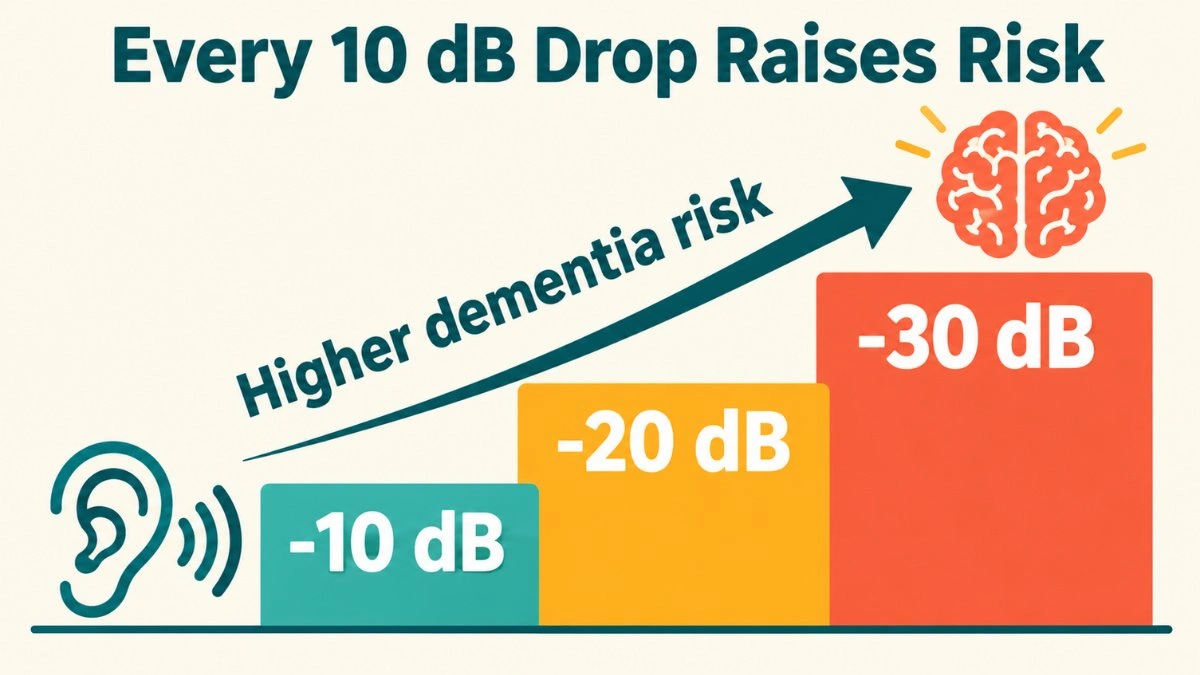
Research from the 2024 Lancet Commission also confirmed a dose-response pattern: every 10 decibel drop in hearing ability was linked to a measurable rise in dementia risk across four independent studies. Hearing loss is not a simple on/off threshold. The worse it gets, the greater the risk.
That dose-response relationship helps explain the ARIC results. These participants had more overall risk loading across multiple factors. Addressing hearing loss in that context may work best because it removes one piece of a compounding burden.
What This Means If You or Someone You Love Has Hearing Loss
Everyone’s hearing health and dementia risk profile is different. What follows reflects the current research evidence. It is not a substitute for a direct conversation with your audiologist or physician, both of whom can assess your situation far more precisely than any article can.
A pattern I see repeatedly in conversations about this research: someone in their mid-60s learns about the ACHIEVE trial and assumes the 48% reduction applies to them directly. Sometimes it does. Often it does not. Knowing the difference matters.
If you have untreated hearing loss and carry other dementia risk factors, including high blood pressure, diabetes, limited social contact, or a history of less formal education, the evidence for intervention is strongest for you. That is precisely the population that showed the most benefit.

If you are a healthy older adult with no elevated risk factors, hearing aids still matter. Better communication, less listening fatigue, improved social engagement. These are real and well-documented benefits. But the case for cognitive protection within a three-year window is less established for lower-risk individuals.
Longer-term follow-up data from the ACHIEVE cohort is still being collected. That window may underestimate the benefit over five or ten years.
What is clear from the research is the scale of the gap between need and action. Hearing loss affects about 65% of adults over age 60, according to the ACHIEVE study researchers. Adoption of hearing aids remains low. The reasons include cost, stigma, and the quiet assumption that declining hearing is just normal aging.

The ACHIEVE data gives people a stronger reason to close that gap sooner. The 2024 Lancet Commission was direct: treating hearing loss, with hearing aids in particular, can reduce dementia risk. That statement reflects strengthened evidence since the Commission’s previous report in 2020.
Conclusion
The 48% figure is real. It is also specific. It describes older adults with elevated dementia risk who used hearing aids consistently over three years, not every person with hearing loss. If you have been putting off a hearing evaluation, that specificity is not a reason to relax. It is a reason to find out which side of that line you are on.
Book a hearing assessment. It is a 45-minute appointment that could change the conversation you have with your doctor for years ahead. Your hearing is worth the hour.