

You made a decision. You looked at your house, your street, your kitchen, and you said: not yet.
Most adults over 70 who are determined to stay in their own home know that feeling well, but most do not know which specific changes actually make that possible safely.
The good news is that this is not about a total renovation. It is about knowing exactly what breaks down first, and fixing that before it breaks you.
This article will walk you through six functional problems that quietly threaten aging in place after 75, and what actually worked to stop each one.
Point First- The Real Reason People Leave Their Homes After 75 (It Is Not What You Think)
Most people assume a fall or a health crisis forces the move. That assumption is wrong.
Research from the National Institute on Aging shows that the real driver is the slow loss of physical function, the daily tasks that quietly become harder, then impossible, then dangerous.
Research suggests that losing the ability to bathe, dress, or use the bathroom without help is a key factor in the loss of home independence for older adults.
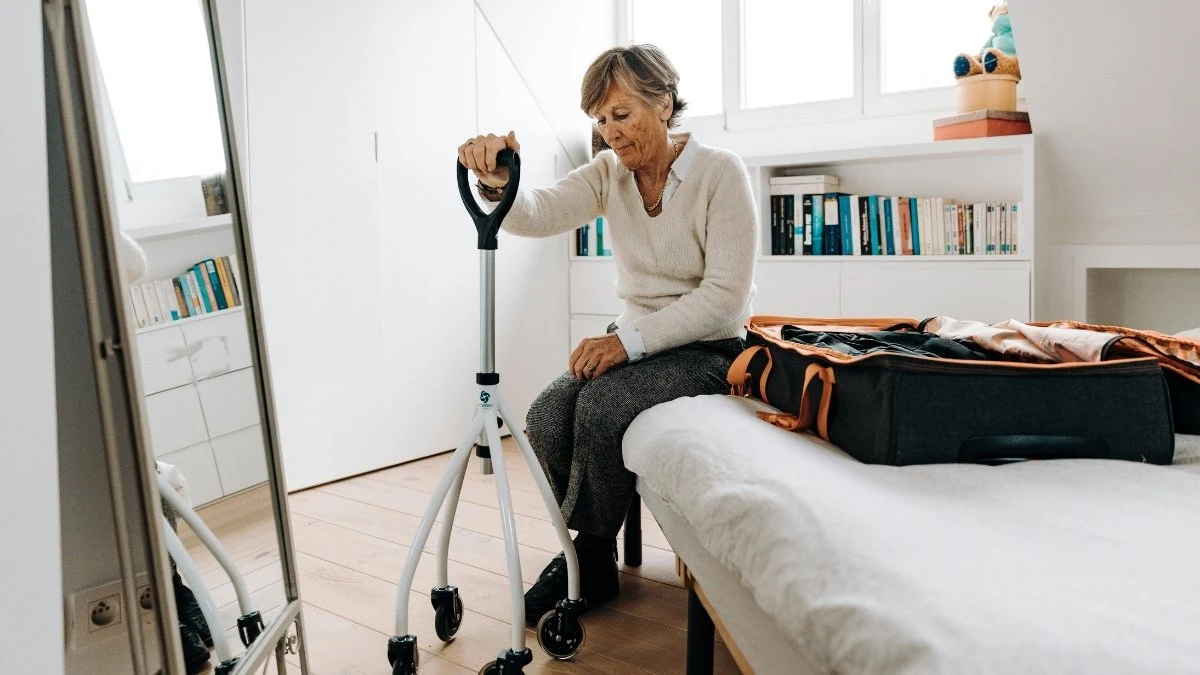
Daily function [the ability to do basic tasks like bathing, dressing, and toileting on your own] does not collapse overnight. It slips.
One task becomes harder. Then another.
By the time a family member notices, the threshold has already been crossed. Aging in place after 75 is not about preventing one dramatic event.
It is about protecting the small daily abilities that make aging in place after 75 possible.
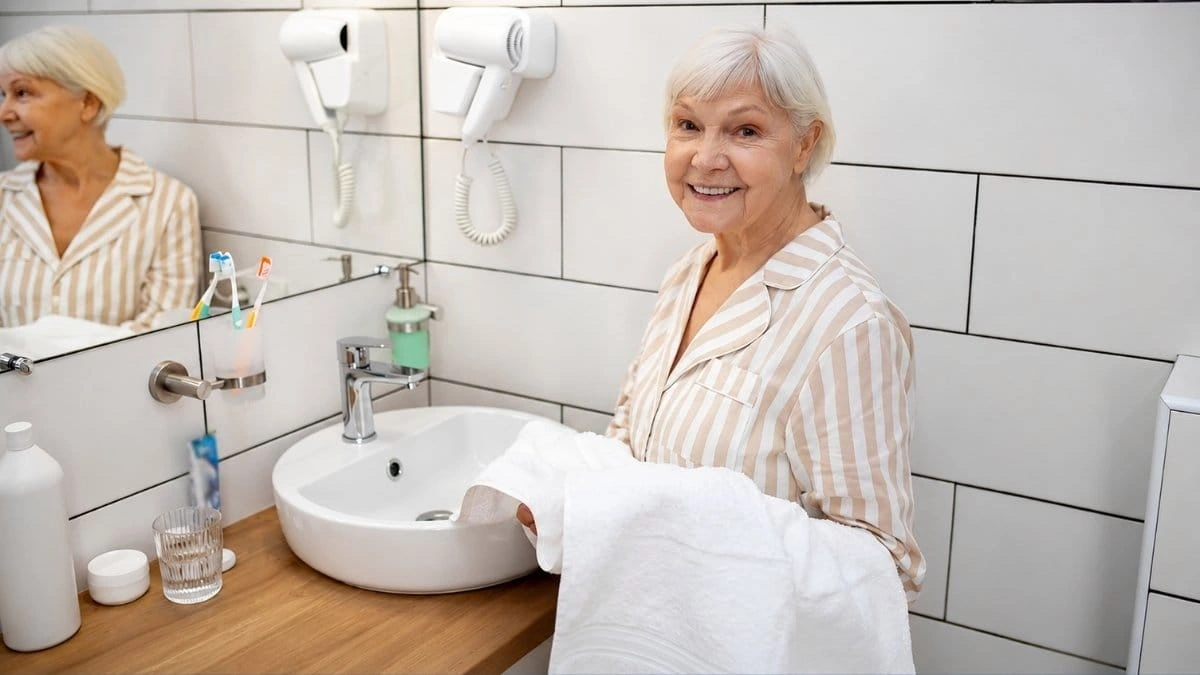
Here is what this means for you:
- Bathing, dressing, and using the toilet are among the most commonly lost abilities in adults as they age
- Most home modification checklists focus on falls, not on these functional tasks
But knowing what breaks down first is only half of it.
Helping tips:
- Write down the one daily task that already feels harder than it did a year ago. That task is your starting point.
- Tell your doctor which tasks are getting harder before they ask. Early input changes what help is available to you.
Point Second- Bathing Without Fear: The One Change That Bought Two More Years at Home

You might still be bathing fine. But if you have started skipping showers, rushing through them, or gripping the wall while you rinse, fear has already changed your behavior.
Research published in a PMC review found that between 40% and 73% of older adults who have experienced a fall report fear of falling, and that this fear is associated with loss of independence, activity restriction, and reduced quality of life, even when no second fall has occurred.
The thing that finally forced people out of their homes was not a fall. It was the morning they could no longer get off the toilet without calling for help.
Fear of bathing [the anticipatory anxiety that causes older adults to change or avoid hygiene routines before any injury occurs] is more common than most doctors ask about. It does not show up in a blood test.
It shows up in a damp towel that gets used twice because showering felt too risky.
Talk to your doctor before making changes if you are managing a balance disorder, recovering from a recent fall, or taking medications that affect your stability.
Here is what actually works:
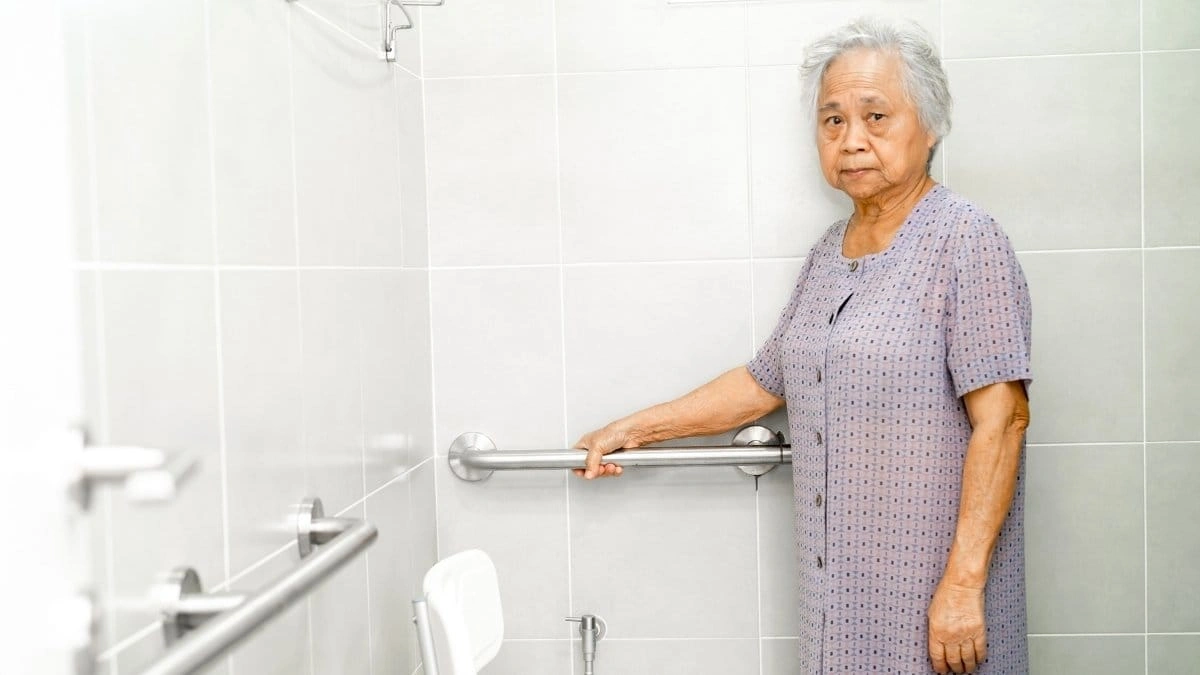
- A grab bar at the shower entry point, not on the wall inside, so you have support when you step in and out, which is when most bathroom injuries happen
- A handheld showerhead on a sliding bar, so you can bathe seated when fatigue is high without abandoning the routine
- A shower seat or fold-down bench, which removes the need to stand through the entire process
None of these require a full renovation. All three together cost less than two hundred dollars.
The bathroom is addressed. Next comes the problem most articles skip entirely.
Helping tips:
- Install a grab bar at the entry point of the shower first, before any other bathroom change. That is where the risk is highest.
- A fold-down shower bench costs under $80 at most hardware stores and removes the need to stand through every shower.
Point Third- Moving Through the House at Night Is Where It All Breaks Down
You wake up at two in the morning. It’s dark.
You need the bathroom. You’ve done this a thousand times.
But at 75, the dark is a different place than it was at 50. Nighttime bathroom trips are one of the most dangerous things you do every day.
NIH clinical data on nocturia [the need to urinate multiple times during the night, which is one of the most common conditions in older adults] shows that a quarter of all falls in older adults happen overnight, and 25% of those are directly linked to nighttime bathroom trips.
Adults making two or more trips to the bathroom at night have more than double the risk of fall-related fractures.
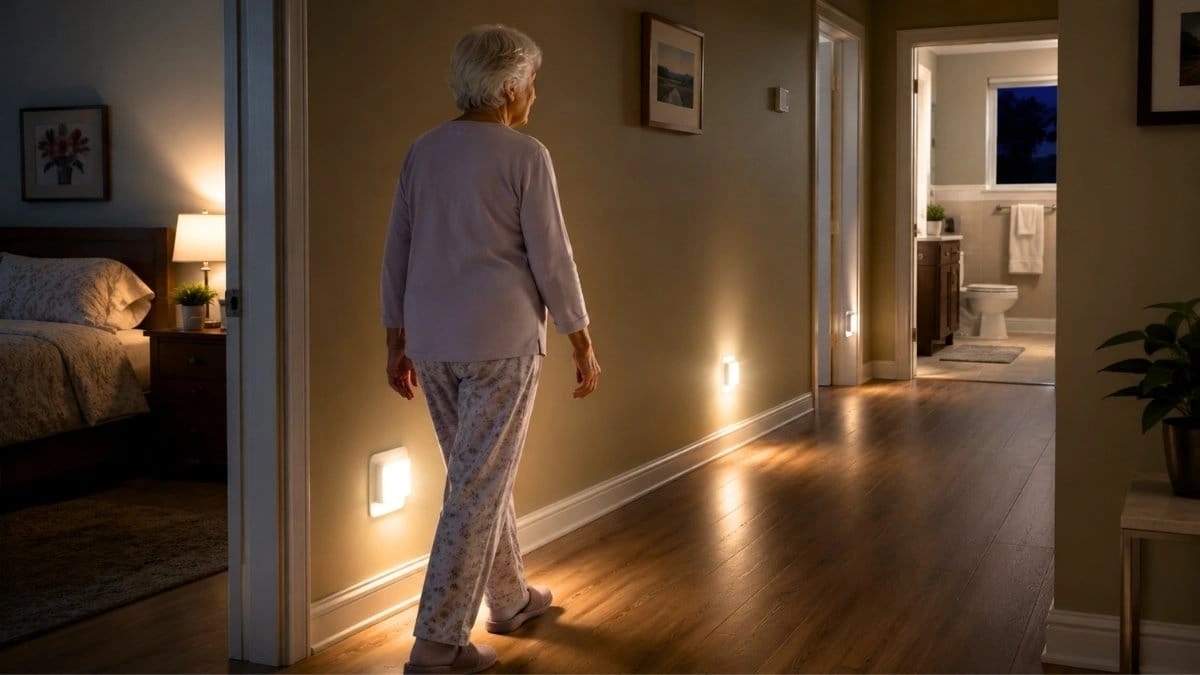
Here is the protocol that works:
Nighttime Safety Protocol
- Place a motion-activated night light at the base of your bed so it triggers the moment your feet hit the floor
- Add a second motion-activated light at the bathroom entry, not inside the room, at the door
- Replace any loose rugs between the bedroom and bathroom with non-slip strips or remove them entirely
- Wear fitted slippers with rubber soles, not soft-soled slip-ons or bare feet
- Keep a clear, straight path with no furniture corners and no charging cables on the floor
One exploratory study found that a destination-based LED lighting system may reduce fear of falling during nighttime bathroom trips in older adults compared to standard nightlights.
This alone does not solve everything. The next problem in aging in place after 75 lives in a room you use every single day.
Helping tips:
- Motion-activated night lights that plug directly into wall outlets cost under $15 and require no installation. Start there tonight.
- Check your slipper soles. If you can’t see a rubber tread on the bottom, replace them before your next trip to the hardware store.
Point Four- The Kitchen Problem Nobody Warns You About
It is not the stove. It is not a sharp knife.
The kitchen hazard that most quietly accelerates functional decline in older adults is the storage layout, specifically anything stored above shoulder height or below knee height.
Research on musculoskeletal risk in adults 55 and older suggests that age-related changes are associated with higher injury risk from awkward postures, including overhead reaching and bending to low positions.
The shoulder and lower back take on loads they can no longer absorb the way they once did.
Musculoskeletal fatigue builds up faster and recovers more slowly in older adults than it did twenty years ago.

The fix is not an appliance. It is a reorganization:
- Move everything you use daily to between shoulder height and hip height, including plates, pots, and pantry staples
- Store heavy items at counter level, not in lower cabinets where you’d need to crouch and lift
- Move rarely used items to the hard-to-reach spots you’ve now cleared at the top and bottom
- Use a lightweight rolling cart as a mobile counter extension if your kitchen has limited waist-height surface space
Aging in place after 75 does not require a new kitchen. It requires a reorganized one. And the next problem is one you sit down into every single day.
Helping tips:
- Spend 20 minutes this week moving your five most-used items to between shoulder and hip height. That single step reduces daily strain immediately.
- A rolling kitchen cart with shelves at waist height costs under $60 and adds usable, low-strain storage to any kitchen layout.
Point Five- Getting Up: Why Your Chair and Couch May Be Working Against You

You have probably never thought of your sofa as a health risk. But if it is low, soft, and deep, the kind you sink into, it may be one of the most significant obstacles to your continued independence.
Research published in PubMed on the sitting-rising test found that the ability to rise from a seated or floor position without support was a significant predictor of mortality in adults aged 51 to 80.
A separate study found that lower scores on rising-from-floor tests are associated with higher risk of morbidity and all-cause mortality in adults aged 46 to 75.
Sit-to-stand capacity [the ability to get up from a seated position using your own leg strength without pushing off with your hands] is one of the most important functional markers of independence. Most people lose it gradually, blaming age, until they can no longer do it reliably.
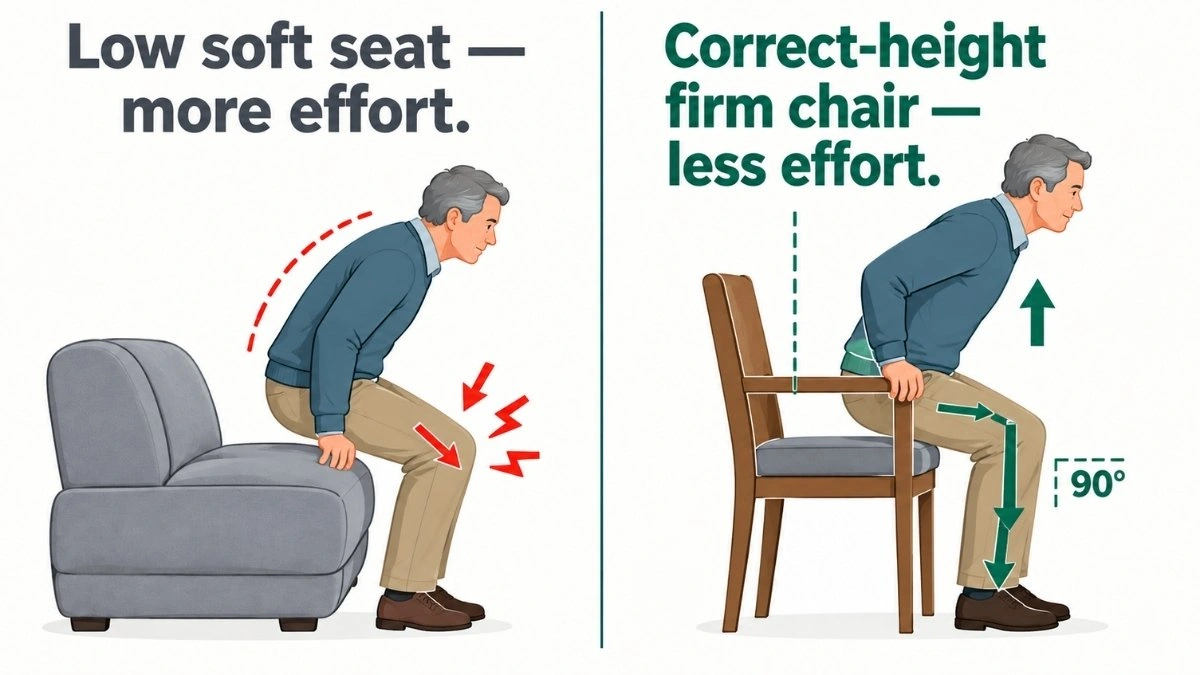
Three things determine whether your seating is helping or hurting you:
- Seat height — your feet should rest flat on the floor with your knees at roughly 90 degrees. If the seat is lower than that, you are working harder to stand every single time.
- Seat firmness — soft cushions require more leg force to rise from than firm ones. A firm seat pad placed on top of an existing chair costs less than twenty dollars and changes the equation immediately.
- Armrests — a chair with solid armrests at the right height lets you push yourself to standing safely. A sofa with no armrests removes that option entirely.
A basic chair riser, a platform placed under the chair legs to raise seat height, costs between thirty and sixty dollars. It requires no tools. The last fix in this article is the one most people never think to make.
Helping tips:
- Test your most-used chair now. Sit down and stand up without using your hands. If you can’t do it, your chair height or firmness is part of the problem.
- A chair leg riser set costs under $40 and can raise seat height by 2 to 4 inches without replacing the chair.
Point Six- Staying Connected Is Not Optional for Aging in Place After 75
You have done every physical fix in this article and you are still not done. It contains the factor that, when missing, makes every other change in this article eventually fail.
Research drawing on data from more than 100,000 adults across 24 countries found that social isolation was significantly linked to reduced cognitive ability across memory, orientation, and executive function, with the strongest effects seen in the oldest-old.
A separate study found that adults over 75 showed more pronounced cognitive deterioration linked to social isolation than any other age group.
Cognitive frailty [the combination of physical frailty and mild cognitive decline that puts older adults at high risk of losing the ability to live independently] does not usually begin with a fall or a diagnosis.
It often begins with weeks of too little contact, too little stimulation, and too little reason to leave the house or answer the phone.

Aging in place after 75 requires more than a safe home. It requires a reason to stay in that home. That reason is other people.
One contact is enough to start. Not a care plan. Not a formal commitment.
One person who calls or visits on a predictable schedule, a neighbor, a family member, a friend from church, a volunteer visitor, creates an accountability structure that keeps you anchored, noticed, and engaged.
That structure does more for your long-term independence than any grab bar.
You have done the physical work. This is the part that holds it together.
Helping tips:
- Identify one person who can check in with you at least once a week. Text them this week and make it a regular thing.
- A weekly call scheduled at the same time each week is more protective than an occasional visit. Predictability matters more than frequency.
Finally:
Start with the one daily task that already feels harder than it used to. That is the fix to make first, not the one an article told you to make.
Pick one change from this article and make it in your home this week, not next month, not after the holidays. Aging in place after 75 is not about perfection. It is about staying ahead of the breakdown before it becomes the reason you leave.