

That stiffness you feel when you first get up in the morning is not proof that your body is falling apart.
Most people over 50 who wake up stiff every morning and assume it is permanent are wrong. That assumption is costing them 30 minutes of pain they do not have to sit through.
This article explains what is actually happening to cause morning joint stiffness after 50, and it gives you a specific set of actions you can start before your feet hit the floor. By the end, you’ll know exactly why you stiffen up and what to do about it today.
What Actually Happens to Your Joints While You Sleep
You wake up stiff because your joints were still for eight hours, and still joints do not stay lubricated. Every joint in your body contains synovial fluid [a gel-like substance that lubricates the surfaces where your bones meet and helps them glide without grinding].
While you move around during the day, that fluid circulates freely. The moment you stop moving, which is exactly what sleep is, the fluid thickens and settles, like gelatin left on the counter.¹
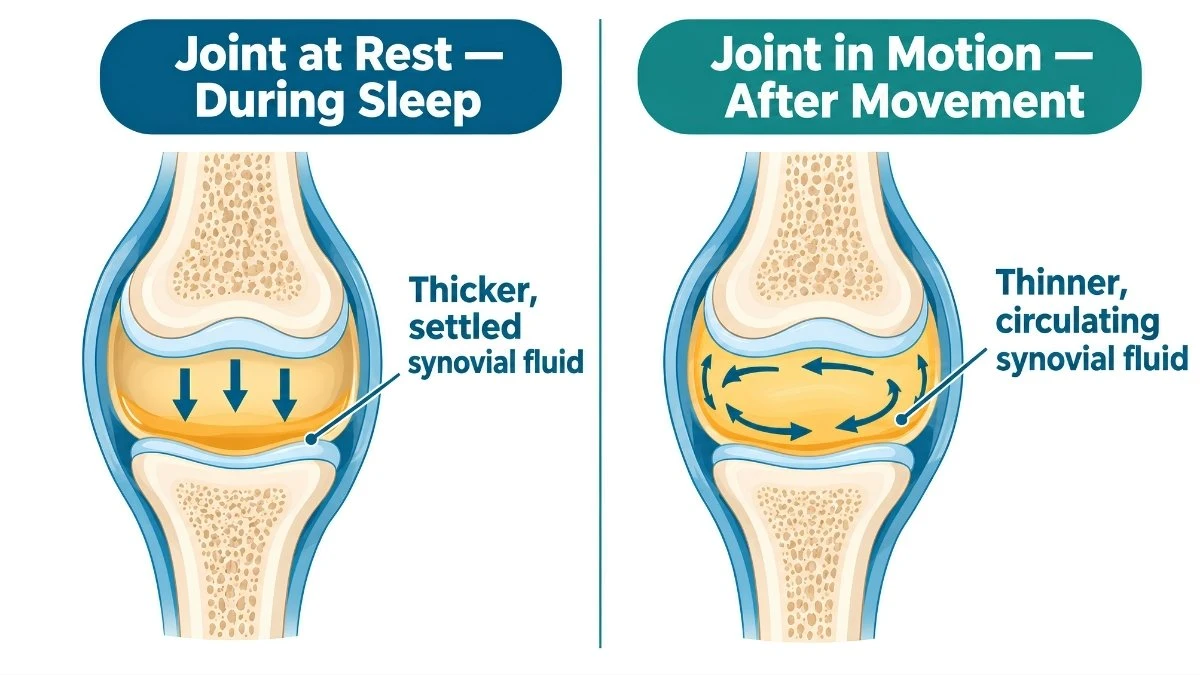
This has a name: doctors sometimes call it the morning gel phenomenon [the temporary thickening of synovial fluid after long periods of rest]. It is not damage. It is physics.
Here’s what changes that: movement. Fluid needs movement to stay thin and slippery. When you’ve been in the same position for six to eight hours, it loses viscosity [the property that makes it an effective cushion and shock absorber]. Once you start moving, it warms up and circulates again.¹
Within 15 to 30 minutes of moving around, that stiffness fades for most people.¹ The joint isn’t broken. The fluid just needs to wake up.
Here’s the part that matters for everything that follows: if your morning joint stiffness after 50 is getting worse, there are specific reasons why. Age alone is not a complete answer.
Why Morning Joint Stiffness Gets Worse After 50
You’ve probably noticed something: it isn’t just that you stiffen up. It’s that it takes longer to shake off. Most people assume that means their joints are more damaged than they used to be. That is only part of the picture, and it’s not the part you can do anything about in the next 10 minutes.
The stiffness is not your joints breaking down. It is your body doing exactly what a resting body does, and you can interrupt it before your feet hit the floor.
Why Joints Stiffen
After 50
The body makes less synovial fluid with age, so morning stiffness starts from a lower baseline — before you even move.
What fluid remains thickens more noticeably, making that characteristic morning gel effect feel more pronounced and last longer.
There’s less fluid to recirculate once movement begins, so the process of warming up and loosening takes noticeably longer.
Cartilage becomes less spongy over time — it absorbs and releases fluid more slowly, which delays recovery to normal range of motion.
What that means for you shows up in the research. In a study of adults aged 70 and older, more than half of the 765 participants reported morning joint stiffness. Those with stiffness in more than one joint area were at higher risk of developing new or worsening difficulty with everyday mobility, independent of pain.² That is not an aging inevitability. It is a signal.

The key word is independent. Stiffness that lingers too long is not just an annoyance.
You are far from alone in this. More than one-third of adults over 50 without inflammatory arthritis still report morning stiffness lasting more than 15 minutes.³ That number tells you this is not a rare problem, and it tells you there are things driving it beyond diagnosis.
The fluid is one piece. But there’s a second system working against you while you sleep. It runs on a 24-hour clock.
Your Body’s Own Anti-Inflammatory System Works Against You at 4 a.m.
You wake up stiff partly because your body’s timing is working against you. This is the part that surprises most people, and it makes morning stiffness feel like a full-body problem, not just a joint problem.
Your Body Runs on a
24-Hour Schedule
Cortisol at its daily lowest
Your body runs on a 24-hour internal schedule — and that includes the hormones responsible for controlling inflammation.
Cortisol — your body’s primary anti-inflammatory hormone — follows the circadian clock closely, rising and falling on a predictable daily cycle.
Cortisol is produced by the adrenal glands, which ramp output up and down in sync with your sleep-wake rhythm throughout every 24-hour period.
Cortisol hits its daily low between 2 am and 6 am — the window when inflammation naturally goes unchecked, which is why joint pain often peaks in the early morning.
That’s a problem, because that same window is when your body’s pro-inflammatory signals are at their peak.
Here’s how much it matters. Research in people with inflammatory arthritis found that levels of interleukin-6 [a protein the immune system releases that drives inflammation and joint swelling] rise sharply between 2 a.m. and 7 a.m.⁴
Changes in those IL-6 levels correlated directly with changes in morning stiffness severity.⁴ The mechanism is documented: low cortisol plus high inflammatory signals equals a stiffer, more painful start to the day.
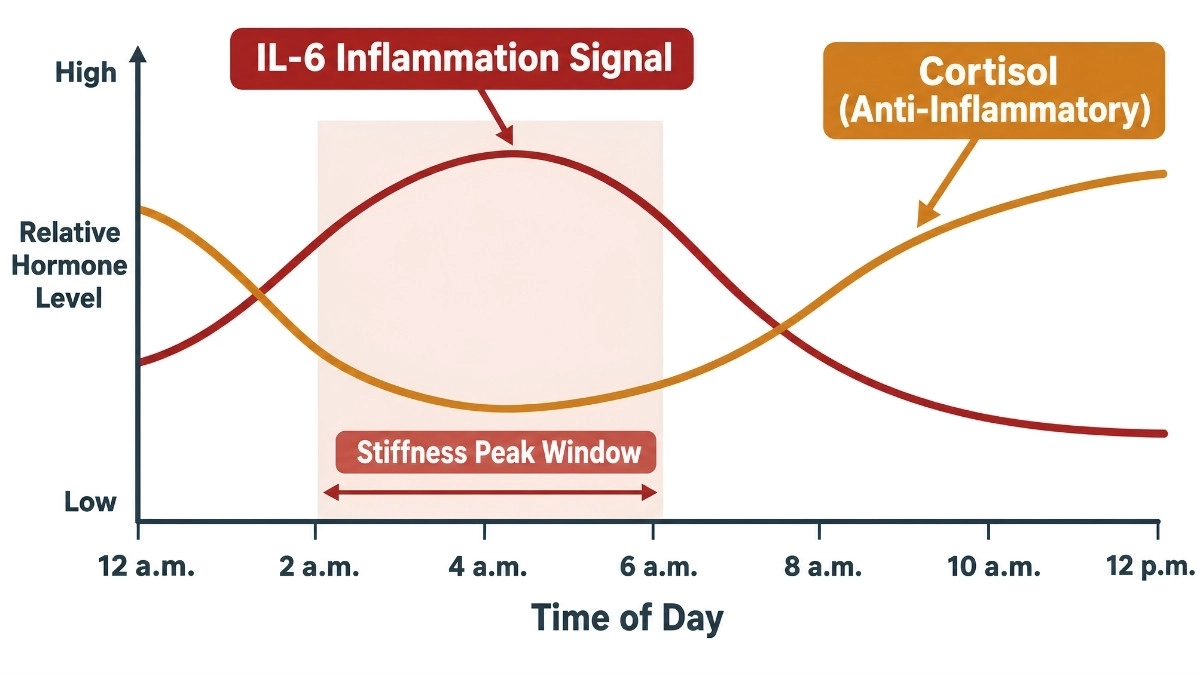
The timing is the problem. Your anti-inflammatory protection is lowest exactly when inflammation is highest.
This applies beyond people with diagnosed arthritis. The circadian pattern of cortisol and inflammation is a basic feature of human biology.⁵ Stress, poor sleep, and low physical activity are each linked to a flatter diurnal cortisol pattern — a smaller gap between the overnight low and the morning peak.¹⁰
You can’t rewrite your hormonal clock. But you can stop the morning from getting worse. The next section starts with what happens in the first five minutes after your alarm goes off.
The Four Moves That Turn the Stiffness Off Before You Stand Up
Talk to your doctor before starting any new exercise routine if you’re managing a chronic joint condition, recovering from surgery, or taking medications that affect your muscles or bones.
You don’t have to stand up first. These are the exercises for morning stiffness that work before you even stand up.
The goal is to restart synovial fluid circulation before you put any weight on your joints. In a clinical trial of 96 people with knee osteoarthritis, structured exercise including range-of-motion work significantly reduced morning stiffness scores compared to a control group.⁶ Moving the joint is the trigger. You don’t need to be upright to do it.
Do these four moves in bed, before you get up. Aim for eight to 10 repetitions of each.
Ankle pumps.
Flex your feet toward your shins, hold for two seconds, point them away, hold for two seconds. This restarts circulation in the ankles and lower legs without loading the knee or hip.
Knee slides.
Lying flat on your back, slide one heel toward your body until the knee bends to about 90 degrees, then slide it back. Alternate legs. This circulates synovial fluid directly in the knee joint.
Hip rotations.
With knees bent and feet flat on the mattress, let both knees fall slowly to one side, then the other. Keep your shoulders down. This moves the hip joints through their range without weight-bearing compression.
Shoulder rolls. Lying flat, roll both shoulders forward in slow circles five times, then backward five times. The shoulder joint holds synovial fluid too, and it’s often overlooked.
The Two-Week Rule
These four moves take under five minutes. The research on exercise and morning stiffness shows benefits that build over time, not overnight.⁶ Do this sequence every morning for two weeks before you judge it. Track how many minutes pass before you feel loose. That number will tell you more than how you feel on day one.
Give yourself 60 seconds lying still after the last move. Let the fluid redistribute. The moves help in the morning, but the conditions for tomorrow’s stiffness are already being set tonight.
What You Do the Night Before Shapes How You Feel in the Morning
By the time your alarm goes off, eight hours of decisions have already been made for you. What you drink, how you sleep, and what position you hold through the night all shape how stiff you feel when you wake up.
Hydration matters more than most people realize. Synovial fluid is largely water. Human synovial fluid is estimated to be approximately 85% water by composition.⁷
When you go to bed mildly dehydrated, that fluid is already thicker than it should be. A glass of water before bed is a small habit with a direct mechanical effect on joint lubrication overnight.

Sleep position is underrated. Sleeping tightly curled keeps your hips and knees bent at sharp angles for hours. A tight fetal curl compresses the joint surfaces and keeps the surrounding soft tissue shortened all night.⁸ When you straighten out in the morning, everything resists.
Two small adjustments make a measurable difference:
- Side sleepers: place a pillow between your knees. This keeps your hips in a neutral position and reduces the compression that builds up in a tight curl.⁸
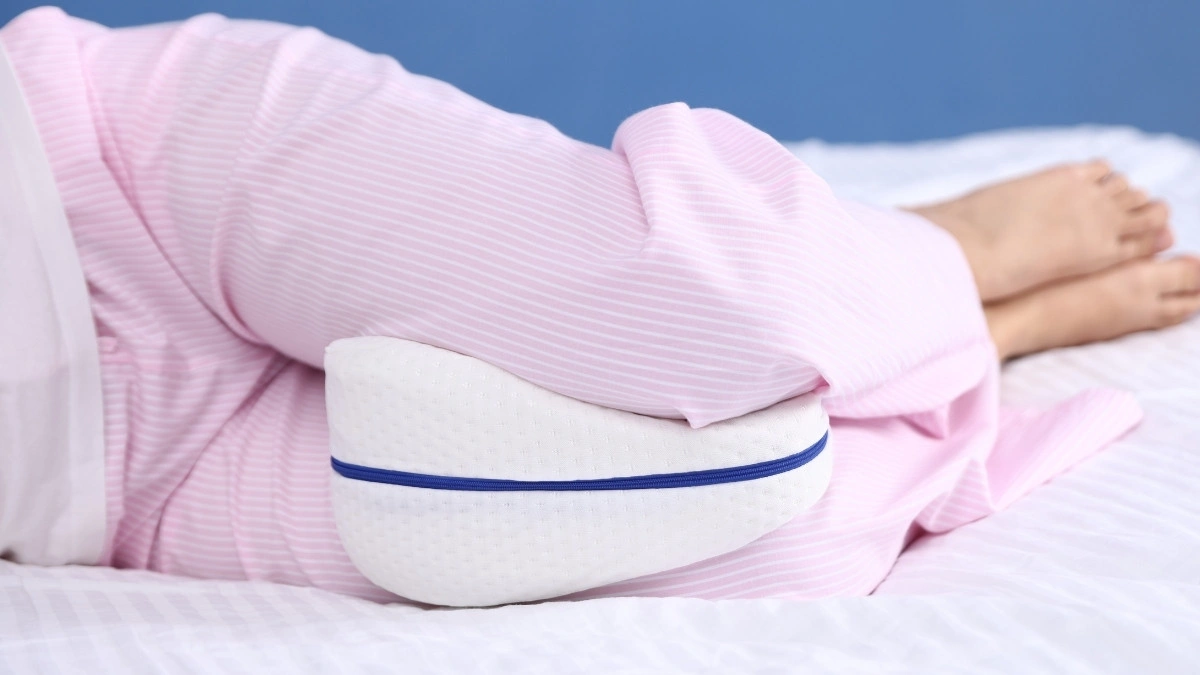
- Back sleepers: place a pillow under your knees. This takes the lower back out of full extension and relieves pressure on the hip joints.
Don’t end the day completely still. A short walk after dinner, even 10 minutes, circulates synovial fluid before it thickens overnight.¹ It does not have to be intense. It just has to happen.
These changes address the mechanical and fluid side of morning stiffness. But there is a different kind of morning stiffness, one that does not get better with movement. The next section tells you exactly what to watch for.
When Morning Stiffness Is Telling You Something That Needs a Doctor
You’ve made it through five sections knowing what to do. But there’s one type of morning stiffness that does not respond to these moves, and it’s worth knowing what it looks like.
The clearest thing to watch is how long it lasts. Duration is the signal most worth tracking. In studies of people with early arthritis, morning stiffness lasting 30 minutes or longer was independently associated with a diagnosis of inflammatory arthritis, including rheumatoid arthritis.⁹
Stiffness that regularly takes more than 45 minutes to ease is worth discussing with a doctor.
Symmetry is also worth watching. Mechanical stiffness from inactivity tends to affect the joints you were sleeping on or areas that were compressed overnight. Inflammatory arthritis tends to affect matching joints on both sides of the body, both hands, both wrists, both knees, at the same time.
Swelling is the third thing to watch for. Joints that are visibly swollen, warm to the touch, or tender when pressed show signs of active inflammation that go beyond overnight fluid thickening.
Watch for these three patterns together:
- Stiffness lasting more than 45 minutes most mornings
- Joint swelling or warmth that is present when you wake up
- Stiffness that affects the same joints on both sides of your body

One rule worth keeping. If morning stiffness is disrupting your first 45 minutes consistently for two weeks or more, book an appointment. You don’t need to wait for it to get worse. Earlier is always better when it comes to inflammatory joint disease.
The Fix Starts This Morning
Start the four-move morning sequence described in this article every day for two weeks and track how long your stiffness lasts before comparing it to your starting time.
Add a glass of water before bed tonight. Adjust how you sleep. None of this requires a gym, a prescription, or a major overhaul of your routine. Morning stiffness relief is within reach before you even put your feet on the floor.
Morning joint stiffness after 50 is real. It is not fixed by waiting for it to pass. It is fixed by giving your body what it needs to fix it itself.
References
- Cleveland Clinic. “Waking Up Stiff: How Morning Gel Can Affect Your Joints.” Cleveland Clinic Health Essentials. 2023. https://health.clevelandclinic.org/waking-up-stiff-how-morning-gel-can-affect-your-joints-tips-for-relief
- Suri P, Kiely DK, Leveille SG. “A stiff price to pay: does joint stiffness predict disability in an older population?” Journal of the American Geriatrics Society. 2014. https://pubmed.ncbi.nlm.nih.gov/25333527/
- Sokka T, Toloza S, Cutolo M, et al. “Reevaluation of the role of duration of morning stiffness in the assessment of rheumatoid arthritis activity.” Journal of Rheumatology. 2009. https://pubmed.ncbi.nlm.nih.gov/19833759/
- Kirwan JR, Clarke L, Hunt LP, Perry MG, Straub RH, Jessop DS. “Effect of novel therapeutic glucocorticoids on circadian rhythms of hormones and cytokines in rheumatoid arthritis.” Annals of the New York Academy of Sciences. 2010. https://pubmed.ncbi.nlm.nih.gov/20398018/
- Cutolo M, Straub RH. “Circadian rhythms and arthritis.” Annals of the New York Academy of Sciences. 2005. https://pubmed.ncbi.nlm.nih.gov/15639059/
- Dehghan M, Bagheri Lankarani K. “Effectiveness of muscle strengthening exercises on the clinical outcomes of patients with knee osteoarthritis: A randomized four-arm controlled trial.” PMC. 2023. https://pmc.ncbi.nlm.nih.gov/articles/PMC10379804/
- “Human synovial fluid comprises approximately 85% water.” Conditionally active biological proteins. US Patent Office publication. https://image-ppubs.uspto.gov/dirsearch-public/print/downloadPdf/10329556
- Orlin and Cohen Orthopedic Group. “Joints Feel Stiff in the Morning? Here’s Why and What You Can Do.” 2026. https://www.orlincohen.com/news/joints-feel-stiff-in-the-morning-heres-why/
- van der Helm-van Mil AH, et al. “Reappraisal of the diagnostic and prognostic value of morning stiffness in arthralgia and early arthritis.” PMC. 2015. https://www.ncbi.nlm.nih.gov/pmc/articles/PMC4445798/
- PMC. “Sedentary behavior and physical activity are longitudinally associated with diurnal cortisol rhythms in individuals up to 1 year after colorectal cancer treatment.” PMC. 2025. https://pmc.ncbi.nlm.nih.gov/articles/PMC13405483/