

You walked into a room and forgot why. Mid-sentence, the word you’ve used a thousand times just vanished.
Women aged 40 to 55 experiencing menopause brain fog are losing words, missing appointments they swore they remembered, and falling behind at work, but most information they find either dismisses what they’re going through or buries the real cause under language no one can follow.
This article will show you exactly what is happening inside your brain, why it’s happening now, and what you can do about it.
What Brain Fog During Menopause Actually Feels Like
You’re mid-email and the name of a colleague you’ve worked with for six years is just gone. That is menopause brain fog, and it’s real. Between 44% and 62% of women in perimenopause [the years of hormonal change leading up to the final menstrual period] report significant cognitive decline.¹
The fog doesn’t feel like ordinary tiredness. Tiredness lifts after sleep. This doesn’t. The specific symptoms that research identifies most consistently are:
- Word-finding difficulty (the name, the noun, the term you know you know)
- Attention lapses (reading the same paragraph three times)
- Slower processing speed (the pause before you respond, the moment you need to think about something that used to feel automatic)
- Verbal memory decline (forgetting what someone told you an hour ago)

Two specific numbers flip what most women expect. In one large study of perimenopausal and menopausal women, 93% reported memory problems and 91% reported difficulty concentrating.² Most women think they’re mainly going to have to deal with night sweats. Cognitive symptoms are actually more common.
One important thing to know before moving on: for the large majority of women, objective performance on memory tests stays within the normal range.³ The fog is real and measurable. It is not dementia. It does not mean your brain is failing in a permanent or progressive way.
What it means is that something specific and identifiable has changed in the way your brain is getting what it needs. The next section names exactly what’s happening in your brain during menopause brain fog, and it is more specific than most articles tell you.
The One Thing Falling Estrogen Does to Your Memory Center
Your memory started slipping around the same time your periods became irregular. That timing is not a coincidence. It points directly to one structure in your brain.
You’ve probably never thought about where a word is stored before you say it. Your brain contains a region called the hippocampus [the part of the brain where new memories are formed and stored].
It’s roughly the size and shape of a seahorse, sitting deep inside each brain hemisphere. New information has to pass through it before it can be stored anywhere else. If the hippocampus isn’t working efficiently, new memories don’t form properly. That is what the fog is.
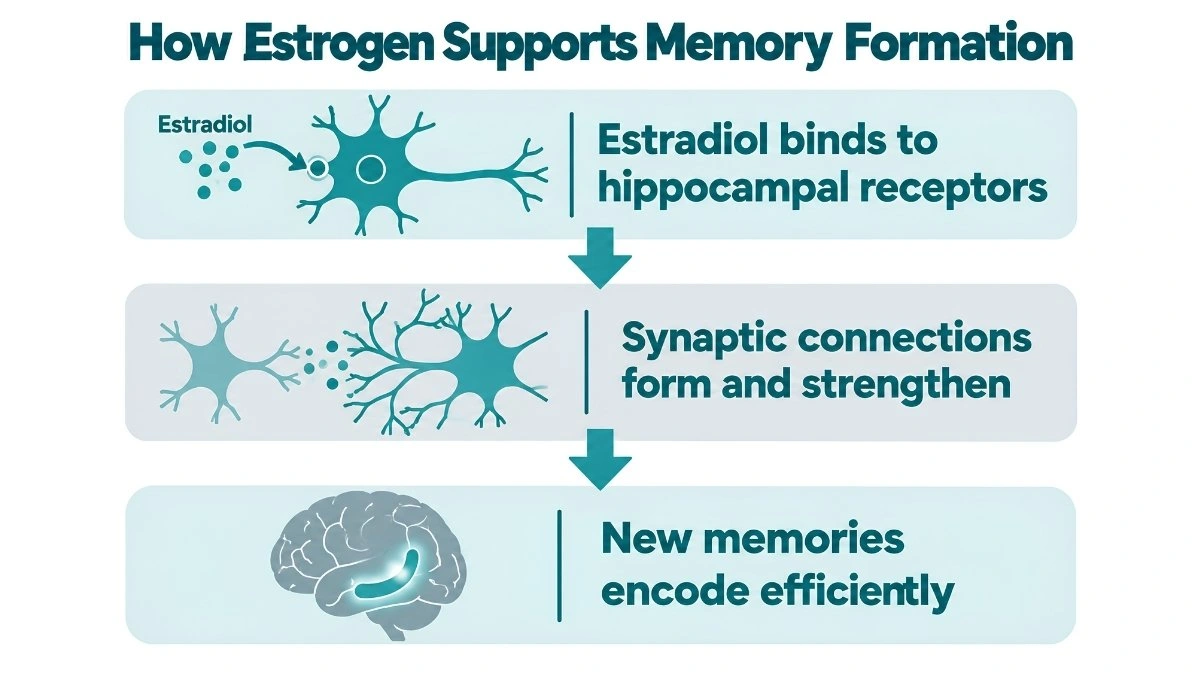
This is where your estrogen comes in. Estradiol [the form of estrogen that most directly affects brain function] binds to receptors inside hippocampal neurons and helps those neurons form connections with each other.
Research in animal models shows that estradiol activation in the hippocampus is associated with enhanced formation of new synaptic connections, faster memory consolidation, and growth of new cell branches within the memory center.⁴
Animal research found these effects in mice and rats; human application is supported by longitudinal evidence showing that women’s verbal memory advantage over men is reduced specifically at menopause, tracking the decline in estradiol levels.⁵
Brain Fog Is a
Chain Reaction
Three linked steps — not one vague symptom.
falls
breaks
floods in
Step One: Estrogen Falls
The chain starts here. Falling estrogen during menopause sets off a cascade — it does not cause brain fog directly, but it triggers what does.Step Two: Sleep Breaks Down
Falling estrogen disrupts sleep architecture. Broken sleep is not just tiredness — it is the mechanism that activates the next link in the chain.Step Three: Cortisol Floods In
Poor sleep drives sustained high cortisol. Chronically elevated cortisol is not just stress — it is a physical signal with direct effects on brain tissue.The End Point: Memory Recording Affected
High cortisol physically affects the brain region that records new memories — which is why the fog feels real. Because at this point, it is.
The estrogen-brain link is specific, not vague. When estradiol declines, hippocampal neurons form new connections more slowly. Words that used to arrive instantly now take longer to surface. The next link in the chain happens every night.
Why Sleep Disruption Makes Menopause Brain Fog Worse, Not Just Tiredness

You know the 3 a.m. wake-up. The hot flush that pulls you completely out of sleep just as your body was settling into its deepest phase. You lie there, then drift back, and in the morning you feel like you barely slept at all. You barely did. And that matters for your memory in a very direct way.
Deep sleep is when your brain files the day. During slow-wave sleep [the deepest stage of sleep, when the brain consolidates short-term memories into long-term storage], the hippocampus replays the day’s information and moves it into stable long-term memory.
When a hot flush wakes you out of this stage, that filing process is interrupted. The information doesn’t get stored. By morning it’s gone, or it’s harder to reach.

Most women are surprised by how directly their night-time symptoms are affecting memory the next day. Research following midlife women found that hot flushes and night sweats are associated with poorer verbal memory performance.⁶
A separate longitudinal study tracking 85 women over 400 visits identified sleep disturbance as one of the key factors linked to a cognitively vulnerable profile, characterized by weakness in verbal learning and memory.⁷
Here’s the part most brain fog articles skip: research in humans has found that disrupted sleep is associated with changes in cortisol levels, including elevations linked to altered stress responses the next day.¹⁴
Cortisol [a hormone the body releases in response to stress and sleep disruption] is meant to be a short-term alert signal.
When sleep is repeatedly disrupted, cortisol rises more than it should, stays elevated longer than it should, and begins to affect the same brain region that estrogen was already struggling to protect. That’s the next link in the menopause brain fog chain.
The Hidden Cortisol Connection Most Articles Skip
You’ve probably noticed the fog gets worse on stressful days. That’s not in your head. Cortisol and cognition are directly connected, and the connection runs straight through your hippocampus.
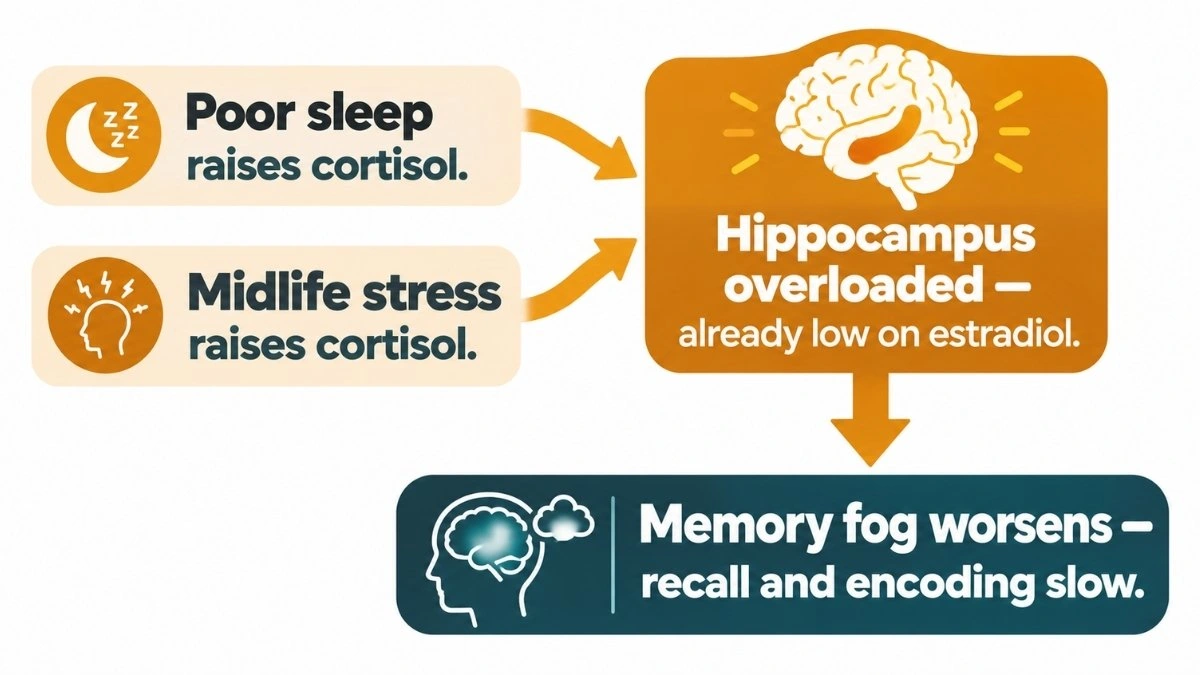
Your hippocampus is especially sensitive to this. It has a high density of glucocorticoid receptors [specialized docking sites on hippocampal cells that cortisol attaches to]. When cortisol is briefly elevated, this is normal and even useful.
When cortisol stays high for weeks or months, those receptors are exposed to more cortisol than they can handle, and hippocampal function starts to suffer.
In people with chronically elevated cortisol levels, such as patients with Cushing’s syndrome [a condition in which the body produces excess cortisol over a long period], researchers found both reduced hippocampal volume and measurable impairment in cognitive function.⁸
In healthy adults, high cortisol at the time of memory testing has been associated with slower working memory performance and impaired recall.⁹
The cortisol connection to menopause brain fog matters because menopause creates two separate cortisol pressures at once. Poor sleep raises cortisol. The stress of managing a body in hormonal transition, combined with midlife demands at work and home, raises cortisol independently. Both arrive together.
The result: your hippocampus is already receiving less estradiol. Now it’s also receiving more cortisol. The fog isn’t one thing. It’s a compounding problem.
This is why generic advice to “reduce stress” is frustrating but not wrong. The mechanism is real. What the next section does is tell you which specific actions actually move the needle on this chain, and why.
What Actually Helps: Strategies with a Real Mechanism Behind Them
Here is what’s frustrating: most lists of tips for menopause brain fog are identical to generic wellness advice. Drink water. Eat vegetables. Sleep more. None of that is wrong, but it doesn’t connect to the actual chain of events driving your symptoms.
Talk to your doctor before changing any exercise or supplement routine if you’re pregnant, on medication, or managing a chronic condition.
The three strategies below connect directly to at least one link in the chain identified in the previous sections.
1. Aerobic exercise, specifically
A 2026 randomized controlled trial found that post-menopausal women who completed an aerobic exercise program showed significantly greater improvements in executive function [the brain’s ability to plan, focus, and switch between tasks] compared to women who did stretching and toning instead.¹⁰
The aerobic group trained four times per week for six months. The benefits were measurably larger in post-menopausal women than in pre-menopausal women in the same trial.
Exercise cannot replace estradiol, but it is associated with increases in BDNF [brain-derived neurotrophic factor, a protein that supports the growth and maintenance of brain cells, including those in the hippocampus].¹¹

2. Sleep targeting night-wake cycles specifically
Keeping the bedroom cooler, using lightweight layered bedding, and addressing the night sweats that cause waking are more targeted than general sleep hygiene advice. They protect the specific deep-sleep stages your brain needs to consolidate memory. The goal is reducing the number of times you wake. Each interruption is a missed filing window.
3. Consistent daily structure as a cortisol buffer
Irregular schedules keep cortisol variable. Predictable wake times, eating windows, and movement schedules allow your cortisol rhythm to normalize. This is not about being rigid. It is about giving your hypothalamic-pituitary-adrenal axis [the system that regulates cortisol release] a stable pattern to follow so it stops producing more cortisol than the situation requires.
These three work. They work better together. But they are not a replacement for a conversation with a doctor, which is what the next section is about.
How to Talk to Your Doctor So You Leave with Answers
A lot of women leave the doctor’s office without answers. Not because their doctor is unhelpful, but because brain fog is hard to describe in a short appointment and easy to dismiss as stress or aging. The way you walk in matters.
Before your appointment, write these things down:
- The specific symptoms you notice (word-finding, losing your train of thought, forgetting recent conversations)
- When symptoms started relative to your cycle changes
- How often they happen and whether stress or poor sleep makes them worse
- How the symptoms are affecting your work, your relationships, or your daily confidence

Bring that written list. Show it at the start of the appointment. Clinical guidance from women’s health specialists recommends providing detailed examples rather than general descriptions, because concrete examples give the doctor something to work with that “I’m just foggy” does not.¹²
Ask your doctor to rule out other causes. Thyroid dysfunction, anemia, and vitamin B12 deficiency are all associated with similar cognitive symptoms and are common in midlife women.¹³ A doctor who doesn’t rule these out first isn’t giving you a complete picture.
If you feel dismissed, you can ask to see a menopause-certified specialist. The Menopause Society maintains a searchable directory of certified practitioners at menopause.org.
The one thing to say plainly: “My cognitive symptoms are affecting my quality of life and I want to understand whether hormonal changes, sleep disruption, or something else is contributing.”
The Fog Is Real. So Is the Path Forward.
The single most important thing you can do today is start tracking your symptoms in writing, then book an appointment to discuss them.
Book an appointment with your doctor this week, bring the list of symptoms you have been tracking, and ask directly whether hormonal changes, sleep disruption, or cortisol are contributing to your cognitive symptoms. Menopause brain fog is not a sign that your brain is broken.
It is a sign that a specific chain of biological events is affecting a specific brain structure, and that chain has identifiable links you and your doctor can work through together.
References
- El Khoudary SR, et al. Cognitive decline prevalence in perimenopause. Cited in: Utah State University Extension Midlife Health and Menopause Program. Brain fog during menopause: understanding what’s going on. 2026. https://extension.usu.edu/midlife-health-menopause/blog/brain-fog-during-menopause
- Reisel D, Crockett C, Glynne S, Kamal A, Newson L. Prevalence of cognitive and mood-related symptoms in a large cohort of perimenopausal and menopausal women. BJPsych Open. 2024. https://www.ncbi.nlm.nih.gov/pmc/articles/PMC11738833/
- Maki PM, Jaff NG. Brain fog in menopause: a health-care professional’s guide for decision-making and counseling on cognition. Climacteric. 2022;25:570-578. https://www.tandfonline.com/doi/full/10.1080/13697137.2022.2122792
- Bean LA, Ianov L, Foster TC. Estrogen receptors, the hippocampus, and memory. Neuroscientist. 2014. https://pmc.ncbi.nlm.nih.gov/articles/PMC4317255/ [Primary evidence from animal models (mice and rats). Human parallel supported by reference 5.]
- Harvard Health Publishing. Menopause and memory: know the facts. 2021. https://www.health.harvard.edu/blog/menopause-and-memory-know-the-facts-202111032630
- Maki PM, Drogos LL, Rubin LH, et al. Objective hot flashes are negatively related to verbal memory performance in midlife women. Menopause. 2008;15(5):848-856. Cited in: Maki PM, Jaff NG. Climacteric. 2022. https://www.tandfonline.com/doi/full/10.1080/13697137.2022.2122792
- Weber MT, et al. Scientific insights into brain fog during the menopausal transition. Climacteric. 2021. https://www.tandfonline.com/doi/full/10.1080/13697137.2021.1942700
- Bhagya V, et al. Elevated basal cortisol level predicts lower hippocampal volume and cognitive decline. Journal of the Neurological Sciences. 2009. https://www.sciencedirect.com/science/article/abs/pii/S0967586809001088 [Population: Cushing’s syndrome patients and aging populations with chronically elevated glucocorticoids.]
- Schommer NC, et al. Psychosocial stress impairs working memory at high loads: an association with cortisol levels and memory retrieval. PubMed. 2007. https://pubmed.ncbi.nlm.nih.gov/17035163/ [Population: 20 young healthy men. Claim in body reflects this as “healthy adults.”]
- Sanz Simon S, et al. Can menopausal status moderate the effects of aerobic exercise on executive functions? Evidence from a randomized controlled trial. Journal of Alzheimer’s Disease. 2026. https://pubmed.ncbi.nlm.nih.gov/42541423/
- Kandola A, et al. Exercise and brain health in postmenopausal women: a review of cognitive benefits, mechanisms, and neurodegeneration prevention. PubMed. 2026. https://pubmed.ncbi.nlm.nih.gov/42646500/
- Jean Hailes for Women’s Health. How to talk to your doctor about midlife brain fog. 2026. https://www.jeanhailes.org.au/articles/how-to-talk-to-your-doctor-about-midlife-brain-fog/
- UT Physicians (Mosquera, MSCP). Understanding brain fog and menopause. 2025. https://www.utphysicians.com/brain-fog-during-menopause/
- Besedovsky L, et al. Influence of sleep deprivation and circadian misalignment on cortisol, inflammatory markers, and cytokine balance. ScienceDirect. 2015. https://www.sciencedirect.com/science/article/abs/pii/S0889159115000069 [Population: human adults; one night of total sleep deprivation found to increase cortisol levels.]