
You’ve done everything right. You heated the milk, you sipped it slowly, and you still stared at the ceiling for an hour.
Most adults who already try natural sleep remedies hit this exact wall, and the reason isn’t that warm milk doesn’t work. Most people who drink warm milk at bedtime get little from it, because tryptophan has to win a race against five other amino acids just to reach the brain.¹
This article explains what that race looks like, what blocks tryptophan from winning, and how to make sure it wins tonight.
Talk to your doctor before changing your diet or supplement routine if you’re pregnant, on medication, or managing a chronic condition.
Why Most People Get No Result From Warm Milk
You’ve probably tried this before. You pour a glass, heat it up, sit with it before bed, and feel nothing. You’re not imagining the disappointment.
Here’s what’s actually happening. Warm milk contains several compounds that can support sleep. But each one has a specific set of conditions it needs to work.
Without those conditions, the compounds go nowhere.
Sleep trouble is genuinely widespread. According to a 2024 survey of U.S. adults, about 15.4% report trouble falling asleep, and 18.1% have trouble staying asleep.¹ The appeal of a natural fix makes sense.
What’s missing is the specific knowledge that warm milk, like most natural remedies, is not passive. It only works when you know how to use it.
The next section names the primary active compound, what it does, and exactly why it sometimes can’t reach its target.
Tryptophan: The Amino Acid in Milk That Starts Your Body’s Sleep Chain

You don’t feel sleepy because you want to. Your brain releases a specific hormone that tells your body sleep is coming.²
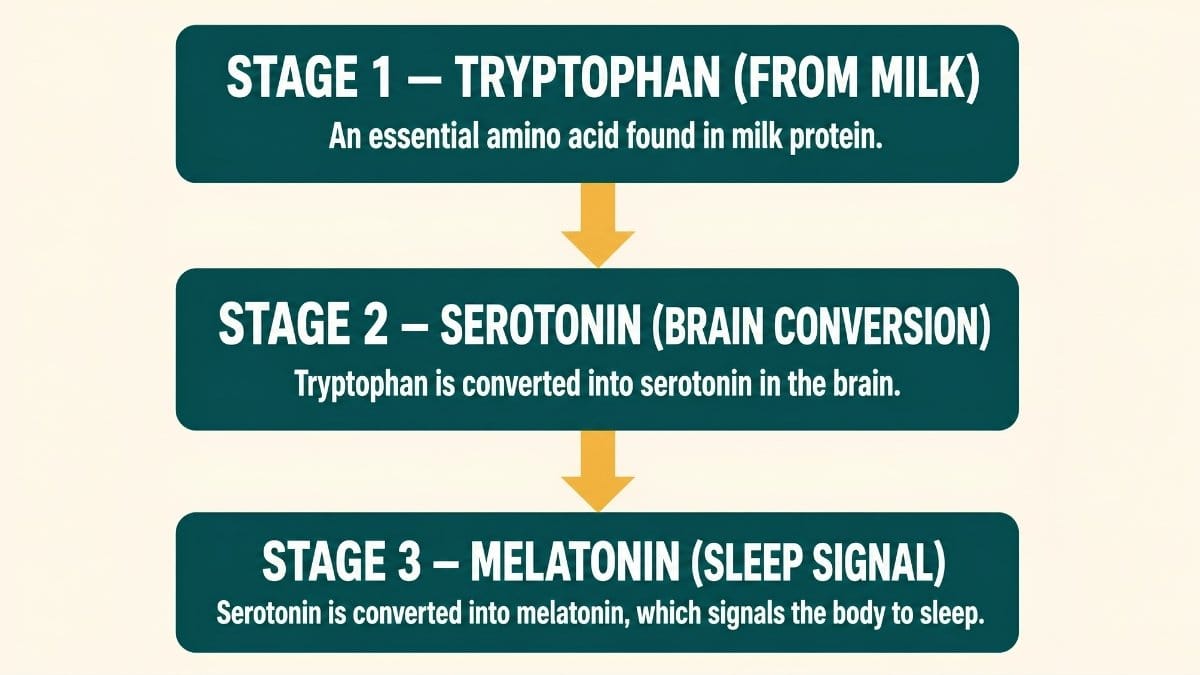
Warm milk contains the raw material that starts that process. Tryptophan (an essential amino acid the body cannot make on its own and must get from food) is present in cow’s milk.⁸
Once it reaches the brain, the body converts it first into serotonin (a chemical messenger in the brain that regulates mood and helps the body prepare for sleep), and then into melatonin (a hormone released by the pineal gland that signals the brain and body that it is time to sleep).²
That chain from tryptophan to melatonin is the sleep mechanism.
If you want to know what tryptophan actually does once it arrives, the evidence in adults aged 55 to 75 points to three specific changes: less time to fall asleep, fewer nighttime awakenings, and better overall sleep efficiency.²
The study population was middle-aged to older adults, and the tryptophan was delivered through enriched cereal rather than plain milk, so the finding applies to the mechanism rather than to the glass itself.
The tryptophan in your glass of warm milk is probably losing a footrace to the amino acids left over from your dinner. That footrace is the reason the remedy fails so often, and the next section explains exactly how it works.
The Hidden Blocker: Why What You Ate for Dinner Matters
You drank the milk an hour after dinner. The chicken and rice felt light enough. But tryptophan doesn’t care how light dinner felt. It cares what was still circulating in your blood when you swallowed the warm milk.

Tryptophan is what researchers call a large neutral amino acid (one of a group of amino acids that are similar enough in size and shape that they share the same entry point into the brain).³
Five others share that entry point: leucine, isoleucine, valine, phenylalanine, and threonine.³ When protein-rich food raises blood levels of all of them at once, tryptophan gains no advantage. It competes with a crowd and often loses.³
A small carbohydrate changes the math entirely. Research suggests that eating a small amount of carbohydrate alongside warm milk prompts an insulin (a hormone released by the pancreas that moves sugar and certain amino acids from the blood into muscle cells) response that pushes competing amino acids into muscle.³
Because tryptophan circulates bound to a protein called albumin rather than free in the blood, it is not taken up the same way.³ The competition clears. Tryptophan’s share of the available entry points rises.³
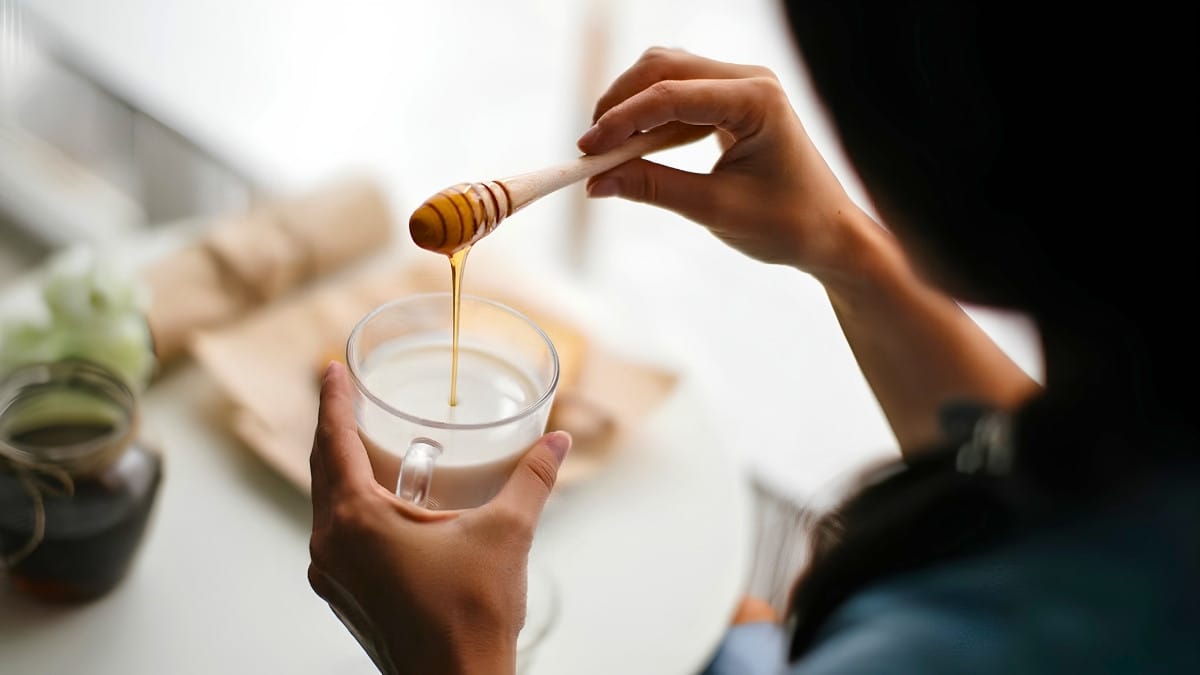
This is not a large intervention. A teaspoon of honey stirred into the milk, or a plain cracker on the side, is enough.³ The timing matters more than the amount.
The setup that makes warm milk actually work:
- Drink warm milk at least two hours after a high-protein meal
- Add one teaspoon of honey or eat one plain cracker alongside
- Skip the high-protein bedtime snack — cheese, peanut butter, and meat all raise competing amino acid levels
- Keep the carbohydrate small — the goal is the insulin response, not a large meal
The carbohydrate pairing opens the door for tryptophan. But milk contains a second compound that works on an entirely different pathway, and most articles about warm milk never mention it.
The Second Active Ingredient Almost Nobody Mentions
Many people assume the story ends with tryptophan. It doesn’t.
When you digest milk, the casein protein breaks apart into fragments that may quietly support sleep on their own.
The protein in milk, specifically a protein called casein (the primary protein in cow’s milk, making up roughly 80% of its protein content), releases small active fragments during digestion that may support sleep in a different way.⁴
Casein tryptic hydrolysate (a mixture of short protein fragments released when the digestive enzyme trypsin breaks down casein in the stomach) has been studied for its calming and sleep-supporting properties.⁴
In a study using mice, casein tryptic hydrolysate was associated with increased sleep duration and altered brain wave patterns consistent with deeper sleep, with effects appearing to work through the brain’s calming receptor system.⁴ Human application has not been confirmed.
The most studied fragment is alpha-casozepine (a ten-unit protein piece from casein, named because its calming effect in animals resembles the action of benzodiazepine-class drugs at very low doses).⁴
Animal research suggests it binds to the same receptor site in the brain that anti-anxiety medications target.⁴ No strong human trial has confirmed that drinking a glass of milk produces the same effect.
Casein peptides are the second mechanism in the glass. Their confirmed evidence is weaker than tryptophan’s, but the biology is plausible and researchers are actively studying it.
The warmth of the milk, the third mechanism, is better established than most people expect.
The Warmth Itself Is Part of the Mechanism
Drinking something warm before bed feels comforting. That feeling turns out to have a physical explanation.
There’s a physical reason you feel drowsy after a warm drink. Falling asleep requires your body’s core temperature to drop.⁵
Research suggests the brain monitors this drop and uses it as a signal to initiate sleep.⁵ Warm liquid hitting the stomach temporarily redirects blood toward the skin surface, a process called vasodilation (widening of blood vessels near the skin that allows heat to escape from the body’s core into the surrounding air).⁵
As heat escapes through the hands and feet, core temperature falls faster.⁵ Research suggests the brain interprets that drop as the cue to begin sleep.⁵
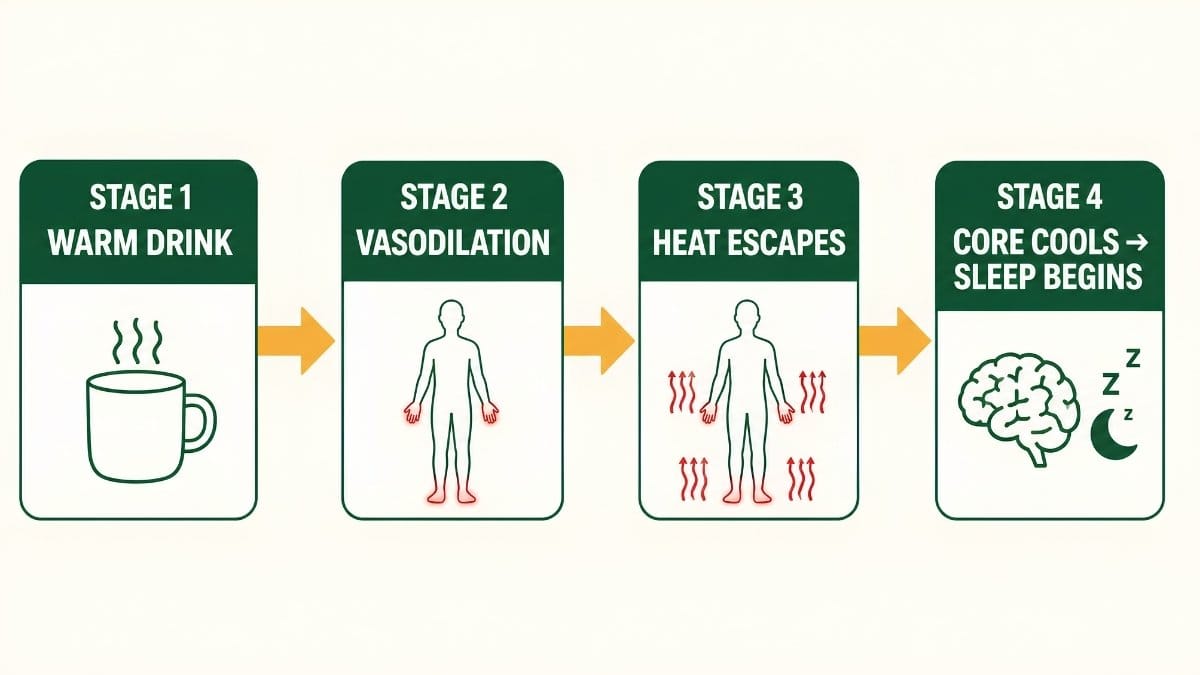
The numbers back this up. A 2019 meta-analysis of 13 human trials found that warm water contact with the body one to two hours before sleep was associated with approximately a 36% reduction in the time it took participants to fall asleep.⁵
The researchers identified vasodilation-driven core cooling as the mechanism.⁵
The glass of warm milk is doing a smaller version of what a warm bath does. It doesn’t cover as much skin, and the effect is briefer, but the direction is the same: warmth in, heat out, core cools, sleep follows.
All three mechanisms are now on the table. The final section puts them together into a protocol you can use tonight.
How to Make Warm Milk Work Tonight
You don’t need a different brand of milk. The approach matters more than the brand.
Time it right. Drink warm milk at least two hours after a high-protein meal. The competing amino acids need time to clear from the bloodstream.
Pair with a small carbohydrate. One teaspoon of honey stirred in, or a plain cracker on the side, may prompt the insulin response that opens the brain’s entry point for tryptophan.³ This is the step most people skip.
Keep it warm, not boiling. Excessively high heat can degrade tryptophan content in milk.⁶ Warm enough to hold comfortably in both hands is the right temperature.
Be consistent. Research in adults with sleep difficulties found that tryptophan delivered in a milk vehicle nightly over 90 days was associated with improved subjective sleep quality across multiple measures.⁷ One glass is not a drug dose. Repetition builds the effect.
Final Words
Make warm milk the right way tonight: pair it with a small amount of honey or a plain cracker, and drink it at least two hours after your last protein-heavy meal. The amino acids from dinner are the thing most people never think to manage, and that one change is what separates a placebo from a protocol.
References
- National Center for Health Statistics. Short Sleep Duration and Sleep Difficulties Among Adults: United States, 2024. CDC/NCHS Data Brief No. 559. Published April 2026. https://www.cdc.gov/nchs/products/databriefs/db559.htm
- Bravo R, Matito S, Cubero J, Paredes SD, Franco L, Rivero M, Rodríguez AB, Barriga C. Tryptophan-enriched cereal intake improves nocturnal sleep, melatonin, serotonin, and total antioxidant capacity levels and mood in elderly humans. Age (Dordr). 2013 Aug;35(4):1277-85. Population: adults aged 55-75 years, n=35. https://pubmed.ncbi.nlm.nih.gov/22622709/
- Wurtman RJ. Recent research on the behavioral effects of tryptophan and carbohydrate. Nutrition Reviews. 1986;44(2):51-60. General mechanistic review of tryptophan, large neutral amino acids, insulin, and blood-brain barrier competition. https://pubmed.ncbi.nlm.nih.gov/6400041/
- Dela Peña IJI, Kim HJ, de la Peña JB, Kim M, Botanas CJ, You KY, Woo T, Lee YS, Jung JC, Kim KM, Cheong JH. A tryptic hydrolysate from bovine milk as1-casein enhances pentobarbital-induced sleep in mice via the GABAA receptor. Behavioural Brain Research. 2016 Oct 15;313:184-190. ANIMAL STUDY: ICR mice. Human application not confirmed. https://pubmed.ncbi.nlm.nih.gov/27401107/
- Haghayegh S, Khoshnevis S, Smolensky MH, Diller KR, Castriotta RJ. Before-bedtime passive body heating by warm shower or bath to improve sleep: A systematic review and meta-analysis. Sleep Medicine Reviews. 2019 Aug;46:124-135. Meta-analysis of 13 human trials. https://pubmed.ncbi.nlm.nih.gov/31102877/
- Kvitkovskaya NP, Ischenko VM, Kochubei-Lytvynenko OV, Ischenko MV. Determination of tryptophan in milk. 2023. Research on tryptophan content across milk samples with varying heat treatment methods. https://agris.fao.org/search/en/records/675ac1440ce2cede71d04a72 [NEEDS VERIFICATION — full journal citation not confirmed by search]
- Pérez-Piñero S, Muñoz-Carrillo JC, Echepare-Taberna J, et al. Effectiveness of Enriched Milk with Ashwagandha Extract and Tryptophan for Improving Subjective Sleep Quality in Adults with Sleep Problems: A Randomized Double-Blind Controlled Trial. Clocks & Sleep. 2024;6(3):28. Population: healthy adults with sleep problems, n=52. Note: study used milk enriched with ashwagandha and added tryptophan, not plain warm milk. https://www.ncbi.nlm.nih.gov/pmc/articles/PMC11348217/
- U.S. Department of Agriculture, Agricultural Research Service. FoodData Central. Tryptophan content, whole milk. https://fdc.nal.usda.gov/