

Eggs for breakfast. Fish twice a week. Chicken on Sunday. Then a blood test shows low B12, and your doctor asks what you eat. The plate looks perfect.
This happens more often than most people expect. With vitamin B12 after 50, the gap often opens in the stomach. You may feel tired, notice tingling in your feet, or lose words more often. Many people blame age and move on. Those signs have many causes, and low B12 is one worth checking.
Age changes how your body handles the B12 in food. Some common medicines add to the problem. Follow the B12 from your plate to your blood, and you can see where it gets lost.
Why Food-Bound B12 Is Harder to Absorb as You Age
Your body needs B12 to build red blood cells and keep nerves working. The vitamin in meat, fish, and eggs comes attached to protein. Your stomach must pull it free before your body can absorb it. That step needs acid.
B12 After 50: Why Levels Slip
The NIH Office of Dietary Supplements reports a common problem.
Less acid means less B12 reaches your blood.
Less Stomach Acid, Less B12
Many older adults do not make enough stomach acid to free the B12 in food. Less acid means less B12 reaches your blood. Your diet can look fine on paper while your levels slip.
A Different Path
Supplements and fortified foods follow a different path. Their B12 is already free of protein. That skips the step that often fails with age.
NIH Advice for Adults Over 50
NIH advises adults over 50 to get most of their B12 from fortified foods or supplements. A September 2026 digest from the same office repeated that advice.
Deficiency Estimates
NIH puts deficiency in older adults anywhere from 3% to 43%. Studies use different tests and groups, so estimates differ a lot. Either way, the risk is real.
This explains why eating more meat and eggs does not always raise levels. More food-bound B12 meets the same low acid. Meat and eggs still count. After 50, they may need backup.
This week, check your breakfast cereal label for added B12. Age is one piece of the puzzle, though. Some common medicines add to the risk.
Medications and Conditions That Raise the Risk Further
A 2025 literature review of older patients links three common drug types to low B12. Two are acid reducers for heartburn: proton pump inhibitors (PPIs) and H2 blockers. The third is metformin, a common diabetes drug. The review found that taking them together raises the risk further.
Acid reducers lower stomach acid, so less B12 comes free from food. The review notes that PPIs do this by blocking the stomach’s acid pump. Metformin works another way.
A pharmacy study on PubMed Central describes the leading theory. Researchers think metformin disrupts a calcium-dependent step that helps B12 attach to its gut receptor. The same study says the risk grows with dose and years of use.
A 2025 paper in the journal Diseases analyzed U.S. Food and Drug Administration adverse-event reports. It focused on metformin and PPIs taken together. Its author concluded that older adults on both may face a higher risk of serious B12-related problems.
The evidence has limits. A 2015 systematic review of PPI studies in older adults found four small studies linking long-term use to B12 deficiency. One case-control study found no link. The FDA analysis flags a possible link, but it cannot prove cause.
The pharmacy study found that most patients on both drugs had no B12 level on record. It did not support routine checks for most people with four years or less of use. Longer use and new symptoms are good reasons to ask.
Pernicious anemia is a different cause. This autoimmune disease stops the body from making intrinsic factor, a stomach protein that B12 needs for absorption. NIH says people with it struggle to absorb B12 from both food and supplements.
Mayo Clinic also lists stomach surgery, celiac disease, and Crohn’s disease as risk factors.
A hypothetical 68-year-old shows how this can slip by. She has taken metformin and a PPI for six years. Her diet is good. Nobody has checked her B12. She mentions mild tingling in her feet and calls it age.

Never stop a prescribed medicine on your own. Instead, list every medicine you take, including over-the-counter acid reducers. Bring that list to your next visit. Then ask whether a B12 check makes sense. A normal result may not settle the question, as the next section shows.
Why a “Normal” Blood Level Can Still Mislead
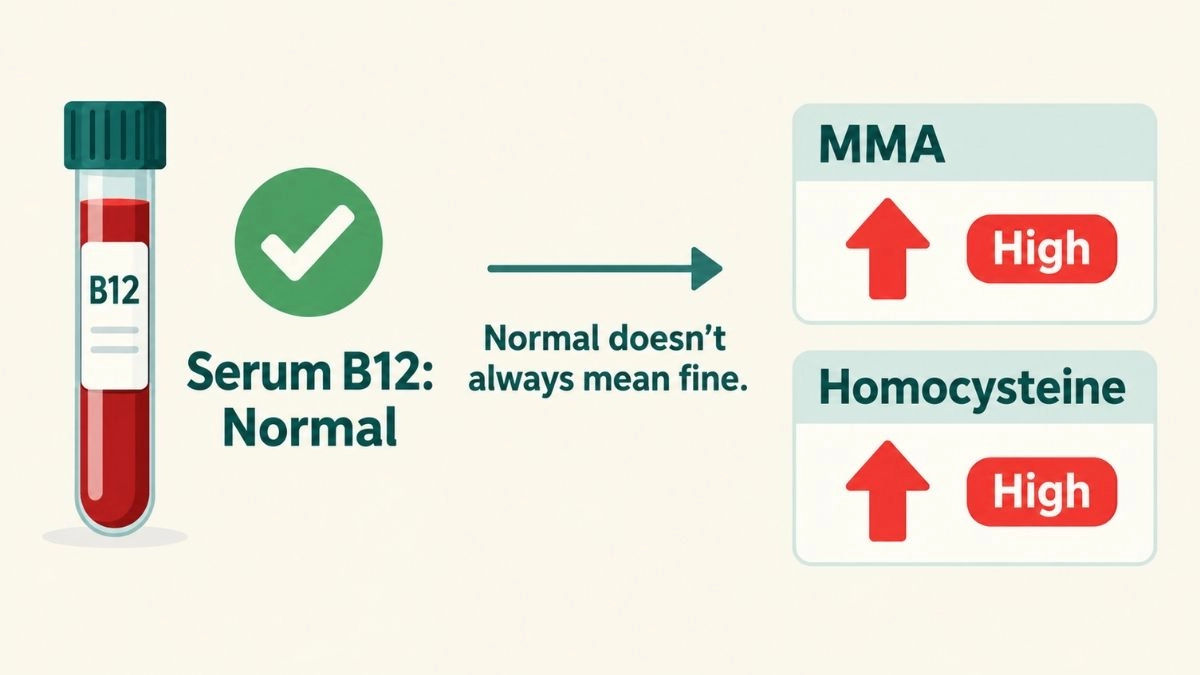
Doctors often start with a serum B12 test, the standard blood measure. A 2003 review in American Family Physician looked at its limits. It found that serum B12 alone may miss up to half of people whose tissues run low on B12.
Two other tests can help. Methylmalonic acid (MMA) and homocysteine rise early when B12 runs short. The same review describes a study of 406 patients with known deficiency. In it, 98.4% had high MMA. MMA is also more specific, since low folate can raise homocysteine too.
The same review notes that older adults often show nerve or thinking problems without any change in blood counts. Signs can include fatigue, tingling, memory lapses, and trouble walking. Many other conditions cause these signs too.
A 2024 case report in the Food and Nutrition Bulletin shows how this plays out. It describes two older patients with severe fatigue, memory and thinking problems, and trouble walking.
One woman’s active B12 test read as normal. Her homocysteine and MMA came back high. That confirmed her diagnosis. I find that case worth remembering, because the first result looked reassuring.
If your B12 result is borderline, ask your doctor about an MMA test. Labs set different cutoffs, so ask what your number means. Keep a symptom note for two weeks. Write down tingling, balance trouble, or memory slips, with dates.
Once you know where you stand, the next step is choosing how to raise your levels.
What Actually Works: Fortified Foods, Supplements, and Injections
Note: If you take medication or have a health condition, ask your doctor or pharmacist first. Do this before you add a supplement or change your diet.
The B12 in fortified foods and supplements comes free of protein, so low stomach acid matters less. NIH says most adults over 50 can absorb B12 from these sources. Supplements still need intrinsic factor to work. People with pernicious anemia need a doctor’s plan.
B12 Intake
RDA, absorption and supplements
Official RDA
The US adult RDA is 2.4 mcg a day.
Older Adults
Mayo Clinic says older adults may need 10 to 12 mcg to get enough. That figure reflects weaker absorption. It does not raise the official RDA.
Supplements
Some supplements contain 1,000 mcg. Your body absorbs only a small share of that.
No Harm Found
NIH says research has found no harm from B12, even at high doses.
NIH says B12 comes in multivitamins, B-complex products, and stand-alone pills, often as cyanocobalamin. Check the label on yours and write down the amount. Bring it to your next appointment so your doctor can match the dose to your needs.
When tests confirm a deficiency, doctors may use pills or injections. A 2018 Cochrane review compared the two. Only one of its trials had a low or unclear risk of bias.
One trial gave 2,000 mcg of oral B12 daily. In it, serum levels ran 680 pg/mL higher with pills than with shots, on average. No trial reported on symptoms.
A 2022 clinical inquiry in American Family Physician reached a similar view. It found that pills and shots perform about the same for restoring blood levels over one to four months. It graded the evidence C, the lowest level on its scale.
Do not switch from injections to pills on your own. A Tools for Practice review published by the College of Family Physicians of Canada suggests a recheck after switching to oral B12. Your doctor will choose the form that fits your cause and your symptoms.
NIH also says researchers need more trials on B12 and thinking in older adults. So use B12 to correct a shortage. Do not count on it to sharpen memory.
Keep eating meat, fish, and eggs. Their B12 still counts toward your intake. Add one fortified food, or a supplement your doctor approves, on top.
A healthy plate and a low B12 number can both be true. You have already done the hard part by paying attention. This week, message your doctor and ask whether a B12 check fits you. Bring a list of every medicine you take. One short conversation can turn a guess into an answer.
References
- NIH Office of Dietary Supplements. Vitamin B12 Fact Sheet for Consumers: https://ods.od.nih.gov/factsheets/VitaminB12-Consumer/
- NIH Office of Dietary Supplements. Vitamin B12 Consumer Fact Sheet (PDF): https://ods.od.nih.gov/pdf/factsheets/vitaminb12-consumer.pdf
- NIH Office of Dietary Supplements. ODS Digest, September 2, 2026: https://ods.od.nih.gov/News/odsdigest20260902.aspx
- Risk of Vitamin B12 Deficiency Associated with Proton Pump Inhibitors, Metformin, and H2 Blockers in Geriatric Patients: A Polypharmacy Perspective (2025): https://ejim.springeropen.com/articles/10.1186/s43162-025-00516-8
- Vitamin B12 Deficiency Associated with Metformin and Proton Pump Inhibitors and Their Combinations, Diseases (2025): https://www.mdpi.com/2079-9721/13/10/334
- Chappell L, Brown SA, Wensel TM. Evaluation of Vitamin B12 Monitoring in Patients on Concomitant Metformin and Proton Pump Inhibitors. Innovations in Pharmacy, via PubMed Central: https://pmc.ncbi.nlm.nih.gov/articles/PMC8127105
- Au M, Power J, Gilmore D. Proton Pump Inhibitors and Vitamin B12 Deficiency in Older Adults: A Systematic Review of Clinical Studies. Annals of the Australasian College of Tropical Medicine (2015): https://researchonline.jcu.edu.au/40572/
- American Family Physician. Vitamin B12 Deficiency (2003): https://www.aafp.org/pubs/afp/issues/2003/0301/p979.html
- Vitamin B12 Deficiency-Induced Neuropathy and Cognitive and Motor Impairment in the Elderly: A Case Study, Food and Nutrition Bulletin (2024): https://pubmed.ncbi.nlm.nih.gov/38987880/
- Mayo Clinic. Vitamin B-12: https://www.mayoclinic.org/drugs-supplements-vitamin-b12/art-20363663
- Wang H, et al. Oral Vitamin B12 Versus Intramuscular Vitamin B12 for Vitamin B12 Deficiency, Cochrane Database of Systematic Reviews (2018): https://pubmed.ncbi.nlm.nih.gov/29543316/
- American Family Physician. Clinical Inquiry: Oral vs. Intramuscular Vitamin B12 (2022): https://www.aafp.org/pubs/afp/issues/2022/0600/p663.pdf
- Tools for Practice #19, Vitamin B12 Deficiency: Monthly Shots or Daily Pills? College of Family Physicians of Canada (CFPCLearn): https://cfpclearn.ca/tfp19