In 2000, the average life included 8.5 years of illness or disability. By 2019, it included 9.6 years. A Mayo Clinic study of 183 countries, published in JAMA Network Open in 2024, found that the gap grew 13 percent. People gained years. The extra years are real, but their quality is the open question.
That gap shapes the final decades of life. It separates the person who still walks the dog at 80 from the person who needs help climbing the stairs. Your genes play a part. Your habits play a part. This article shows how much each one counts and where to start, so living well becomes a plan, not a hope.
The Extra Years Are Not Always Good Years
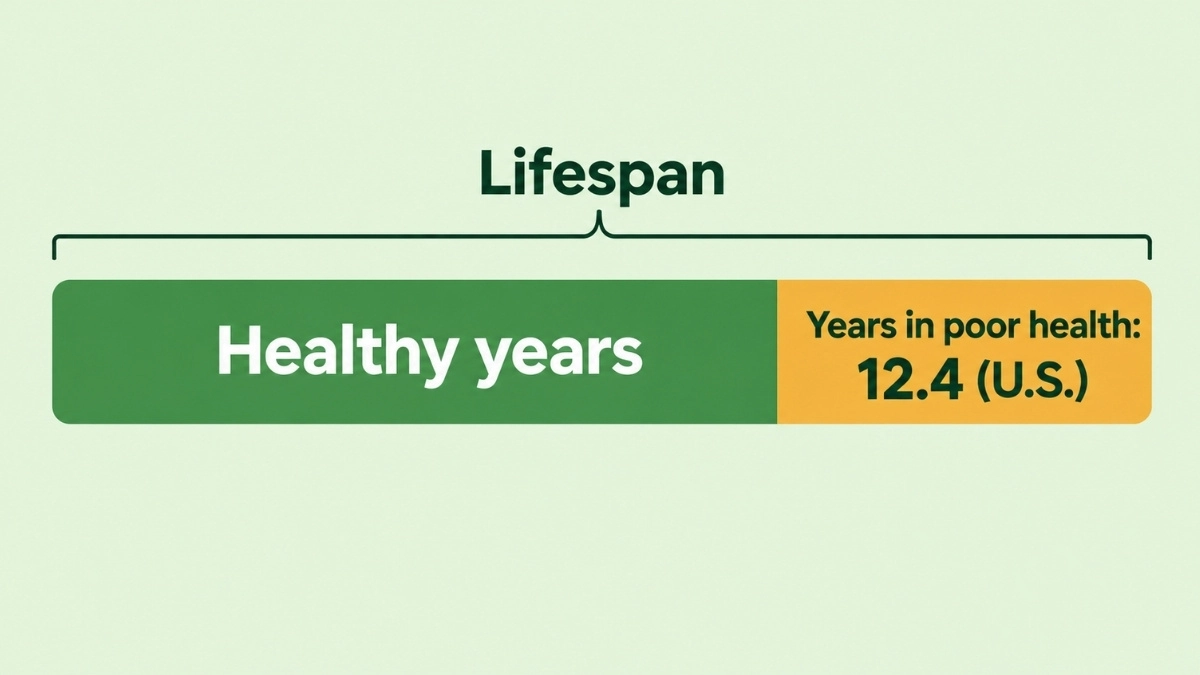
Lifespan vs Healthspan
The two are not the same.
Lifespan
Lifespan counts the years you live.
Healthspan
Healthspan counts the years you live in good health.
Not the Same
The two are not the same. Now they drift apart. The difference is time spent with illness or disability.
Lifespan counts the years you live. Healthspan counts the years you live in good health. The two are not the same. Now they drift apart. The difference is time spent with illness or disability.
Armin Garmany and Andre Terzic of the Mayo Clinic measured that drift. They used World Health Organization data. For each country, they subtracted healthy life expectancy from total life expectancy. The result is the number of years lived in poor health.
The United States has the widest gap at 12.4 years. The authors tied it to a rise in chronic disease. Women face a gap 2.4 years wider than men. These numbers describe whole populations, not any one person, so your own path can look very different.
Take a composite example that draws on common patterns, not one real person. A 58-year-old manager feels fine. Her mother lived to 91 but spent nine of those years with heart failure and a walker. She wants to know whether she is headed the same way.
Her real question is how much of that story her genes already wrote.
What Your Genes Decide, and What They Leave Open
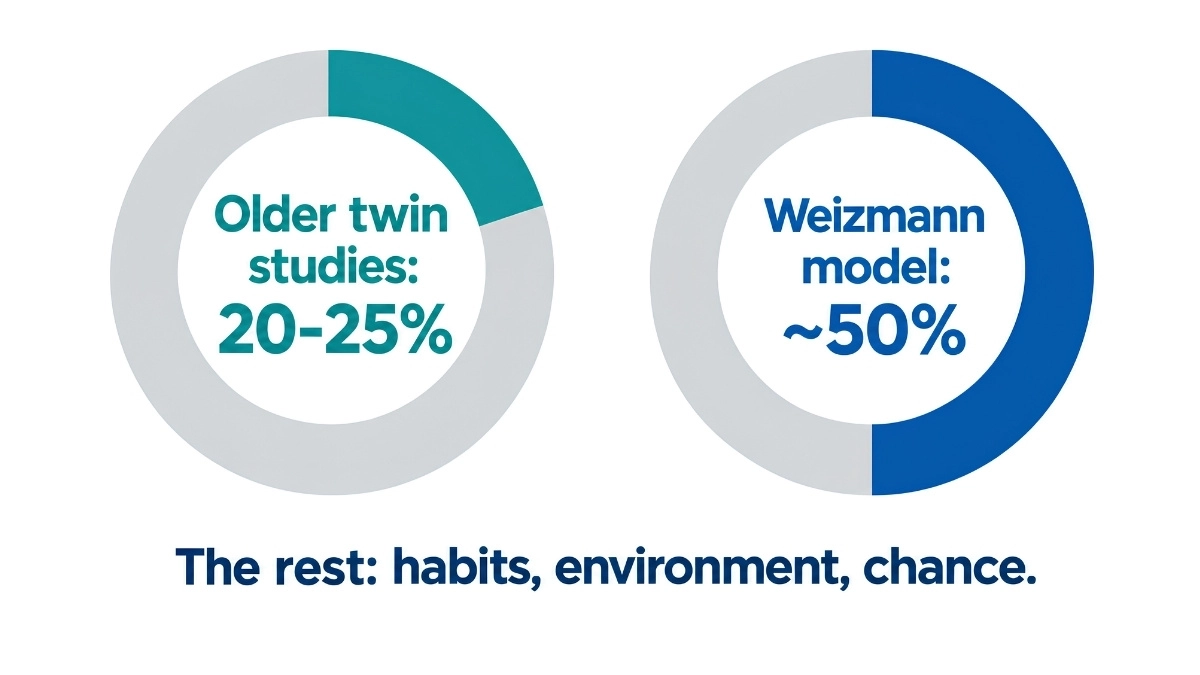
Genes matter, and the science on how much has shifted. According to Scientific American, twin studies for decades put the genetic share of lifespan at about 20 to 25 percent. A recent Weizmann Institute study in Science raised that estimate to roughly 50 to 55 percent.
The team separated deaths from outside causes, such as accidents and infection, from deaths that aging itself causes. In their model, removing outside causes about doubled the genetic share.
Other experts urge caution. Kaare Christensen of the Danish Twin Research Center told Scientific American that real people die from both kinds of causes. So the two estimates measure different things. Live Science reported that it remains unclear whether the estimate holds across diverse groups.
Heritability does not mean destiny. It describes patterns across large groups, not what will happen to you. The other half comes from habits, environment, and chance.
No single gene switches long life on or off. Many genes each add a small push. So two people with the same family history can age very differently.
Family history tells you where you start. A parent’s early heart disease is a reason to act sooner, not a verdict. Habits shape much of what happens next. The next section shows which habits carry the most proof.
Five Habits That Moved the Numbers
Some of the best-known evidence comes from Harvard. In 2018, researchers at the Harvard T.H. Chan School of Public Health published a study in Circulation. It followed about 123,000 adults for about 30 years.
The study tracked five habits. They were a healthy diet, regular exercise, a healthy weight, moderate alcohol, and no smoking. At age 50, women who kept all five lived about 14 more years than women who kept none. For men, the gain was about 12 years.
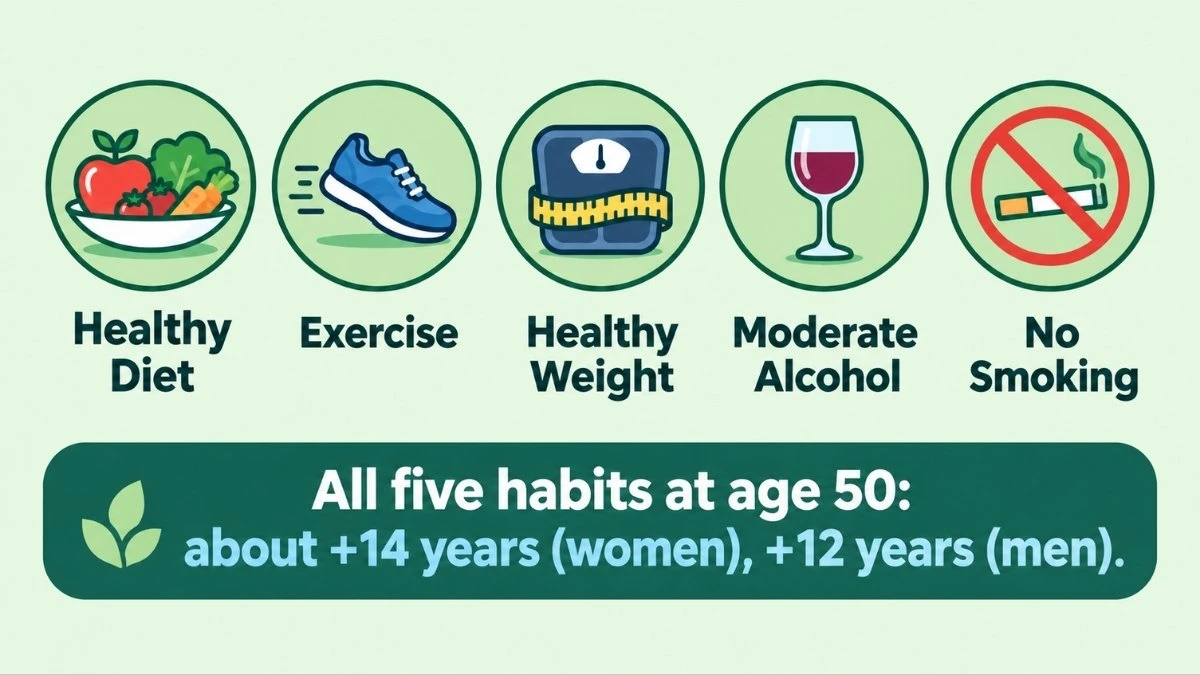
Those who kept all five also had a 74 percent lower risk of death during the study. Frank Hu, the senior author, noted that adherence to these habits is very low.
The 12 and 14 year gains compare people with all five habits to people with none. Most of us sit in between. Moving from two habits to three does not promise 14 years. It still points you the right way.
Length of life is only half the question. A 2020 follow-up in the BMJ looked at years free of diabetes, heart disease, and cancer. Men who kept four or five habits at age 50 lived 31.1 disease-free years. Men with none lived 23.5 years.
Shared Biology & Disease-Free Life
Shortest Disease-Free Lives
Men who were heavy smokers, and men and women with obesity, had the shortest disease-free lives.
Shared Biological Impact
These habits work on shared biology, shaping blood vessel health, blood sugar, and body fat.
Resulting Conditions
Those three factors feed heart disease, diabetes, and some cancers.
Men who were heavy smokers, and men and women with obesity, had the shortest disease-free lives. These habits work on shared biology. They shape blood vessel health, blood sugar, and body fat. Those three feed heart disease, diabetes, and some cancers.
The Mayo gap and the Harvard habits meet at one point. Mayo’s team tied the widest gap, in the United States, to chronic disease. These habits target chronic disease.
Keep the limits in mind. These studies are observational, and the participants were mostly white health professionals. They show a strong link, not a guaranteed gain for any one person.
NIH’s summary of the study notes that each habit lowered the risk of death on its own. That suggests even one change counts.
Where to Start This Month
Note: If you have a health condition or take medication, speak with your doctor before changing how you exercise, eat, or drink alcohol.
Start with a simple score. Check each of the five habits and mark which ones you already keep. Those habits are a healthy diet, regular movement, a steady weight, limited drinking, and no tobacco. Then pick the one that feels both important and doable. Choose one habit for the month, not five.
In these studies, moderate drinking meant up to one drink a day for women and two for men. If you do not drink, these results are not a reason to start.
If you smoke, ask your doctor about quitting support first. If you do not smoke, movement is a practical place to begin.
The CDC advises adults to build toward 150 minutes of moderate activity each week, with muscle strengthening on two days. Adults 65 and older should add balance exercises. Brisk walking counts.

Back to our composite 58-year-old. She does not smoke and eats well, but she sits most of the day. She starts with a 10-minute walk after dinner. Each week she adds five minutes. By week five, she walks 30 minutes a day.
Pick a fixed time, such as right after dinner. A fixed time gives the habit an anchor. Then write the habit on your calendar.
Conclusion
Nobody gets to pick every part of how they age. You still get to pick more than you were told. This week, tell one person which habit you chose, and ask them to check in on you. Then take the first small step. Ordinary days build good years, and you have plenty of them ahead.
References
- Garmany A, Terzic A. Global Healthspan-Lifespan Gaps Among 183 World Health Organization Member States. JAMA Network Open. 2024;7(12):e2450241. https://doi.org/10.1001/jamanetworkopen.2024.50241
- Li Y, et al. Impact of Healthy Lifestyle Factors on Life Expectancies in the US Population. Circulation. 2018;138(4):345–355. https://doi.org/10.1161/CIRCULATIONAHA.117.032047
- Li Y, et al. Healthy lifestyle and life expectancy free of cancer, cardiovascular disease, and type 2 diabetes: prospective cohort study. BMJ. 2020;368:l6669. https://doi.org/10.1136/bmj.l6669
- Shenhar B, et al. Heritability of intrinsic human life span is about 50% when confounding factors are addressed. Science. 2026;391(6784):504–510. https://doi.org/10.1126/science.adz1187
- Mayo Clinic News Network, “The global divide between longer life and good health”: https://newsnetwork.mayoclinic.org/discussion/the-global-divide-between-longer-life-and-good-health/
- JAMA Network Open media release via Scimex: https://www.scimex.org/newsfeed/we-are-living-longer-but-the-gap-between-our-lifespan-and-our-healthspan-is-getting-bigger
- Scientific American, “How long you live may depend much more on your genes than scientists thought”: https://www.scientificamerican.com/article/how-long-you-live-may-depend-much-more-on-your-genes-than-scientists-thought
- Live Science, “Lifespan may be 50% heritable, study suggests”: https://www.livescience.com/health/ageing/lifespan-may-be-50-percent-heritable-study-suggests
- NIH Research Matters, “Healthy habits can lengthen life”: https://www.nih.gov/news-events/nih-research-matters/healthy-habits-can-lengthen-life
- Harvard Gazette, “5 healthy habits may offer years free of chronic diseases”: https://news.harvard.edu/gazette/story/2020/01/5-healthy-habits-may-offer-years-free-of-chronic-diseases
- The Boston Globe, “Harvard researchers say these habits can keep you healthy longer”: https://www.bostonglobe.com/2020/01/09/metro/harvard-researchers-say-these-habits-can-keep-you-healthy-longer
- CDC, “Adult Activity: An Overview”: https://www.cdc.gov/physical-activity-basics/guidelines/adults.html
- CDC, “What Counts as Physical Activity for Older Adults”: https://www.cdc.gov/physical-activity-basics/adding-older-adults/what-counts.html