
You lift on Tuesday and again on Friday. Then a friend at the gym tells you two days is not enough. Doubt creeps in. I hear this worry often from adults in their late 50s. They train twice a week, yet they wonder if they are wasting their time. That doubt can push people to quit for good.
Mayo Clinic gives a clear answer, but two small words change how you should read it. Strength training after 50 does not need a fancy plan or a daily grind. It does need the right dose. Below, I cover what Mayo says, what the trials show, and who may need more than two sessions.
What Mayo Clinic Actually Says About Twice a Week
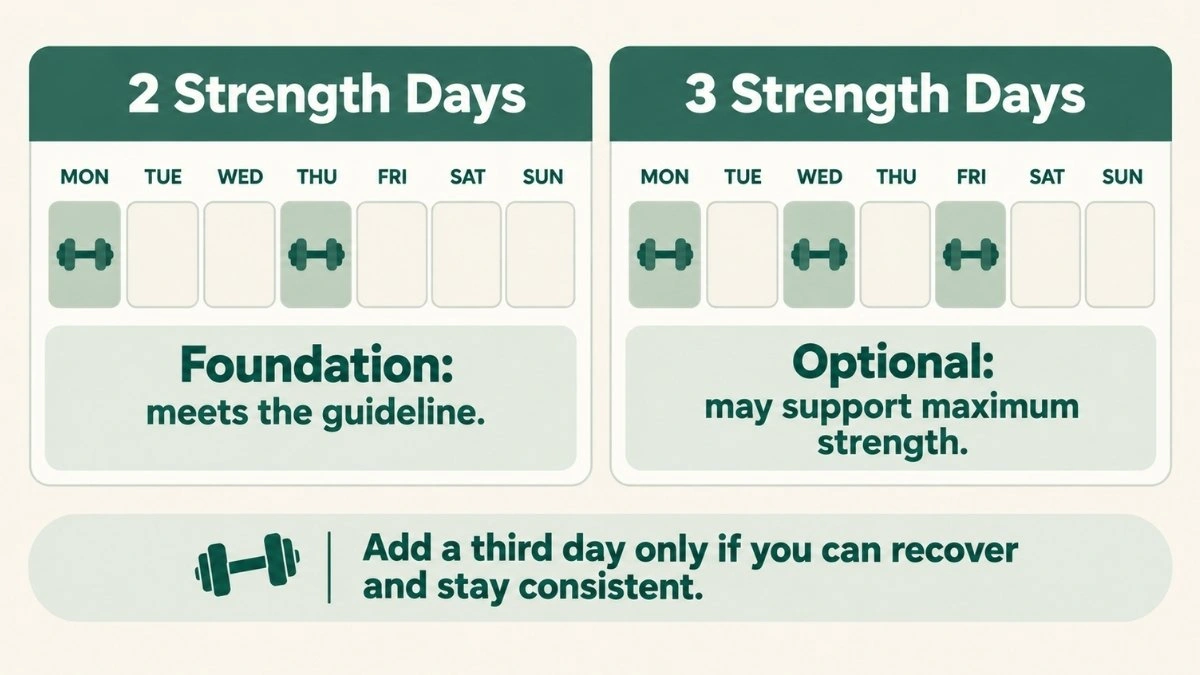
Mayo Clinic’s strength training guide says you may notice stronger muscles with at least two sessions a week. Each session can run about 20 to 30 minutes. The words “at least” matter most. Mayo names the minimum dose, not the ceiling.
Mayo also cites the U.S. Department of Health and Human Services guidelines. They call for strength work on all major muscle groups at least two times a week.
The CDC agrees. Its guidance for adults 65 and older asks for muscle-strengthening on at least 2 days a week. The work should cover your legs, hips, back, belly, chest, shoulders, and arms. The trials tell us whether that number holds up.
What the Research Shows About Training Frequency
Researchers have tested this question for decades. In 1999, Taaffe and colleagues ran a 24-week trial in healthy adults aged 65 to 79. Groups trained one, two, or three days a week. Strength gains in the one-day and two-day groups were similar to the three-day group.
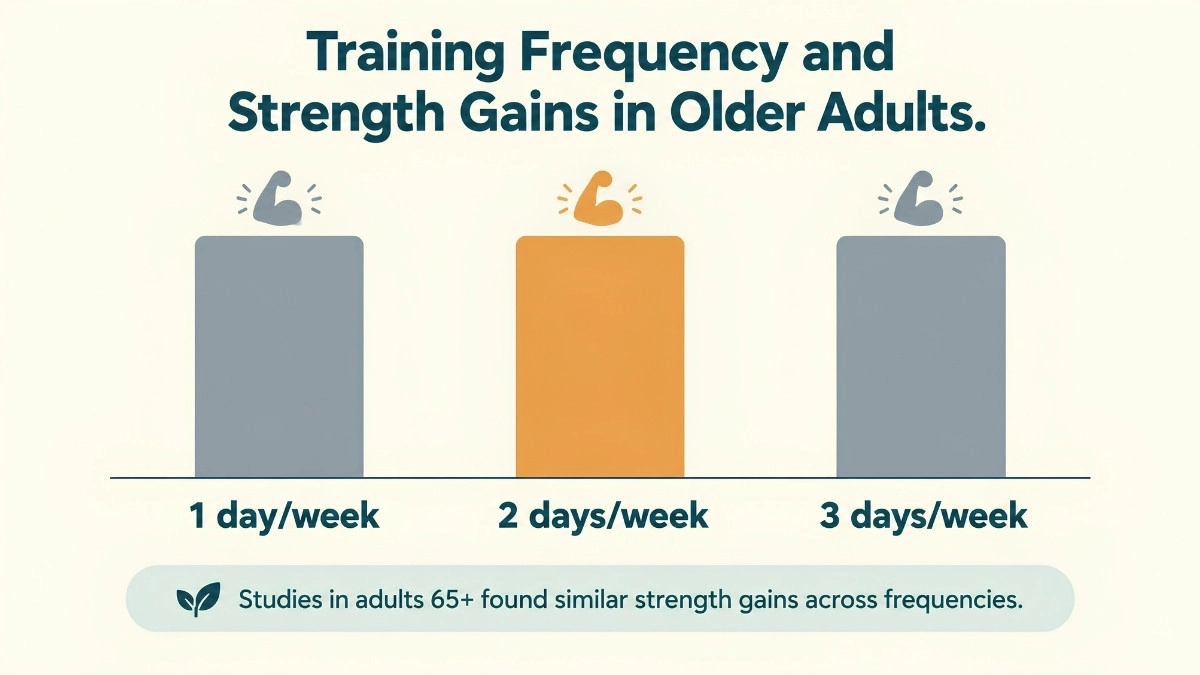
A 2007 trial in the British Journal of Sports Medicine tested 18 adults aged 65 to 79. One group trained once a week and one trained twice. After 9 weeks, strength gains did not differ. The trial was small, so I treat it as a hint, not a final answer.
A 2021 analysis in the Journal of Sports Sciences pooled 14 articles on adults over 60. Muscle growth did not change with training frequency. The authors judged it unlikely that more than two weekly sessions would add benefit.
The 12-Minute Muscle Trial
How minimal lowering-phase exercise impacts strength in older adults
Target Demographic
A randomized trial of 36 adults with an average age of 69 evaluated senior strength maintenance.
The Lowering Method
Focus was placed on lowering-phase exercise (eccentric contraction), moving weights downward under slow control.
Surprising Efficiency
Just one weekly 12-minute session improved muscle function about as well as two weekly sessions.
Important Caveat
Because the training method was unusual, researchers caution it does not prove one session fits every routine.
A 2024 trial in Scientific Reports randomized 36 adults, average age 69, into three groups. One weekly 12-minute session of lowering-phase exercise improved muscle function about as well as two. The training method was unusual, so it does not prove once a week fits every routine.
Most trial participants were 65 or older, so evidence for people in their early 50s is thinner. Still, the pattern holds across these studies. For most healthy adults, the answer is yes. Twice a week is enough to gain strength and meet the guideline. Some goals need more, though.
When Twice a Week May Not Be Enough
That same 2021 analysis found that each extra training day added a small strength gain. If maximum strength is your goal, a third session may help.
The American College of Sports Medicine updated its advice in 2026. Its position stand drew on 137 systematic reviews. It tells healthy adults to train all major muscle groups at least 2 days a week and add more over time. For muscle growth, it points to about 10 sets per muscle group each week.
Adults with sarcopenia, the loss of muscle with age, are a special case. A 2025 network meta-analysis in Frontiers in Physiology pooled trials in this group. It found that two to five sessions a week improved handgrip strength. Two sits at the low end, so ask your doctor or trainer if you need more.
More is not always better. A 2022 analysis by Momma and colleagues in the British Journal of Sports Medicine pooled 16 studies. The largest benefit came at 30 to 60 minutes of muscle-strengthening a week. That level linked to about 10 to 20% lower risk of death, heart disease, and cancer. Gains beyond that were unclear.
These studies tracked people over time, so they show a link, not proof. The authors say that combining strength work and aerobic activity may add even more benefit. Keep your walks, and build two strong sessions around them.

In my conversations with adults in their 50s and 60s, a common pattern shows up. They add a third day out of guilt. Soreness builds, and they skip the next week. Two steady sessions beat three they cannot keep.
Note: If you have a health condition or take medication, talk with your doctor before you start. Adjust the weights to your fitness level, and stop if anything hurts.
How to Make Two Sessions Count
Train your whole body in each session. That way every major muscle group gets two workouts a week. Pick a weight that tires your muscles after 12 to 15 repetitions.
Mayo says the last rep should feel very hard. That is enough work to make a muscle stronger. Start with a chair squat, a wall push-up, and a band row.
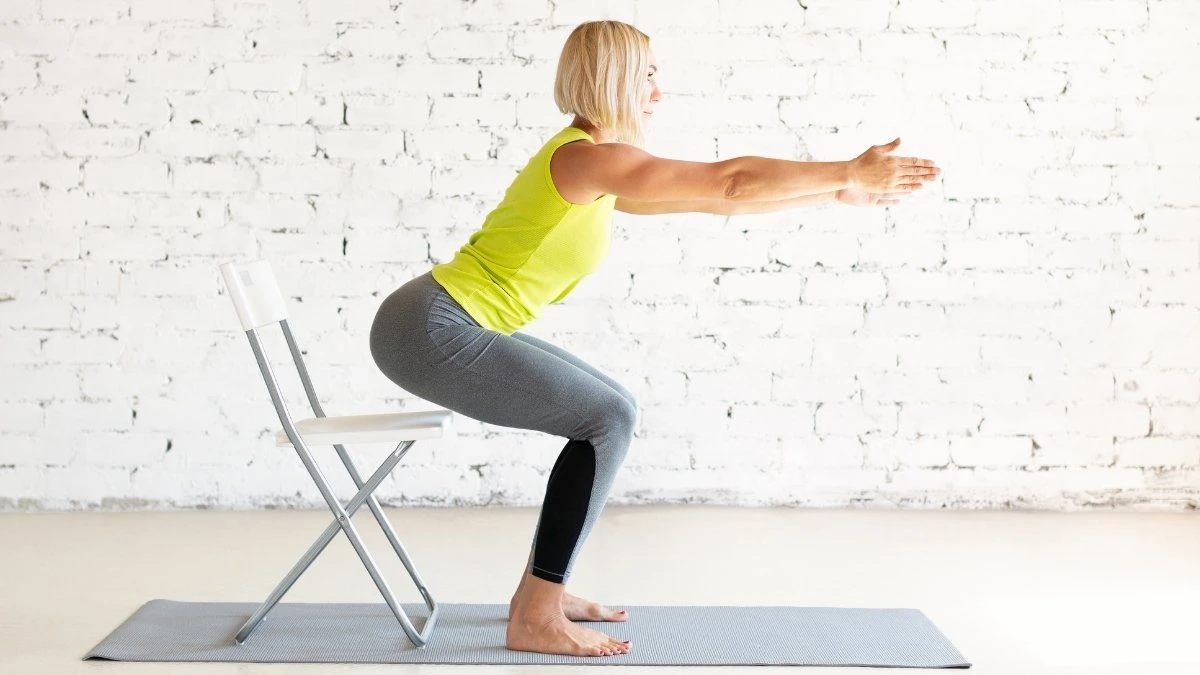
When more reps feel easy, Mayo advises adding weight or resistance in small steps.
Pick two days with a day of rest between them, such as Tuesday and Friday. Mayo says to rest one full day between exercising each specific muscle group. Warm up first with a few minutes of brisk walking.
Keep it simple. Mayo says a single set of 12 to 15 reps with the right weight can build muscle in most people. You do not need an hour. You do not need a gym. Mayo lists body weight, resistance tubing, and water bottles as options.
Many of the adults I advise pick a fixed time, such as 8 a.m. on Tuesday and Friday. A fixed slot removes the daily decision. Before you start, take one safety step.
Who Should Check With a Doctor First
Mayo Clinic says to talk with a healthcare professional before you begin if you have a chronic condition or safety concerns. Conditions such as heart disease or osteoporosis are common reasons to ask first. A doctor can tell you which moves to skip and how heavy to go.
Mild muscle soreness is the most common side effect, according to Mayo’s patient guide. Sharp pain is different. Stop any exercise that causes pain. Mayo suggests a lower weight, or trying the move again in a few days.
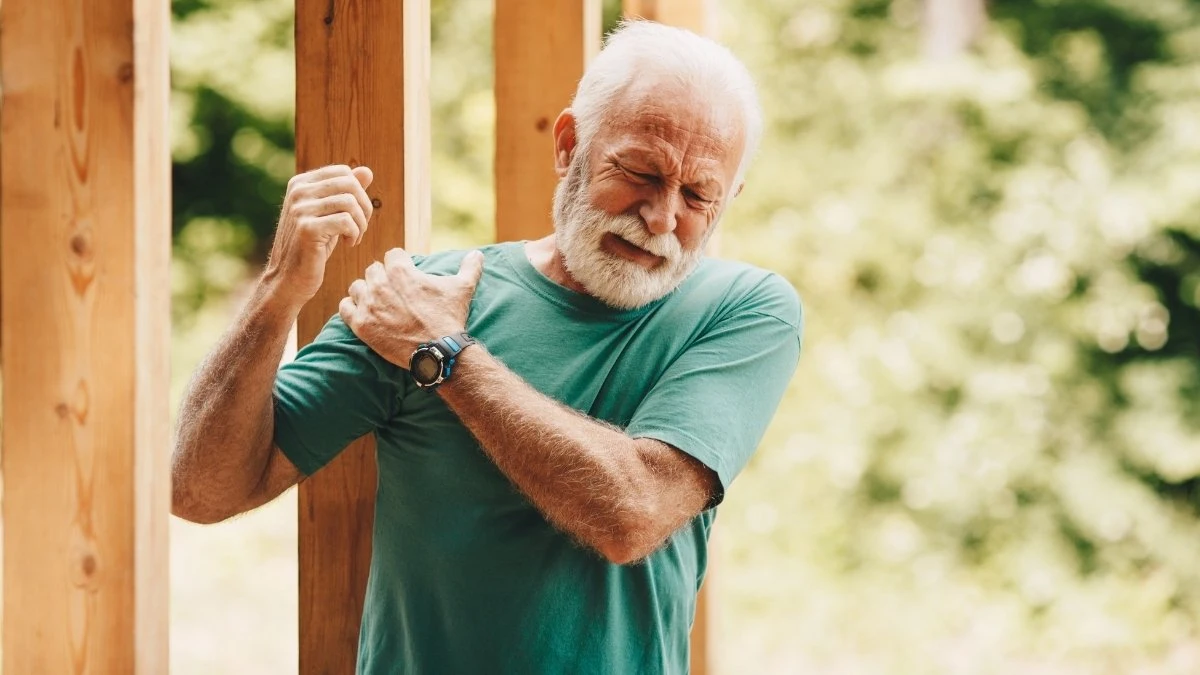
If you are new to lifting, learn good form first. Mayo advises working with a trainer or fitness specialist. Remember to breathe on every rep. A short check-in with your doctor now can keep you lifting for years.
Conclusion
Your two days are not a compromise. They match the guideline. This week, pick your two days and put 25 minutes on each in your calendar. Keep the first session easy and unhurried. One ordinary Tuesday at a time, you build strong legs and steady balance. Showing up twice a week is the hard part, and you are already doing it.
References
- Mayo Clinic. Strength training: Get stronger, leaner, healthier
- Mayo Clinic Cancer Education. Strength Training for Adults (patient guide)
- CDC. https://www.cdc.gov/physical-activity-basics/guidelines/older-adults.html
- U.S. Department of Health and Human Services. https://odphp.health.gov/sites/default/files/2019-10/PAG_ExecutiveSummary.pdf
- American College of Sports Medicine. https://pmc.ncbi.nlm.nih.gov/articles/PMC12965823 Currier BS et al. Med Sci Sports Exerc, 2026.
- Taaffe DR, Duret C, Wheeler S, Marcus R. Once-weekly resistance exercise improves muscle strength and neuromuscular performance in older adults. J Am Geriatr Soc, 1999;47:1208–1214. https://pubmed.ncbi.nlm.nih.gov/10522954/
- DiFrancisco-Donoghue J, Werner W, Douris PC. Comparison of once-weekly and twice-weekly strength training in older adults. Br J Sports Med, 2007.
- A meta-regression of the effects of resistance training frequency on muscular strength and hypertrophy in adults over 60 years of age. J Sports Sci, 2021.
- Effects of once- versus twice-weekly eccentric resistance training on muscular function and structure in older adults. Scientific Reports, 2024.
- Optimal dose of resistance training to improve handgrip strength in older adults with sarcopenia. Frontiers in Physiology, 2025.
- Momma H et al. Muscle-strengthening activities are associated with lower risk and mortality in major non-communicable diseases. Br J Sports Med, 2022.