

Researchers tracked 3,128 middle-aged adults for 12 years. Some slept in on weekends by about one hour. Among well-rested people, that extra hour went with a 64% lower risk of death. Among people who slept very little, the same hour went with an 84% higher risk.
Both numbers compare against one group: well-rested people who never slept in. Other studies on weekend sleep disagree with each other too. If you catch up on sleep every Saturday, which result applies to you? The answer turns on one detail that most headlines skip.
Your lie-in may be a quiet repair or a sign of a bigger problem. I will show you how to tell which, and what I would do about it.
What the Swedish Data Seemed to Say About Weekend Sleep
The idea that weekends can rescue a short week gained wide attention from a Swedish study. Torbjörn Åkerstedt and colleagues at Stockholm University published it in the Journal of Sleep Research in 2018. They followed more than 38,000 adults for up to 13 years.
Adults under 65 who slept about five hours or less every day died at a 65% higher rate than steady, moderate sleepers. People who slept little on weekdays but longer on weekends showed no extra risk. Their death rate matched the comparison group.
A 65% higher rate does not mean a 65% chance of dying. It means this group died at 1.65 times the rate of the comparison group during the study.
The link vanished at age 65 and older. Åkerstedt told Live Science that older adults tend to get the sleep they need. If you are in your late sixties or seventies, this study says little about your habits.
Long sleepers fared worse too: people who slept eight hours or more every day also died at a higher rate. Åkerstedt suspects hidden illness explains this. He also told Live Science that the catch-up idea is a reasonable assumption, not a proven fact.
Does Weekend Sleep Even It Out?
A common pattern
5.5 hoursWeeknights
10 hoursSunday
The Common Pattern
A common pattern among adults in their fifties: they sleep five and a half hours on weeknights, then ten hours on Sunday.
Does It Even Out?
They ask whether it evens out. This study alone says maybe.
A Later Study
A later study with an overnight sleep test adds a twist.
The Same Extra Hour Meant Two Different Things
Yoshiike and colleagues in Japan analyzed the Sleep Heart Health Study. They published the work in Sleep and Biological Rhythms in 2023. It covered 3,128 adults aged 40 to 64. Each person had an overnight sleep test, and the team followed them for about 12 years.
Participants also reported their weekday and weekend sleep. A gap of about one hour counted as short catch-up sleep, and two hours or more counted as long.
Every result compares against one yardstick group. Its members had normal sleep on the test night and did not sleep in on weekends. Researchers express each result as a hazard ratio. Below 1 means lower risk. Above 1 means higher risk.
Take people who slept at least six and a half hours on the test night. For them, an extra weekend hour went with a 64% lower risk of death. Now take people who slept under five and a half hours. These two figures come from a stricter analysis of 2,028 of the 3,128 people, which left out anyone who slept between five and a half and six and a half hours. In the main analysis, with a six-hour cutoff, one extra hour went with a 52% lower risk.
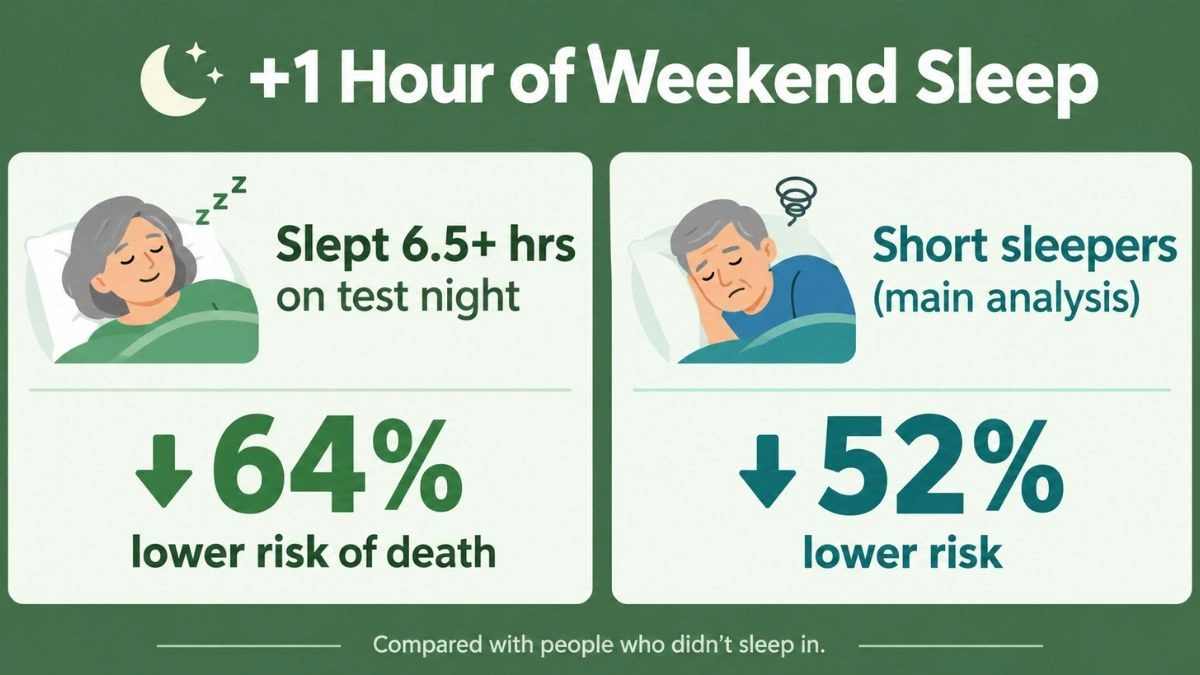
The second number needs care. In a later check, short sleepers who never slept in also showed higher risk. So the extra hour may signal trouble more than it causes it.
The authors offer one reading. A small sleep debt can shrink with a small top-up. When weekday sleep runs very short, the debt may be too big for two weekend nights to clear. That is their interpretation, not a proven cause.
Two hours or more did not help people with normal sleep. The study has other limits. Researchers measured sleep on one night, and they asked about weekend habits in a survey. Death is also only one outcome, and heart and blood sugar studies tell a messier story.
Why the Heart and Metabolic Evidence Doesn’t Agree
Heart data lean hopeful. In August 2024, researchers from Fuwai Hospital in Beijing presented a study at the European Society of Cardiology Congress. It followed 90,903 UK Biobank adults for almost 14 years. Motion sensors tracked their sleep.
People with the most weekend catch-up sleep had a 19% lower risk of heart and blood vessel disease. The comparison group had the least catch-up sleep. The benefit was stronger in people who slept too little on weekdays. This was a conference presentation of observational data, so it cannot prove cause.
A second UK Biobank analysis, led by Jean-Philippe Chaput in the journal Sleep, found no link. It followed 73,513 adults for about eight years. Catch-up sleep did not relate to death or heart disease. Results held when the team looked only at people who slept under six hours on weekdays.
Both studies used the same biobank and motion sensors, yet they disagreed. They grouped catch-up sleep in different ways, and that choice may explain part of the gap.
A lab experiment adds a third view. In 2019, University of Colorado Boulder researchers published a Current Biology study of 36 healthy adults. One group slept five hours a night for nine nights. Another slept five hours on weekdays, slept as long as they wanted on the weekend, then returned to five hours.

A third group slept up to nine hours every night. Insulin sensitivity shows how well your body handles blood sugar. It fell 9% to 27% in the weekend group once short nights returned. It fell 13% in the group that never caught up. Recovery sleep did not prevent weight gain either.
The weekend group slept just 66 extra minutes on average. Lead author Christopher Depner told Consumer Reports that a shifted body clock could explain the lack of benefit. The study was small and short, and it tested blood sugar, not lifespan.
Lab director Kenneth Wright said one question stays open. It is unclear whether recovery sleep helps people who miss sleep only a night or two a week. That leaves a practical question.
What I Would Do With This Evidence
Note: If you have a health condition or take medication, talk with your doctor before changing your sleep routine.
My short answer is this. A small weekend top-up may help some people. The evidence does not show that it can undo a short week.
Start with weeknights. Kenneth Wright advises about seven hours of sleep on as many nights as you can. In 2019, Michael Twery was director of the National Center on Sleep Disorders Research.. He said frequent schedule changes are a form of stress linked to metabolic problems.
If you sleep in, keep it short. The Japanese study found a benefit at about one extra hour for people who slept well. It found none at two hours or more. The National Sleep Foundation suggests no more than two extra hours on days off. The CDC advises the same bed and wake times every day.
Here is a routine for this week. Pick one weekday wake time and hold it. On weekends, wake within one to two hours of that time. If you wake at 6:30 on weekdays, aim for 7:30 or 8:30 on weekends.
If you need far more than two extra hours to feel normal, your weeknights may be too short. That is my rule of thumb, not a study result.
A common pattern is sleeping nine hours on Saturday and still feeling flat on Monday. That pattern fits Depner’s body clock idea. A steady wake time keeps your clock in one place.
Know What a Lie-In Cannot Fix
Signs of sleep apnea
Signs of Sleep Apnea
Mayo Clinic lists loud snoring, pauses in breathing, waking up gasping and heavy daytime drowsiness as signs of sleep apnea.
Ask Your Doctor
If that sounds like you, ask your doctor about a sleep study before you blame sleep debt.
One Small Step Before Next Weekend
Your Saturday lie-in is not a failure. It is also not a repair crew. This week, set an alarm for bedtime, not just for morning. Aim to be in bed 30 minutes earlier Monday through Thursday, and see how Friday feels. Small changes last longer than big ones, and you are already paying attention.
References
- Åkerstedt et al., “Sleep duration and mortality: does weekend sleep matter?” Journal of Sleep Research
- Live Science: Can you make up for lost sleep on the weekend?
- Yoshiike et al., Sleep and Biological Rhythms, 2023
- ESC Congress 2024 weekend sleep and heart disease study (AJMC)
- Chaput et al., device-measured weekend catch-up sleep, Sleep (Oxford Population Health / UK Biobank)
- Depner et al., Current Biology, 2019
- University of Colorado Boulder: Catching up on sleep on the weekend doesn’t work
- Consumer Reports: Catching up on sleep on the weekend doesn’t work
- https://news.harvard.edu/gazette/story/2023/09/not-getting-enough-sleep-thats-only-half-the-battle-health/
- Mayo Clinic: Obstructive sleep apnea