
Two people can lose ten pounds and end up in very different shape. One keeps muscle and loses fat. The other loses muscle along with fat. The scale shows the same number for both. You only notice the difference later, when stairs, jars, and grocery bags feel heavier.
Protein is one lever you control. The US federal guideline is 0.8 grams per kilogram of body weight a day. Stanford Lifestyle Medicine says many nutrition experts think that falls too low after 50. So how much protein do adults over 50 need while losing weight? Here is a five-step way to find your number, plus what to pair with it to protect your strength.
Why the Standard Number Falls Short After 50
Age changes how your body handles protein. AARP reports that older adults respond less to small doses of amino acids than younger people do. Stanford Lifestyle Medicine cites research where men near age 71 needed 0.4 grams of protein per kilogram at each meal. Men near age 22 needed only 0.2.
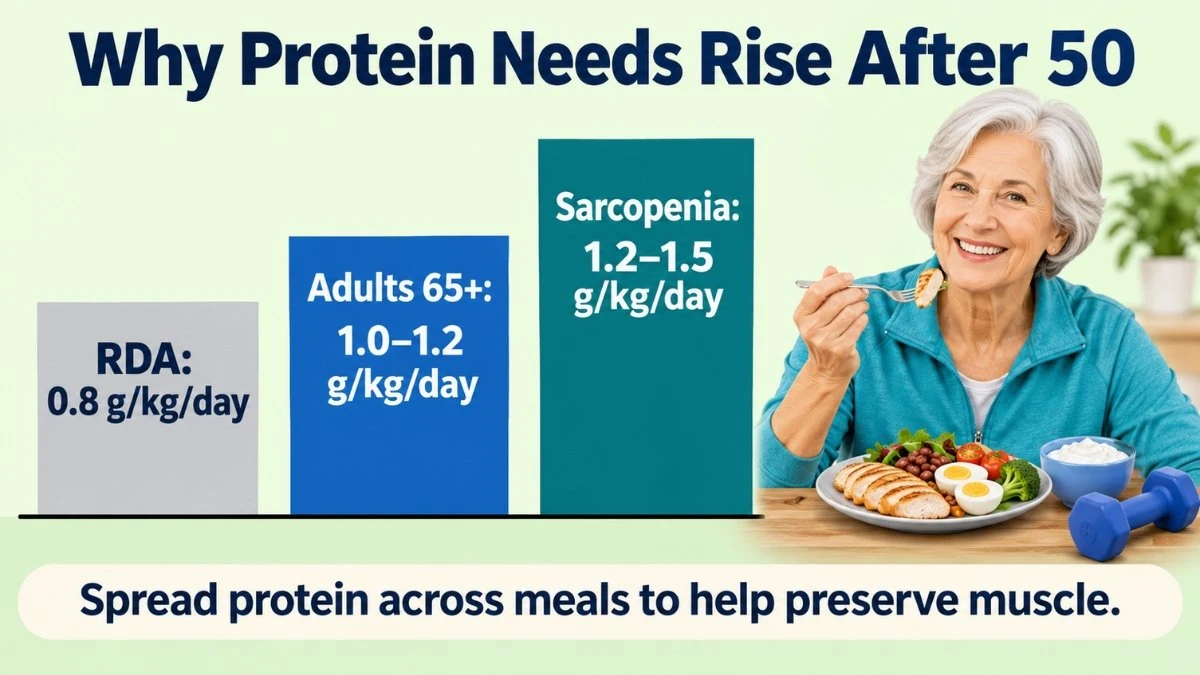
Protein Needs in Older Adults
The PROT-AGE study group reviewed protein needs in older people.
Grams per kilogram a day
The PROT-AGE Recommendation
Its 2013 position paper recommends at least 1.0 to 1.2 grams per kilogram a day for adults over 65.
Above the RDA
That sits above the 0.8-gram recommended dietary allowance (RDA).
What Sarcopenia Is
Doctors call age-related muscle loss sarcopenia. It is the loss of muscle mass, strength, and function.
Needs With Sarcopenia
AARP, citing Mayo Clinic, says people with sarcopenia may need 1.2 to 1.5 grams per kilogram a day.
Weight loss raises the stakes. A 2016 systematic review and meta-analysis in Nutrition Reviews studied adults older than 50 who cut calories. It compared intakes above and below 1.0 gram per kilogram a day, or 25% of energy.
Older adults on higher protein diets kept more lean mass and lost more fat mass, the review found. That is the result most dieters want.

A 2024 review of randomized trials in Clinical Nutrition ESPEN backs this up. It looked at adults with overweight or obesity who were trying to lose weight. Those who raised their protein kept more muscle than those who did not.
Studies set their cutoffs in different places, so treat these numbers as a guide. Your doctor or dietitian can fine-tune them for your health and your goals.
A common pattern at this age: toast and coffee in the morning, a light lunch, and a big dinner. Protein can land near the RDA, and most of it arrives in one meal. Your muscles may get only one strong signal to build each day. Next, you will turn all of this into one number.
Your Step-by-Step Protein Target for Weight Loss
Stanford Lifestyle Medicine recommends 1.2 to 1.6 grams of protein per kilogram of body weight each day for adults over 50. That equals about 0.54 to 0.72 grams per pound. Follow these five steps to find your number.

- Convert your weight to kilograms. Divide your pounds by 2.2. A 165-pound adult weighs 75 kilograms.
- Choose your starting point. I suggest 1.2, the low end of Stanford’s range. It also matches the top of the PROT-AGE range. Stanford says athletes and people recovering from illness or surgery may need the high end, so ask your dietitian before aiming there.
- Do the math. Multiply your kilograms by 1.2 and by 1.6. At 165 pounds (75 kilograms), Stanford lists about 90 to 120 grams a day. My own math gives 72 to 96 grams at 132 pounds (60 kilograms). It gives 96 to 128 grams at 176 pounds (80 kilograms).
- Split it across meals. Stanford recommends about 0.4 grams per kilogram at each meal. For a 165-pound adult, that is 30 grams. Three meals that size reach the low end of the range. A protein snack can help you reach the rest.
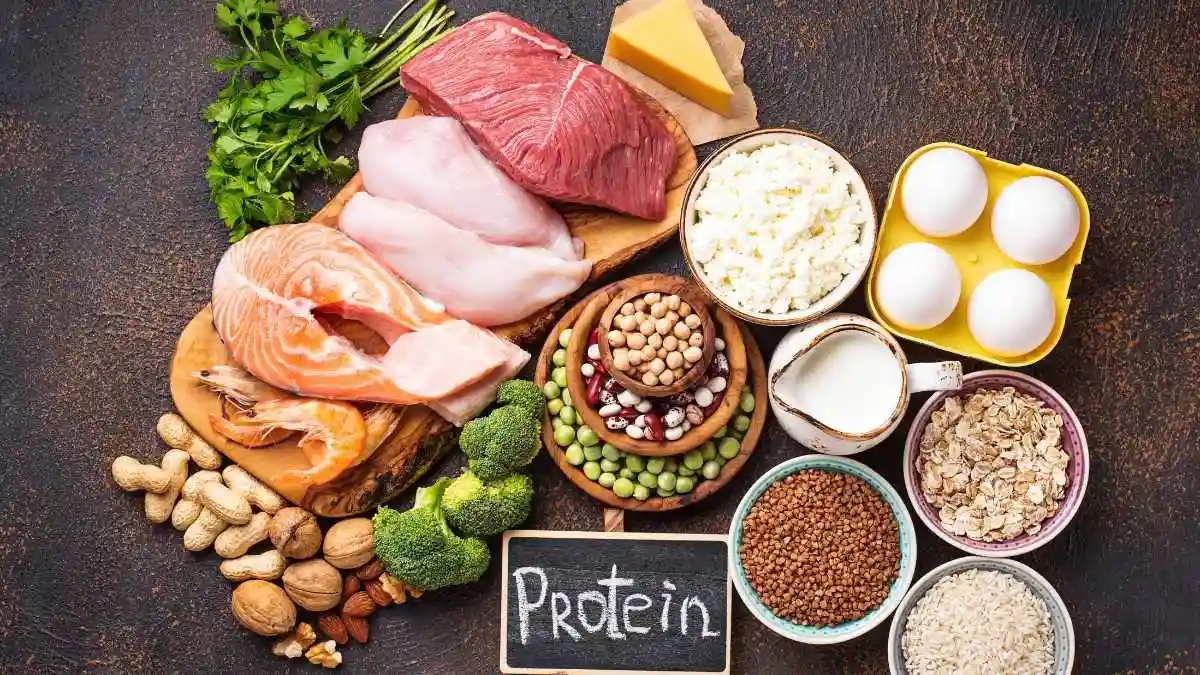
- Build your plate. Pick the protein first, then add sides. Eggs, Greek yogurt, fish, chicken, beans, lentils, and tofu all count. Stanford notes that an 8-ounce salmon fillet and a handful of almonds equal the 60-gram US federal guideline for a 165-pound adult. Check labels for grams per serving.
Here is a sample day for a 165-pound adult aiming for 30 grams per meal. Breakfast: eggs with Greek yogurt. Lunch: chicken with lentil soup. Dinner: baked fish with white beans. Check labels and adjust portions until each plate lands near 30 grams.
Splitting the dose matters. Stanford Lifestyle Medicine says a meal needs enough protein to tell your muscles to build. In older adults, a small dose may go toward energy or other jobs instead.
If you carry a lot of extra weight, ask a registered dietitian which weight to use. Your current weight may overshoot your real need. Next, protein needs a partner to protect your muscle.
Note: If you have kidney disease or another health condition, talk with your doctor before raising your protein or starting new exercise.
Protecting Your Muscle, and Knowing When to Check First

Protein alone will not protect your muscle. Stanford Lifestyle Medicine says strength training is the most important way to prevent age-related muscle loss. AARP reports that medical experts say protein should pair with resistance exercise.
Lifting weights tells your body to keep and build muscle. Stanford suggests about 30 grams of protein within a couple of hours after you train. A simple start is one short session this week with body weight or light dumbbells.

Watch for this pattern when dieting after 50: the scale keeps dropping, yet rising from a low chair gets harder. Track strength, not only the scale. Pick one move, such as the chair stand, and count your repeats every two weeks.
Higher protein does not suit everyone. The National Kidney Foundation advises people with kidney disease who are not on dialysis to eat less protein. It also warns that too little protein can cause malnutrition at any stage. Ask your healthcare professional about a kidney dietitian.
The PROT-AGE group agrees. It lists severe kidney disease without dialysis as an exception to its advice. Bring your gram range to your next visit and ask if it fits you.
Conclusion
Losing weight after 50 does not have to cost you your strength. You now have a number to aim for. This week, take one step: add a protein food to tomorrow’s breakfast. It is small, and it puts your plan on the plate. I am rooting for you, and for the strong years ahead.
References
- Effects of dietary protein intake on body composition changes after weight loss in older adults: a systematic review and meta-analysis. Nutrition Reviews, 2016;74(3):210-224. https://pubmed.ncbi.nlm.nih.gov/26883880/
- Enhanced protein intake on maintaining muscle mass, strength, and physical function in adults with overweight/obesity: a systematic review and meta-analysis. Clinical Nutrition ESPEN, 2024. https://www.sciencedirect.com/science/article/abs/pii/S2405457724001761
- Evidence-based recommendations for optimal dietary protein intake in older people: a position paper from the PROT-AGE Study Group. Journal of the American Medical Directors Association, 2013;14(8):542-559. https://doi.org/10.1016/j.jamda.2013.05.021
- Protein Needs for Adults 50+. Stanford Lifestyle Medicine. https://lifestylemedicine.stanford.edu/protein-needs-for-adults-50/
- CKD Diet: How much protein is the right amount? National Kidney Foundation. https://www.kidney.org/kidney-topics/ckd-diet-how-much-protein-right-amount
- How Much Protein Do You Need After 50? AARP (reports Mayo Clinic guidance on sarcopenia). https://www.aarp.org/health/healthy-living/protein-needs/