
You switched to decaf for a good reason. Maybe your sleep fell apart. Maybe your heart skipped a beat after the second cup. Then a headline said decaf offers no brain benefit. Now you wonder if that choice cost you something.
That headline came from a 2026 Harvard study on coffee and dementia risk. It followed more than 131,000 people for up to 43 years. The study is large and careful. Its limits matter just as much. The lead author warned against reading the result at face value.
Below, you will find what the numbers show, who ends up drinking decaf, and what to do with your own cup. The answers change how you should read that headline.
What the Harvard Data Actually Shows
Researchers from Harvard and Mass General Brigham published the study in JAMA in February 2026. They tracked 131,821 nurses and health professionals for up to 43 years. Over that time, 11,033 people developed dementia.
Coffee, Tea and Dementia Risk
Highest caffeinated coffee group vs lowest group
18% Lower Risk
People in the highest caffeinated coffee group had an 18% lower risk of dementia than people in the lowest group.
Where the Gap Was Widest
The gap was widest at 2 to 3 cups of coffee or 1 to 2 cups of tea a day.
Not a Straight Line
The link was not a straight line. More cups did not keep adding benefit.
Decaf and Genetic Risk
Decaf showed no link to lower risk. The coffee benefit looked the same in people with high and low genetic risk.
Lead author Yu Zhang called the decaf result surprising.
The JAMA paper notes that most earlier studies did not separate caffeinated coffee from decaf. This one did. That split makes the decaf result stand out.
A May 2026 article in The Conversation also pointed to a combined analysis of 38 other studies. Those studies found a 6% to 16% lower risk among caffeine drinkers. Other research points the same way.
This is an observational study. It shows a link, not proof. Participants were US health professionals, so results may differ for you. They also reported their own habits on questionnaires. Cups are a rough guide, too. Brew method and cup size change the caffeine in your mug.
Zhang says even small differences can matter, since dementia is common and builds over many years. Cleveland Clinic neurologist Dylan Wint, MD, said the findings match earlier research.
Aladdin Shadyab, PhD, an associate professor of public health, called the study very large and rigorous. The decaf result makes more sense once you see who drinks decaf.
Why People Switch to Decaf, and Why It Muddies the Picture
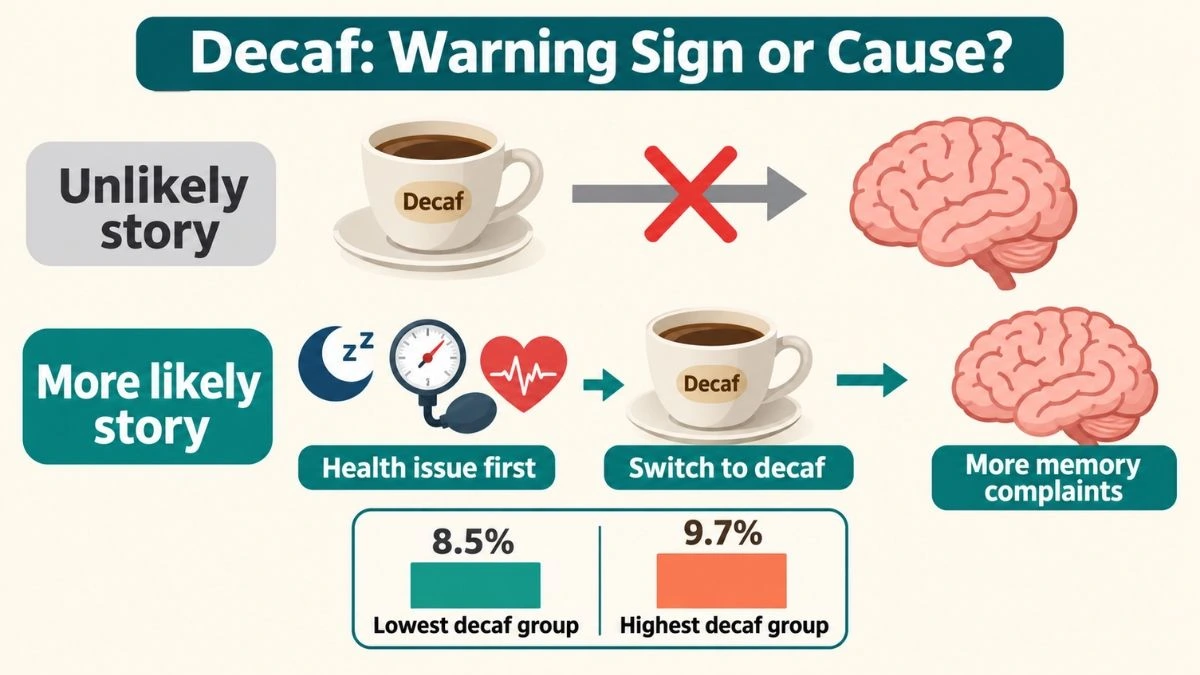
Zhang told Medscape that people may switch to decaf because of caffeine intolerance or underlying health issues. That detail changes the story. So the decaf group may differ from the coffee group in ways that matter for the brain.
Consider a man in his late 50s who starts waking at 3 a.m. His blood pressure reading creeps up at a checkup. He switches to decaf that week.
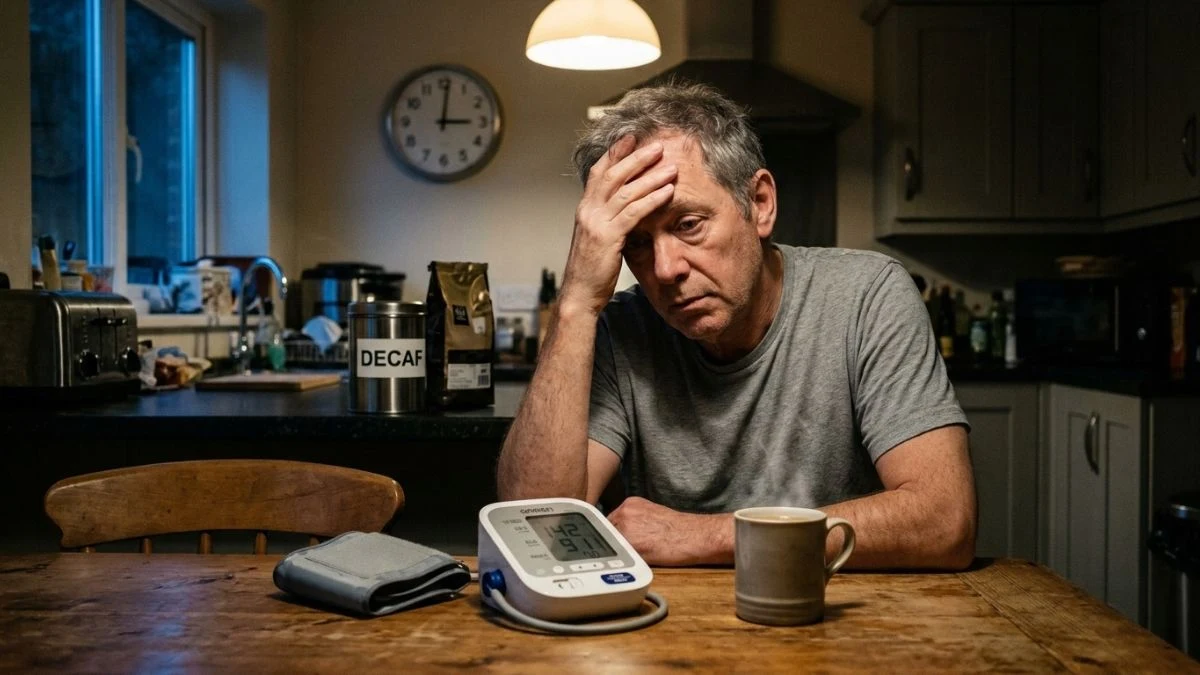
A May 2026 article in The Conversation names three triggers: sleep trouble, high blood pressure, and heart rhythm problems. Each ties to cognitive decline and dementia. So decaf may mark a health issue that already raises risk.
Scientists also worry about the reverse path. They call it reverse causation. Early memory changes may shift what a person drinks long before diagnosis. The JAMA authors say they cannot fully rule this out.
The authors also tested 4-year and 12-year delays between coffee habits and diagnosis. An expert reacting to the study for the Science Media Centre said the 12-year test showed the same pattern. That makes reverse causation less likely for caffeinated coffee.
Another expert in the same roundup noted the team adjusted for high blood pressure and for changes in caffeine intake. A National Elf Service review adds that coffee drinkers may differ in social life, sleep, and health care habits. Statistics adjust for many traits, but some gaps remain.
Decaf tells a different story. In the JAMA data, people in the highest decaf group reported more memory complaints, 9.7% versus 8.5% in the lowest group. They also scored a little lower on a verbal memory test. The authors say this may reflect a health weakness that came first, not harm from the drink.
Zhang also cautioned against calling decaf ineffective. Coffee and tea hold plant compounds such as polyphenols, he noted. These relate to brain inflammation, blood vessel health, and metabolism.
Data from the UK Biobank differ. PsyPost reported that the UK study suggested decaf may still offer some protection. That leaves a practical choice about what you pour tomorrow morning.
What This Means for Your Cup
Note: If you have a health condition or take medication, speak with your doctor before changing your caffeine intake.
If you drink coffee or tea and feel fine, keep your intake moderate. Zhang told Medscape the findings support moderate intake for people who tolerate caffeine.
Mayo Clinic says up to 400 mg of caffeine a day appears safe for most healthy adults. That equals about four cups of brewed coffee. The study’s best range of 2 to 3 cups sits below that line.
If you chose decaf for sleep, blood pressure, or palpitations, keep it. Those reasons come first. Mayo Clinic notes that caffeine can keep you from sleeping. Treat your sleep as the first goal and your cup as the second.
Consider a woman in her mid-60s who loves an afternoon latte but lies awake at night. She could keep her morning cups with caffeine and switch to decaf after lunch. That plan fits Mayo Clinic’s advice to avoid caffeine late in the day.
Decaf still has some caffeine, Mayo Clinic notes. If you want to cut back, go in small steps. Sudden cuts can cause headaches, tiredness, and crankiness for a few days, the same source says.
Check your medicine, too. Mayo Clinic says some pain relievers and energy bars hold caffeine. When a doctor prescribes a new medicine, tell them how much coffee or tea you drink.
If you do not drink coffee, this study gives you no reason to start. It tracked long-term habits and cannot show that a new habit would lower your risk. Your body gives you the best data on which cup fits.
The decaf headline does not need to follow you around. This week, write down the time of your last caffeinated cup each day and how you slept, for seven nights. Those notes show which cup suits your body.
Bring them to your next checkup. You already care enough to ask, and that is where good answers begin.
References
- Zhang Y, et al. Coffee and Tea Intake, Dementia Risk, and Cognitive Function. JAMA. 2026. https://jamanetwork.com/journals/jama/fullarticle/2844764
- Medscape. Coffee and Tea May Protect Against Dementia but Hold the Decaf. https://www.medscape.com/viewarticle/coffee-and-tea-may-protect-against-dementia-hold-decaf-2026a100046l
- WBUR. Study finds moderate caffeine intake may reduce dementia risk. https://www.wbur.org/news/2026/02/09/coffee-tea-caffeine-intake-dementia-risk-mass-general-study
- Science Media Centre. Expert reaction to study looking at tea and coffee intake and dementia risk. https://www.sciencemediacentre.org/expert-reaction-to-study-looking-at-tea-and-coffee-intake-and-dementia-risk/
- National Elf Service. Coffee, tea and dementia risk: does your daily brew help? https://www.nationalelfservice.net/mental-health/dementia/coffee-tea-and-dementia-risk-does-your-daily-brew-help/
- PsyPost. Moderate coffee and tea consumption linked to lower risk of dementia. https://www.psypost.org/moderate-coffee-and-tea-consumption-linked-to-lower-risk-of-dementia/
- The Conversation, via ScienceDaily. This daily habit could lower dementia risk by 35%, scientists say. https://sciencedaily.com/releases/2026/05/260512202350.htm
- Pharmacy Times. Research Suggests Caffeinated Coffee or Tea Could Reduce Dementia Risk. https://www.pharmacytimes.com/view/research-suggests-caffeinated-coffee-or-tea-could-reduce-dementia-risk
- Benefits and Pensions Monitor. Daily caffeine tied to lower dementia risk in long-term studies. https://newsroom.clevelandclinic.org/2026/04/03/study-shows-how-coffee-could-benefit-brain-health
- Mayo Clinic. Caffeine: How much is too much? https://www.mayoclinic.org/healthy-lifestyle/adult-health/in-depth/caffeine/art-20045678