

The dread can start while you are still at your desk. Sunday evenings feel flat. Projects you once loved lose their pull. You wonder whether retirement depression has begun early, and whether that means trouble ahead.
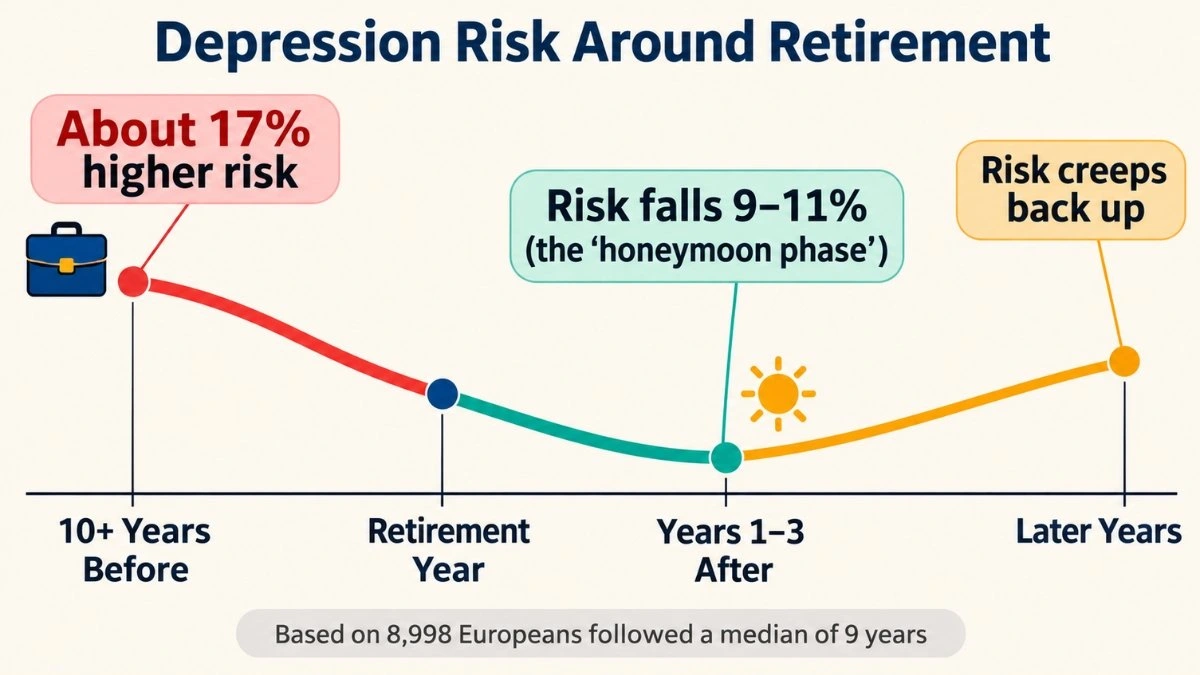
Short answer: low mood can start early. A 2023 analysis of European workers found a pattern worth knowing. Depression risk was 17% higher ten or more years before retirement than in the retirement year. The study did not test why.
But the reasons can lie in your health and in your job. Some of the findings should bring real relief, and some deserve your attention. Here is what the research shows, and what you can do about it before your last day.
What the Timeline Really Looks Like
A 2023 study in Epidemiology and Psychiatric Sciences followed 8,998 Europeans from work into retirement. The median follow-up was nine years. The data came from the Survey of Health, Ageing and Retirement in Europe.
The team’s summary results appeared in Population Medicine in 2023. Depression risk ran about 17% higher ten or more years before retirement than in the retirement year. Chance could explain the dip as retirement neared, so treat that trend with care.
After people stopped working, risk fell by 9% to 11% over three years. The authors call this early period the honeymoon phase. Risk then crept up in the years that followed. Relief from job stress may explain the early drop. The Swedish study below backs that idea for some people.
A 2021 meta-analysis in Epidemiology and Psychiatric Sciences pooled 41 studies and 557,111 people. On average, retirement cut depression risk by almost 20%. The results varied a lot between studies, so the average hides many different paths.
These studies show links, not proof of cause. The 2023 authors note that most earlier work used one-time snapshots. Snapshots cannot show what came first.
Start your own record. Each evening, write one line about your mood and energy. After a month, you will have a pattern to look at instead of a guess.

So depression risk can run high a decade or more before the last day. The practical point is timing. Check in on your mood years before you retire, not only after. That raises a harder question about which came first, the low mood or the decision to retire.
When Low Mood Comes Before Retirement, Not After
Consider a composite example, not a real client. A 61-year-old manager counts down the months to retirement. Sundays feel heavy. Sleep is poor, and small tasks feel hard. She tells herself retirement will fix it.
Her hope has some research behind it, and so does her worry. A 10-year analysis of the Health and Retirement Study followed 6,584 older adults. The 2018 paper in Psychiatry Research found that retirement raised depressive symptoms. It also found that depressive symptoms made retirement more likely.
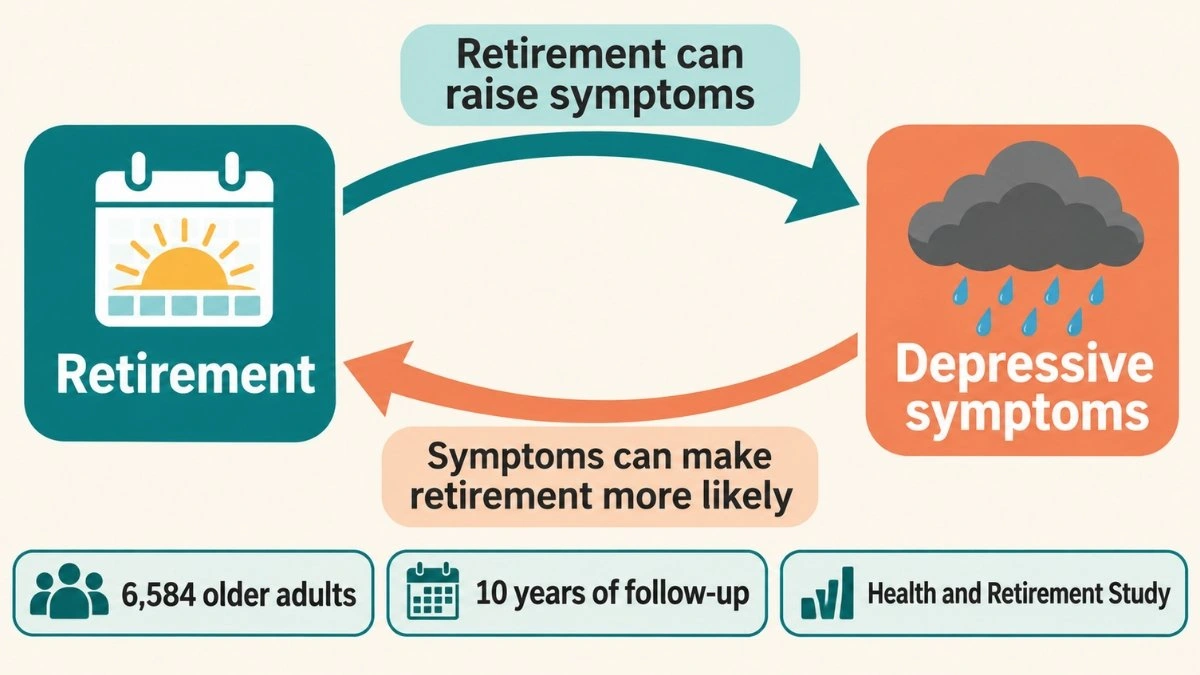
That first finding runs against the pooled average above. Research on this topic is mixed, so your own pattern matters.
Danish researchers found a related pattern in eldercare workers, but they measured retirement plans, not actual retirement. A 2015 paper in BMC Public Health used surveys of 4,041 workers in one analysis and 2,444 in another.
Workers with depressive symptoms were more likely to plan retirement before age 62. So were workers whose symptoms worsened over two years, though the two-year links faded once earlier retirement plans were counted.
Depression and Retirement
The pattern is easy to follow.
Depression
Depression drains energy and interest.
Work Feels Like a Burden
Work starts to feel like a burden, so retiring looks like relief.
2018 Authors
The 2018 authors urge practitioners to spot depression in older workers before they retire.
Leaving a Job
Leaving a job does not treat depression that has other roots. The symptoms travel with you.
Try one thing this week. Note whether the heaviness began before your job got harder or after. Write the answer down with today’s date. Bring that note to your doctor if the feeling stays.
Sometimes the job itself explains the low mood. The next study looks at exactly that.
Why the Job Itself Shapes the Final Years
A 2020 study in the Scandinavian Journal of Work, Environment & Health followed 1,735 Swedish retirees. Their average retirement age was 66. The study left out people who retired because of ill health, since their paths differ.
The researchers tracked depressive symptoms from nine years before retirement to eleven years after. They also asked about job stress near the end of working life.
On average, symptoms fell. On a 24-point scale, the mean score dropped from 5.9 nine years before retirement to 2.9 just after. Between the last survey at work and the first survey in retirement, symptoms eased in 53.5% of people. They held steady in 23.7% and rose in 22.9%. That is nearly one in four.

Job stress marked the people who struggled most. Heavy job demands, job strain, low support from coworkers, low rewards, and effort-reward imbalance all went with higher symptom levels. Effort-reward imbalance means you give a lot and get little back.
Even among people with no depression, poor working conditions went with scores that ran a little higher. For a small group, symptoms dropped a lot after retirement. The authors say relief from poor working conditions may explain that drop.
For others, poor working conditions went with symptoms that stayed in place. These two groups were small, about 2% and 4% of the sample, and the study cannot prove cause.
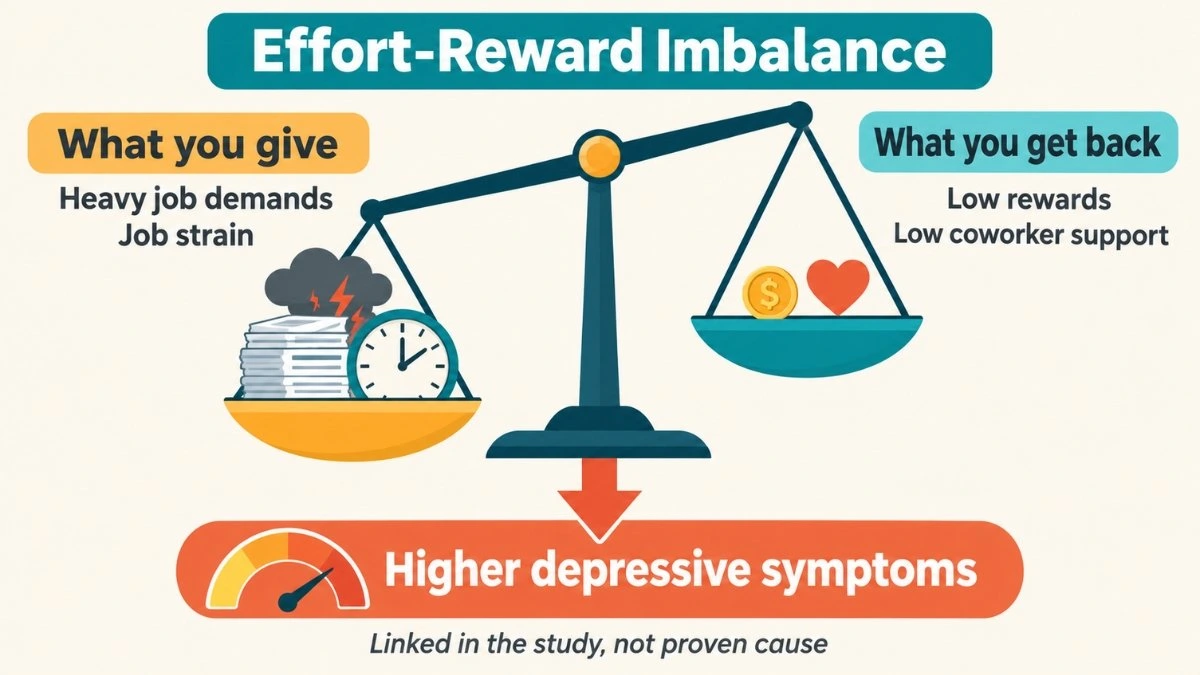
When I read this study, one point stood out to me. Low mood in your final working years may trace back to your workload. Some of that load may be open to change.
Test this on your own job. Compare what you give with what you get back. This week, list the three parts of your job that drain you most. Pick one to hand off, shorten, or drop.
Once you know what drives the mood, you can build a plan around it.
What to Do Before Your Last Day (and When to Get Help)
Note: This article is general education, not medical advice. If low mood lasts more than two weeks, talk with a doctor. If you ever feel unsafe, contact local emergency services or a crisis line right away.
Start by sorting the feeling. Sadness about leaving a career is normal. Depression looks different. The American Psychiatric Association says depression brings sadness or lost interest. For a diagnosis, symptoms must be present most of the day, nearly every day, for more than two weeks, with a clear change in daily functioning.

The association also draws a line for grief that helps here. In grief, painful feelings come in waves, mixed with warm memories. In major depression, mood or interest stays low for most of two weeks.
Other signs include poor sleep, low energy, guilt, and trouble concentrating. It also notes that medical problems, such as hormonal imbalances or vitamin deficiencies, can mimic depression. So book a doctor visit if several signs last two weeks. Do not wait for your last day.
Bring your dated notes to the visit. They show your doctor the pattern.
Next, consider easing out instead of stopping all at once. In their 2021 meta-analysis, Odone and colleagues argued that older workers should get more flexibility in retirement timing. Fewer days or shorter hours can protect your routine and your coworker contact while you adjust.

Then build your first retirement week before it starts. Set fixed times for a walk, a phone call, and one task that matters to you. Put them on a calendar, so no day starts blank. A fixed routine takes the guesswork out of empty days.
Volunteering is one way to add purpose. A 2013 study in the Journal of Aging and Health followed 585 retirement community residents. Researchers led by Eva Kahana found that volunteering was linked to keeping up life satisfaction and positive mood, but not to fewer depressive symptoms or less negative mood. Treat it as a clue, since these residents already lived in retirement communities.
Back to our composite manager. Her plan might be one volunteer shift a week and a Tuesday coffee with a former coworker. She would also book a doctor visit this week. None of it is dramatic. All of it gives her days a shape.
If the heaviness showed up early for you, it deserves attention, not shame. This week, tell one trusted person how you have been feeling. Say it plainly, even if it comes out clumsy. You are noticing this while you still have time to shape what comes next. That is a real head start.
References
- Mosconi G, et al. (2023). Transition to retirement impact on risk of depression and suicidality: results from a longitudinal analysis of the Survey of Health, Ageing and Retirement in Europe (SHARE). Epidemiology and Psychiatric Sciences, 32, e34. https://doi.org/10.1017/S2045796023000239
- Vigezzi GP, et al. (2023). Transition to retirement impact on depressive symptoms: results from a longitudinal analysis within SHARE. Population Medicine, 5 (Supplement), A20. https://www.populationmedicine.eu/Transition-to-retirement-impact-on-depressive-symptoms-results-from-a-longitudinal,165368,0,2.html
- Odone A, et al. (2021). Does retirement trigger depressive symptoms? A systematic review and meta-analysis. Epidemiology and Psychiatric Sciences, 30, e77. https://doi.org/10.1017/S2045796021000627
- Segel-Karpas D, Ayalon L, Lachman ME (2018). Retirement and depressive symptoms: A 10-year cross-lagged analysis. Psychiatry Research, 269, 565-570. https://hrs.isr.umich.edu/bibcite/reference/14395
- Depressive symptoms and early retirement intentions among Danish eldercare workers: cross-sectional and longitudinal analyses (2015). BMC Public Health. https://www.ncbi.nlm.nih.gov/pmc/articles/PMC4504417/
- Åhlin JK, et al. (2020). Psychosocial working characteristics before retirement and depressive symptoms across the retirement transition: a longitudinal latent class analysis. Scandinavian Journal of Work, Environment & Health, 46(5), 488-497. https://pmc.ncbi.nlm.nih.gov/articles/PMC7737805
- Kahana E, Bhatta T, Lovegreen LD, Kahana B, Midlarsky E (2013). Altruism, helping, and volunteering: Pathways to well-being in late life. Journal of Aging and Health, 25(1). https://facultyprofile.csuohio.edu/en/publications/altruism-helping-and-volunteering-pathways-to-well-being-in-late–4/
- American Psychiatric Association. What Is Depression? https://www.psychiatry.org/patients-families/depression/what-is-depression