
Most older walkers I meet hold one belief. A daily walk keeps you steady on your feet. I hear it often, and I understand why. A Sydney trial put that belief to the test. Researchers followed 386 adults aged 65 and over for 48 weeks.
One group got a walking plan. The other did not. Both groups logged falls on a monthly calendar. The walkers walked more. Their falls did not drop in any way the trial could confirm. That result matters. The trial’s authors note that walking is the exercise most older adults choose.
So, does walking prevent falls? Not by itself. The reason points to a plan that fits into your week. It also shows who should take extra care.
What the Easy Steps Trial Found After 48 Weeks of Walking
The trial goes by the name Easy Steps. Alexander Voukelatos and colleagues published it in Age and Ageing in 2015. They enrolled 386 inactive adults aged 65 or over from greater Sydney. All lived in the community, not in care. The team did not choose people for high fall risk.
Walking Plan and Falls
The plan changed behavior, but not fall rates.
Two Groups
Researchers split the adults into two groups.
The Plan
One group followed a self-directed 48-week walking plan. It came as three mailed manuals and coaching calls by phone.
The other group got health information unrelated to falls.
Behavior Changed
The plan changed behavior. The walkers walked more and grew more active.
No Difference in Falls
The study found no significant difference in fall rates between the groups. It found no significant difference in how many people fell, or fell more than once.
It could not show that walking prevented falls.
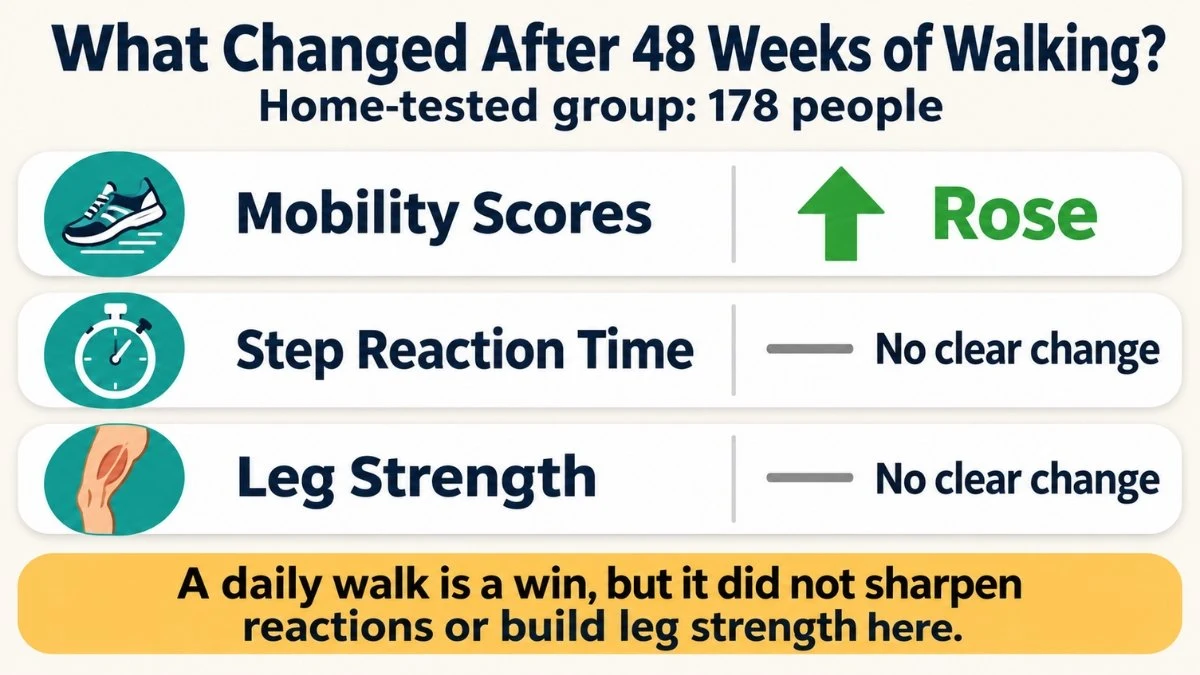
A sub-group of 178 people took extra tests at home. Their mobility scores rose. Their choice step reaction time showed no clear change. Nor did their knee extension strength, a test of thigh muscle strength. Voukelatos said the plan had no impact on balance, which may explain the falls result.
In my talks with older walkers, I often hear one line. “I walk every day, so I am safe.” A daily walk is a real win. In the group tested at home, though, more walking did not sharpen reaction time or build leg strength.
This trial has limits. It tested one self-directed plan in people who began inactive. It did not track heart health or lifespan. So it cannot speak to those benefits. It did hint that age may change the story.
Why Age 75 Changes the Conversation
Easy Steps also looked at age. The signal was weak. Walking’s effect seemed to differ between adults aged 65 to 74 and adults aged 75 and over. Among the older group, the walkers had a rise in fall rates that chance could explain.
The authors note that people over 75 tend to be frailer and at higher risk. That may explain the trend. The trial protocol raised another idea. More walking can mean more exposure to hazards in the environment, which could raise fall risk.
Other research points the other way. A 2016 study by Okubo and colleagues in Japan put 90 adults aged 65 to 79 into two groups. One group took brisk walks. The other trained balance and strength. When falls were counted per active day or per step, the walkers had fewer falls than the balance group.
Even so, the authors warned against advising walking for people who are frail or prone to falls. Walking can bring more trips, they said. The study compared walking with balance training only.
A 2024 research abstract adds a twist. Researchers followed 359 adults aged 65 to 95 in central Massachusetts. Women who walked for exercise at least once a week had 86% lower indoor fall rates than women who did not. The margin of error was wide. No significant link appeared for outdoor falls, or for men.
This study only watched people, so it cannot prove cause. Women who walk may differ from women who do not in other ways.
The evidence is mixed. Walking helps many people stay active. It does not look like a dependable shield against falls on its own.
If you are over 75 or already unsteady, ask your doctor for advice about walking. Voukelatos said walking may be a useful add-on for raising activity, most of all for people under 75. The best evidence points to a different kind of exercise.
What Does Cut Falls, and Where Walking Fits
Note: If you have fallen before, feel unsteady, or have a health condition, check with your doctor first. A physiotherapist can also help you plan safe changes.
The strongest evidence comes from a 2019 Cochrane review. Cathie Sherrington and colleagues pooled 108 trials with 23,407 adults living in the community across 25 countries. The average age was 76. The team found that exercise programs cut both the rate of falls and the number of people who fall.
A 2020 summary in the British Journal of Sports Medicine gives the details by type. Balance and functional exercises cut the fall rate by 24%. Programs that mixed those with strength work probably cut it by 34%. Tai Chi may help too. The reviewers were unsure about walking alone. That means the evidence is too thin to judge.
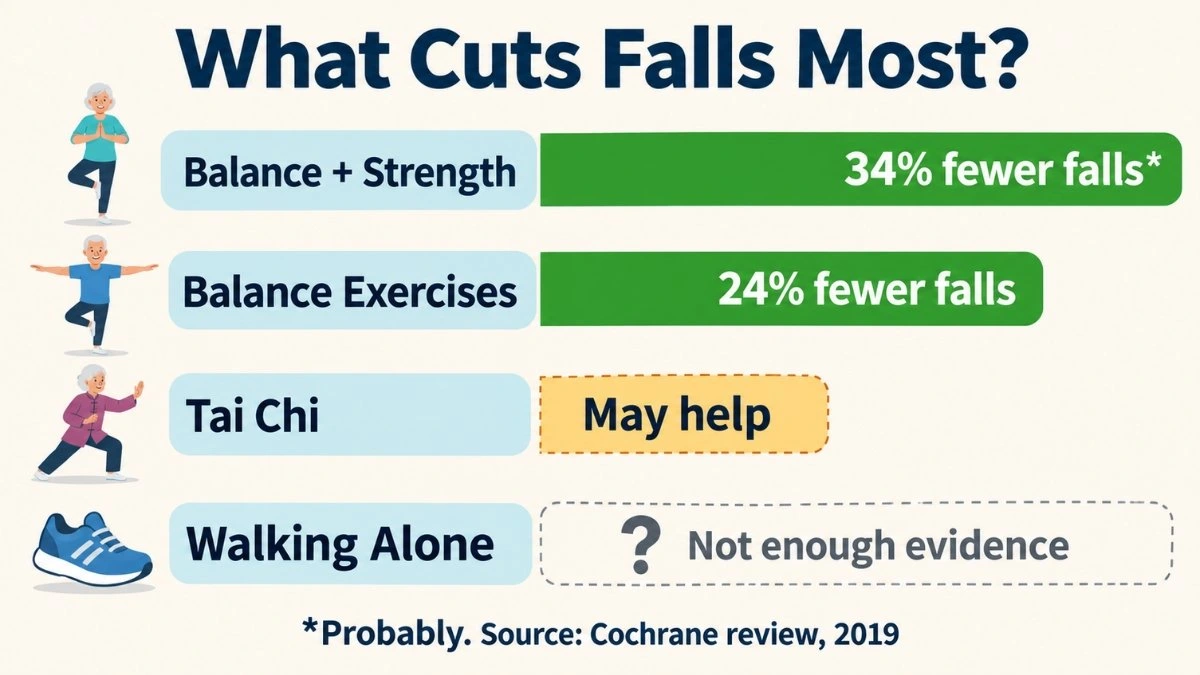
Here is the scale. Take 1,000 older adults who do no exercise to prevent falls. The Cochrane data suggest they would have about 850 falls in a year. Across all exercise types, exercise programs prevent about 195 falls. Exercise also cut the number of people who fall at all by 15%.
These programs share a feature. Most of the work happens standing, and it copies daily tasks, such as rising from a low chair or climbing stairs. Cochrane also found the programs worked in groups or alone. They worked for adults aged 75 and over, too.
A 2022 world guideline in Age and Ageing adds weight. A panel of experts and older adults recommends that all older adults hear advice on both falls prevention and physical activity.
Here is a practical way to use all this. Keep your daily walk for staying active. Choose even, well-lit routes. Then add standing balance and leg-strength moves. A physiotherapist or trained instructor can match them to your level.
Many walkers I speak with feel strong on a long walk. They feel less sure on stairs or when rising from a low chair. Those are the exact moves this training practices. Start there.
A Final Word
If falls worry you, you already hold the hardest piece: a daily walking habit. This week, call one local clinic or senior center and ask when their next balance class starts, and whether you can join. That single call can turn a good habit into a safer one. I wish you many more steady miles.
References
- Voukelatos A, et al. The impact of a home-based walking programme on falls in older people: the Easy Steps randomised controlled trial. Age and Ageing, 2015. https://doi.org/10.1093/ageing/afu186
- Voukelatos A, et al. The effect of walking on falls in older people: the “Easy Steps to Health” randomized controlled trial study protocol. BMC Public Health, 2011. https://www.ncbi.nlm.nih.gov/pmc/articles/PMC3251253/
- Okubo et al. Walking can be more effective than balance training in fall prevention among community-dwelling older adults. Geriatrics & Gerontology International, 2016. https://onlinelibrary.wiley.com/doi/10.1111/ggi.12444
- Gender differences in the associations of recreational walking with indoor and outdoor falls among older adults. Research abstract, 2024. https://www.ncbi.nlm.nih.gov/pmc/articles/PMC11691354/
- Sherrington C, et al. Exercise for preventing falls in older people living in the community. Cochrane Database of Systematic Reviews, 2019. https://www.cochrane.org/evidence/CD012424_exercise-preventing-falls-older-people-living-community
- Sherrington C, et al. Exercise for preventing falls in older people living in the community: an abridged Cochrane systematic review. British Journal of Sports Medicine, 2020. https://doi.org/10.1136/bjsports-2019-101512
- Montero-Odasso M, et al. World guidelines for falls prevention and management for older adults: a global initiative. Age and Ageing, 2022. https://doi.org/10.1093/ageing/afac205