
You put the phone down and somehow feel worse than before you picked it up.
Scrolling daily through Facebook or YouTube can slowly raise your anxiety, wreck your sleep, and leave you feeling mentally drained without you ever realizing the phone is the cause.
If you’re one of the many adults over 50 who use social media daily, that quiet, unsettled feeling after a scroll session isn’t in your head. There’s a biological reason for it.
This article explains what’s happening in your brain, how fast things improve when you cut back, and how to do a social media detox without losing touch with the people you care about most.
| # | Section | What’s coming |
|---|---|---|
| 1 | Why Scrolling Drains You | The brain chemistry your phone is quietly changing |
| 2 | The Loneliness Trap | Why quitting cold turkey can leave you worse off |
| 3 | The Seven-Day Reset | What your brain does the moment you step back |
| 4 | The Swap Plan | The one shift that makes a detox actually stick |
| 5 | When You’ll Feel It | The changes most people notice first — and when |
| 6 | After the Detox | How to go back without falling into the same trap |
Why Scrolling Every Day Makes You More Anxious
You already know something feels off after a long scroll session. It’s not your imagination. Your brain has been working against you the whole time.
Every time you open a social media app, your brain’s reward center fires. The nucleus accumbens [the region deep in the brain that releases dopamine and drives you to repeat a behavior] gets a small hit of dopamine with each new post, notification, or reaction.
That hit is real. So is the crash that follows when the next scroll doesn’t deliver anything satisfying.
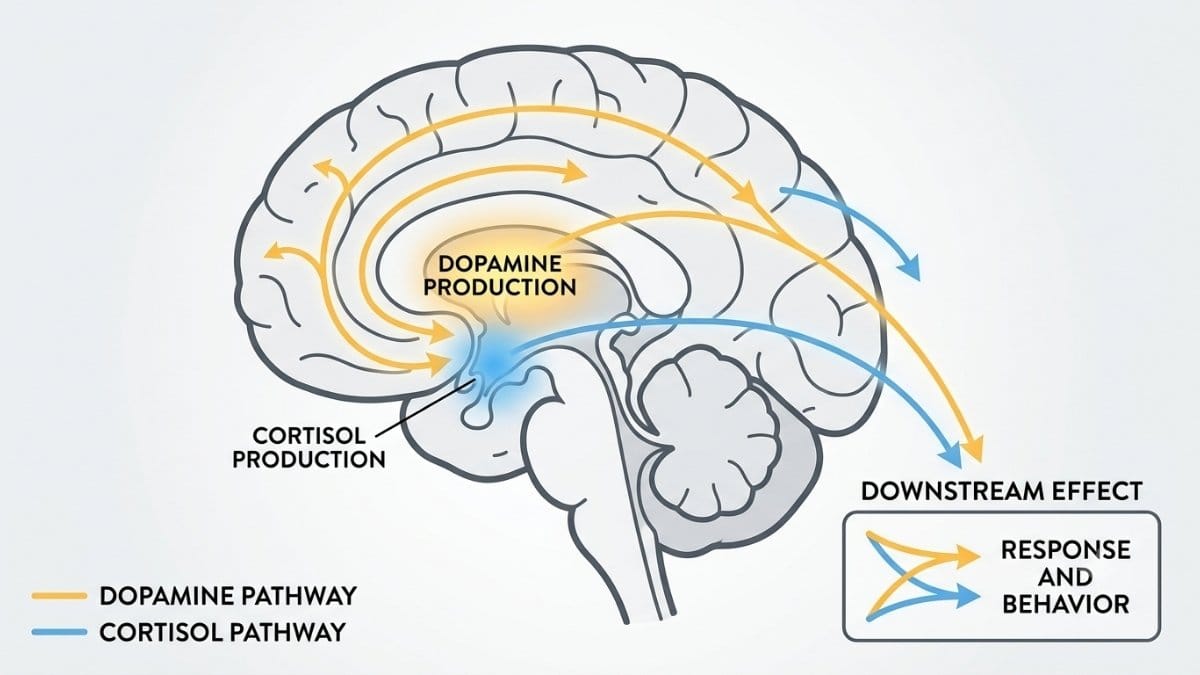
At the same time, your brain’s threat-detection center is scanning alarming headlines and conflict-heavy posts. The amygdala [the region that fires when you sense danger, triggering fear and stress responses] treats that content like a real threat.
It raises cortisol [a hormone your adrenal glands release under stress that raises heart rate and sharpens alertness].
When your phone keeps cortisol elevated all afternoon, it doesn’t just make you anxious. It disrupts your sleep and leaves your whole body in a lower-grade alert state.
The research is specific. A 2025 cross-sectional study of 15,986 retired adults found that those spending six or more hours daily on social media had 44% higher odds of anxiety and 50% higher odds of depression compared to lighter users.
That cycle has a specific reset, and it starts faster than most people expect. This is exactly why a social media detox can change how your brain feels within days.
Tip 1: Notice when you feel worse after scrolling than before. That signal is data.
Tip 2: Check your screen time once a week. Most people underestimate daily usage by 40 to 50%.
The Loneliness Trap: Why Going Cold Turkey Can Backfire After 50
Here’s the thing most detox articles don’t tell you. For some people, quitting social media entirely makes things worse, not better.
For people over 50, going cold turkey on social media can make loneliness worse, not better, if the apps were the main way they stayed in touch with family. This is not a small risk.
Social isolation is one of the most significant health threats for adults as they age, linked in research to depression, cognitive decline, and premature death.

Research on social media use among older adults gives important context here. A study using data from 4,184 community-dwelling adults aged 65 and older found that higher levels of social media communication with close ties — children, family members, friends — was linked to lower loneliness through increased social contact and perceived support.
If you’re using Facebook to message your daughter every morning or share photos with friends from your old neighborhood, cutting that off completely is not a mental health improvement.
The goal of a social media detox for older adults is not to erase the apps. It is to cut passive scrolling — the mindless feed-reading with no specific purpose — while keeping the active connections alive.
The difference is simple:
- Passive use: opening the app, scrolling the feed, reading posts from people you don’t know or barely know
- Active use: sending a direct message, replying to a specific person, sharing something with someone in mind
One drains you. The other connects you.
Once you know which type of use you’re keeping and which you’re cutting, the reset can begin.
Tip 1: Before you open a social app, ask yourself: am I here to contact someone specific, or just to scroll? If you can’t name the person, close the app.
Tip 2: Keep messaging apps or direct message features available during your detox. Cut the feed, not the relationship.
How Your Brain Resets During a Social Media Detox
Most people expect to feel better immediately when they cut social media. The first two days often feel like the opposite.
That’s expected. It’s how the reset works.
Your One-Week Social Media Detox
What happens inside your brain and body when you unplug
⏳ Days 1–3
Expect restlessness and a strong urge to check. This is normal biological recalibration—your dopamine cycle slowing down as it adjusts to fewer artificial reward hits.
🌙 Days 4–5
Sleep quality significantly improves. Halting late-night exposure to alarming updates allows your amygdala’s alert state to settle much faster before bed.
✨ Day 7+
Measurable shifts occur. Data shows young adults experience a powerful reduction in mental distress after just one full week offline.
Knowing the timeline is half the work. The other half is having a plan for each day.
Tip 1: Write down your mood score (one to ten) each morning before you look at any screen. This gives you real data instead of guesswork.
Tip 2: Plan something physical for days two and three specifically. A short walk, light stretching — anything that moves cortisol out of your body.
Week One: What to Swap, Not Stop
Talk to your doctor before making any significant changes to your daily routine if you’re managing a chronic condition, depression, or anxiety.
The most common reason a social media detox fails on day three isn’t willpower. It’s boredom. There’s nothing to fill the 40-minute gap where the scrolling used to live.
A swap works better than a stop.
Three swaps that hold:
- Replace the morning scroll with five minutes outside or a short walk before you touch your phone. Your cortisol is naturally highest in the first 30 minutes after waking. Adding a screen to that window raises it further. Taking it away drops it faster.

- Replace one daily scroll session with one intentional message to a real person. Text a family member. Send a voice message. The goal is to protect active connection while cutting passive consumption.
- Replace unrestricted app access with a single 15-minute daily window. Set it for a time of day when you’re already alert, not first thing in the morning or before bed. Use your phone’s built-in screen time tools to set the limit.
Research on young adults who completed a two-week social media detox found improvements across sleep, life satisfaction, stress, and supportive relationships. The study used younger participants, so the findings are directional rather than definitive for adults over 50, but the pattern holds across multiple studies.
The one practical friction trick: Delete the social apps from your home screen. Don’t uninstall them. The extra two steps to find and open the app are enough friction to break a dozen automatic checks per day.
The next section tells you what those changes actually feel like when they arrive.
Tip 1: Set your phone to charge in a room other than your bedroom. This removes the before-sleep and first-waking scroll in one move.
Tip 2: If 15 minutes feels too short at first, start at 30 and cut it by five minutes every two days.
When You’ll Actually Feel the Difference
You won’t feel better on day one. Most people don’t feel better on day two either. Here’s when it tends to happen.
Sleep usually shifts first. Most people who cut evening social media report falling asleep faster within the first four to five days. The mental quiet before bed — no alarming headlines, no social comparison — lets the brain’s alertness system wind down at a normal pace.

Focus is usually next. During a 14-day internet block study of 467 adults with an average age of 32, researchers found improvements in sustained attention roughly equivalent to reversing ten years of age-related cognitive decline.
The study used a broader internet block rather than social media specifically, but the mechanism is the same: removing the constant interruption cycle lets the brain rebuild its ability to hold attention on one thing.
Mood tends to follow sleep and focus. When you’re sleeping better and not carrying the low-grade cortisol load from a day of alarming content, irritability drops. The background noise in your head gets quieter.
One finding that may surprise you: in the same PNAS Nexus study, even people who did not complete the full 14 days experienced measurable positive changes. Partial progress still counts.
The expectation to set for your social media detox: not a dramatic lift, but a quieter baseline. Less anxious, not euphoric. Less drained after a day, not energized. It’s a subtraction, and that subtraction sets up everything that comes next.
Tip 1: Compare your morning mood score from day one to day seven. The change is usually clearer in writing than in memory.
Tip 2: Don’t judge the detox by how you feel on day three. Judge it on day seven.
How to Use Social Media Without Letting It Use You
The detox is not the destination. It’s a reset button that makes it possible to go back and use these platforms without the drain.
After seven days, your brain’s reward cycle is calmer. Your baseline anxiety is lower. You’ve proved to yourself that the urge to check passes. Now the question is: what do you come back to?
Research gives a useful distinction here. A 2025 study of 15,986 retired adults found that social media addiction [compulsive, uncontrolled use that continues despite negative effects] was more strongly linked to anxiety and depression than total time spent. That means how you use it matters more than how long.
Active use — with a purpose and a stopping point — is what the research supports for older adults. Social media communication with close social ties has been shown to reduce loneliness and increase perceived support in adults aged 65 and older. The platform isn’t the problem. The feed is.

A simple framework for coming back:
- Open the app with a specific reason in mind
- Do that one thing
- Close the app before you start scrolling
- Set a daily time limit of 30 minutes across all social apps
You don’t have to quit forever. You just have to be the one who decides when you open it and when you stop.
Tip 1: Turn off all push notifications for social apps permanently. Every notification is a designed interruption. Remove it.
Tip 2: Schedule a weekly check of your screen time totals. Treat it like a health number — not to judge yourself, but to stay honest.
Final Thought:
Start today by setting a 15-minute daily limit on your social apps and turning off every social media notification on your phone. Pick a start date, write it on paper, and take a seven-day detox starting today — tracking your mood each morning so you can see the difference for yourself.
The goal isn’t to disappear from the internet. It’s to stop letting a scroll session quietly drain your energy, your sleep, and your peace of mind. A social media detox mental health reset doesn’t take months. It takes one week, and the data shows your brain will already be changing by day four.