

Something felt off, and you noticed.
Maybe you stood in the kitchen and couldn’t land on a simple decision, or a familiar word slipped away right when you needed it.
Most people over 50 dismiss early brain warning signs as stress or aging and miss the window when action is most effective.
If you’re one of the adults over 50 who has noticed small, worrying changes in your thinking or memory, this article covers the early signs of cognitive decline that are written off most often.
You’ll finish knowing exactly which five signals matter, why they show up before memory problems do, and what one step to take if any of them sound familiar.
| # | Section | What’s waiting for you |
|---|---|---|
| 1 | Why the brain warns you early | The signal most people overlook entirely |
| 2 | Signal 1: Your sense of smell | What your nose has to do with your brain |
| 3 | Signal 2: Simple decisions feel harder | The effort shift that catches people off guard |
| 4 | Signal 3: Your sleep changes | Not all sleep changes are the same |
| 5 | Signal 4: You lose your thread | What disappears mid-sentence and why |
| 6 | Signal 5: Familiar words vanish | The word you know but can’t find |
Why the Brain Shows Early Signs of Cognitive Decline Before Memory Fails
You probably picture memory slipping as the first sign something is wrong.
Research on early cognitive decline suggests a different picture.
The brain runs on multiple separate systems, and they don’t all slow down at the same rate.¹
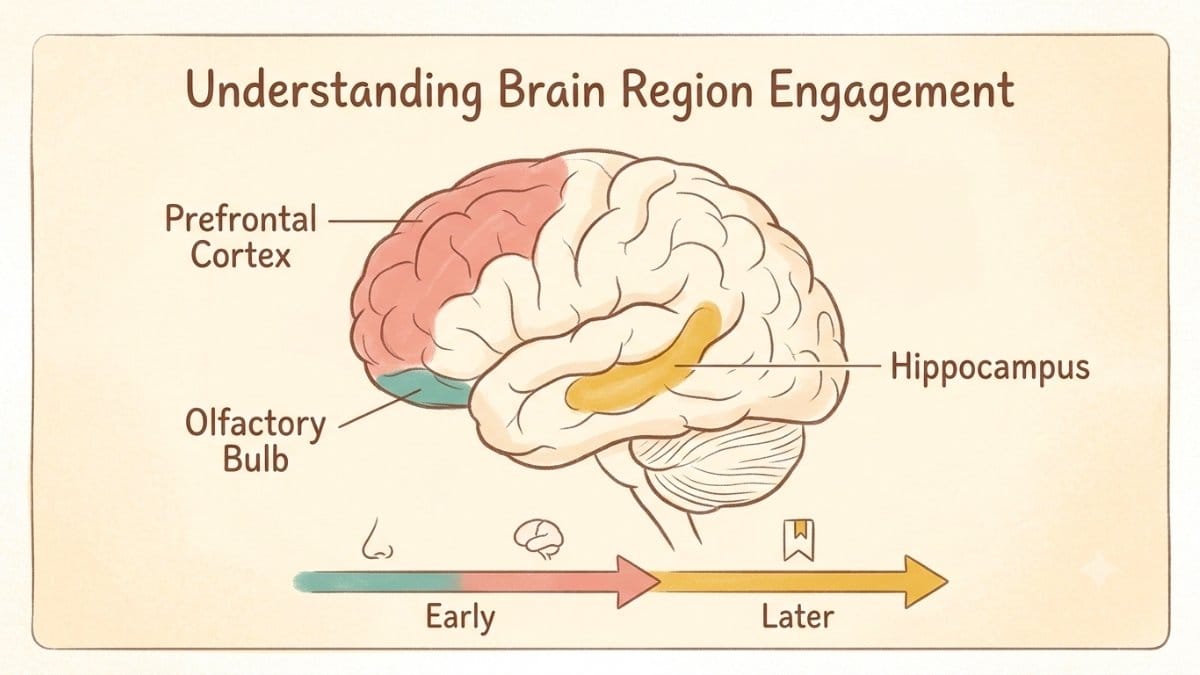
The regions that handle smell, planning, and sleep regulation can show early strain while the regions most people connect with memory are still largely intact.
A systematic review of 80 community-based studies found that cognitive impairment affects a median of 19% of adults over 50 living in the community.²
That number includes people at early stages, people who might pass a standard memory test on any given day.
Research tracking cognitive function in non-demented older adults found that cognitive declines precede and predict functional declines, sometimes by years, before a formal diagnosis is made.³
This matters because the checklist most people carry, “Am I forgetting names? Am I losing keys?”, looks for signs that often come later.
The five signals below show up first.
Each one is easy to write off as something else.
That’s exactly what makes them worth knowing.
Signal 1: Your Sense of Smell Gets Weaker Without a Clear Reason

You open a jar of coffee and notice it smells faint.
You walk into a bakery and barely catch the bread smell that used to hit you from across the room.
You’re not sick.
Your sinuses are clear.
The smell is just quieter than it used to be.
Your brain starts sending distress signals through smell, sleep, and small decisions long before you forget a name.
The reason smell matters here is specific.
The olfactory bulb [the part of the brain that processes smell signals] sits close to the hippocampus and entorhinal cortex, which are two regions among the earliest targets of neurological change associated with Alzheimer’s disease.⁴
Protein clusters linked to this process appear in the olfactory bulb before they appear in the memory centers.⁴
In cognitively intact older adults, impairment in odor identification is associated with future cognitive decline, and in the same group, episodic verbal memory impairment was not.⁴
A separate meta-analysis of older adults without cognitive impairment at baseline found that olfactory impairment was linked to an almost doubled risk of developing cognitive decline or dementia over time.⁵
Research on this is striking.
In cognitively intact older adults, the olfactory signal appears to arrive before the memory signal does.
What to notice is not one bad smell day.
It’s a gradual weakening over months, in the absence of any physical explanation, no allergies, no infection, no medication change.
Track it.
It’s the one signal almost no one thinks to watch.
Signal 2: Making Simple Decisions Starts to Feel Harder Than It Should

You’ve made breakfast every day for 30 years, but today you stood there longer than usual trying to choose.
Planning the order to run your errands took more mental effort than it used to.
Small choices feel like they have friction now, and that’s new.
Executive function [the brain’s ability to plan, weigh options, and initiate decisions] can decline in the early stages of cognitive impairment, and research shows this can happen before memory complaints become the dominant symptom.
A study examining 41 normal elderly adults alongside adults in early and late stages of mild cognitive impairment [a level of cognitive change greater than normal aging that doesn’t yet meet the definition of dementia] found that impairments in executive function were detectable even in the earliest sub-stage of MCI.⁶
A prospective study tracking specific executive function measures in older adults found that declines in inhibition and task-switching ability were associated with broader cognitive changes in the years that followed.⁷
Talk to your doctor if you’re on medication or managing a chronic condition before drawing conclusions from any self-assessment like the one below.
Here’s the checklist that matters for this signal:
- The difficulty is new compared to how you’ve always operated
- It happens with decisions that used to feel automatic
- It shows up repeatedly over weeks, not just on one hard day
- It involves simple, familiar choices, not complex or unfamiliar ones
The signal isn’t a bad decision.
It’s the effort the decision now costs, and the next signal shows up somewhere most people wouldn’t think to look.
Signal 3: Your Sleep Changes in a Very Specific Way

You used to sleep through until morning.
Now you’re awake at 3 a.m. with a running brain, or you feel exhausted but can’t nap.
The shift didn’t come with a clear reason, no new stress, no schedule change.
Sleep and cognitive health are connected in both directions.
Research reviews have found that disruptions in sleep, including changes in slow-wave sleep and REM sleep [the stage of sleep when the brain consolidates memories and clears metabolic waste, including proteins associated with neurological disease], may be associated with increased risk of cognitive decline.⁸
Researchers have described changes in sleep consolidation and sleep spindle activity as early potential markers of worsening cognitive function in older adults.⁹
A 2025 study of 140 middle-aged adults aged 40 to 60 found that those sleeping fewer than six hours per night had significantly greater declines in memory, executive function, and attention over a three-year follow-up period.¹⁰
The signal here is change, not just poor sleep.
If your sleep pattern has shifted in duration, timing, or quality compared to your own baseline a year or two ago, and there’s no obvious cause, that shift is worth noting and worth discussing with a doctor.
Your brain regulates sleep.
When that regulation starts to shift, sleep changes often arrive before the next signal does, and that one shows up mid-conversation.
Signal 4: You Lose Your Place in Conversations More Often

You were in the middle of a sentence, fully focused, and the point just disappeared.
You said “I lost my train of thought” and moved on.
But it’s been happening more often lately, not when you’re distracted, not when someone interrupted you, but in quiet moments when you were paying full attention.
This reflects changes in working memory [the brain’s short-term holding system that keeps the beginning of a sentence in mind while you’re still finishing it].
Research tracking working memory across stages from normal cognition through mild cognitive impairment found that working memory impairments are measurable in early MCI and become more pronounced as cognitive changes progress.¹³
The key distinction is context.
Losing your train of thought because the dog barked, or because you’re exhausted, is not the signal.
Losing it repeatedly in calm, focused moments is.
One practical marker to watch:
If you’re speaking clearly, engaged in the conversation, and you still lose the point, not just once, but regularly over recent weeks, that pattern is worth writing down and bringing to your next medical appointment.
Working memory is also one of the areas researchers track when monitoring early signs of cognitive decline, since it lets you hold a phone number in your head long enough to dial it, or follow the logic of a conversation across several exchanges.
Its early decline tends to be quiet, easy to chalk up to distraction, and connected to the final signal in a way that makes the two worth reading together.
Signal 5: Familiar Words Disappear Right When You Need Them

You’re telling a story.
You need a word you’ve used for decades.
You know you know it, you can almost feel it sitting just out of reach, and then it’s not there.
You talk around it.
Later, driving home, the word arrives without any effort.
This is a tip-of-the-tongue state [the experience of being certain a word exists in your memory but being temporarily unable to retrieve it].
These happen to everyone at every age.
The signal is how often it’s happening now compared to before.
A study of older adults aged 50 to 79 found that those with subjective memory complaints, people who felt their memory was declining even when standard tests showed normal results, experienced significantly more tip-of-the-tongue episodes than those without such complaints.¹¹
Even with identical performance on objective cognitive tests, the frequency of these word-retrieval failures was noticeably higher in the group who felt something had changed.¹¹
Separate research confirms that tip-of-the-tongue frequency increases with age and is linked to measurable changes in brain regions involved in retrieving the sound form of words, distinct from the regions that store word meanings.¹²
The words to watch are the familiar ones: common nouns, names of people you’ve known for years, everyday terms you’ve used your whole life.
Occasional blanks are normal.
A noticeably rising rate, one where you can’t remember the last time it happened this much, is the signal.
What to Do Now
The most useful thing you can do today is write down which early signs of cognitive decline you’ve noticed and how recently the pattern started.
One signal on one day means very little.
A pattern of two or three signals repeating over recent weeks, in a way that feels new for you, is information your doctor should have.
Talk to your doctor this week if you have noticed any of the five signals in this article.
The early signs of cognitive decline are most actionable before they become impossible to dismiss, and catching them early leaves you with more options than waiting does.