

You eat your vegetables. You drink water. You try to make smart food choices. But something still feels off.
You’re tired when you shouldn’t be. Your skin is dry and dull. Your mood drops for no clear reason. And no matter how much you eat, you feel hungry again within an hour.
Most people never think to blame their fat intake. In fact, most people were told to eat less fat for years. But cutting good fats from your diet is like pulling fuel from an engine. Your body needs them to work.
Your body sends signals when it’s not getting enough good fats. In this article, you’ll learn 4 surprising signs and exactly what to eat to fix it today.
Sign 1: You’re Always Hungry Even When You Just Ate
You finish a full meal. You sit back. And 40 minutes later you’re hungry again. This is one of the most common signs of a low-fat diet.

Fat is what keeps you full. It slows your digestion. When there’s no fat in your meal, food moves through your stomach fast. Blood sugar rises and then crashes. Hunger comes back quickly.
Registered dietitian Ashley Reaver explains it well: “The body uses up carbs and protein very quickly. Fat really slows down the digestion of food and provides substantial calories.”
Think about your last meal. Did it have any fat in it? No olive oil. No nuts. No egg. No avocado. If not, that’s likely why you felt hungry so soon.
The fix is simple. Add one fat source to each meal. Half an avocado. A handful of walnuts. A drizzle of olive oil. Even small amounts make a real difference in how long you stay full.
Add half an avocado or a handful of walnuts to your next meal. You’ll stay full much longer without eating more food.
Sign 2: Your Skin Is Constantly Dry and Your Hair Has Lost Its Shine
You’ve changed moisturizers. You’ve tried different shampoos. But your skin is still dry and your hair still feels brittle. The problem might not be in your bathroom.
Your skin cells are surrounded by a protective layer of fat. That layer locks in moisture and keeps out irritants. When you don’t eat enough good fat, that layer weakens.

Los Angeles dermatologist Jessica Wu, MD, says it plainly: “All of your skin cells are wrapped in a protective bubble of fats. If you have a problem with the skin barrier, your skin looks and feels dry, and can be more prone to eczema rashes.”
Your hair follicles also need essential fatty acids to stay strong. Without enough good fat, hair can become thin, brittle, or fall out more than usual. Many people see a real change in skin texture within 2 to 4 weeks of eating more good fats.
Add salmon, sardines, or walnuts to your meals three times a week. Swap your cooking oil for extra virgin olive oil. Your skin will feel the difference.
Sign 3: You Feel Foggy, Irritable, or Low and You Can’t Explain Why
It’s 2pm. You had lunch. You had coffee. But you’re staring at your screen and can’t focus. You feel low. A little irritable. And you have no idea why.

This might be your brain asking for more fat.
Your brain is made up of roughly 60 percent fat. It needs dietary fat to produce serotonin and dopamine, the chemicals that control your mood, focus, and energy. Low-fat diets have been connected to higher rates of depression, anxiety, and brain fog.
Dr. Wolfgang Marx, deputy director of the Food & Mood Centre at Deakin University, puts it simply: “Eating a balanced meal with protein, fiber, and healthy fats can stabilize blood glucose and reduce irritability, fatigue, and brain fog within hours.”
Brain fog is not just tiredness. It affects your focus, memory, and mood. Adding walnuts, fatty fish, and olive oil to your daily meals can support sharper thinking and a more stable mood within 2 to 3 weeks.
Add a small handful of walnuts to your morning yogurt or oatmeal. It takes 30 seconds and gives your brain the fat it needs to start the day right.
Sign 4: You Wake Up Stiff and Your Joints Ache Without a Clear Reason
You wake up in the morning. Your knees are stiff. Your fingers ache. You move slowly for the first 20 minutes. And you have no injury to blame.
This kind of joint pain is often linked to inflammation inside the body. And your diet plays a direct role in how much inflammation you carry.

Most modern diets are heavy in omega-6 fatty acids from processed foods, seed oils, and snacks. Omega-6s are not harmful on their own. But when you eat too many of them and too few omega-3s, your body stays in an inflamed state.
Omega-3s help calm that inflammation. People who eat omega-3-rich foods or take a fish oil supplement have shown real reductions in joint pain and stiffness. A 2025 global review found that most health authorities recommend 250 mg per day of EPA and DHA for adults, yet most people fall well short of that.
Eating fatty fish 2 to 3 times a week is one of the most effective steps you can take.
Swap your cooking oil to olive oil this week. Add salmon or sardines to two meals. Check in on your morning stiffness after 4 to 6 weeks.
The Best Good Fat Foods to Add to Your Plate Starting Today
You know the signs. Now here’s what to actually eat.
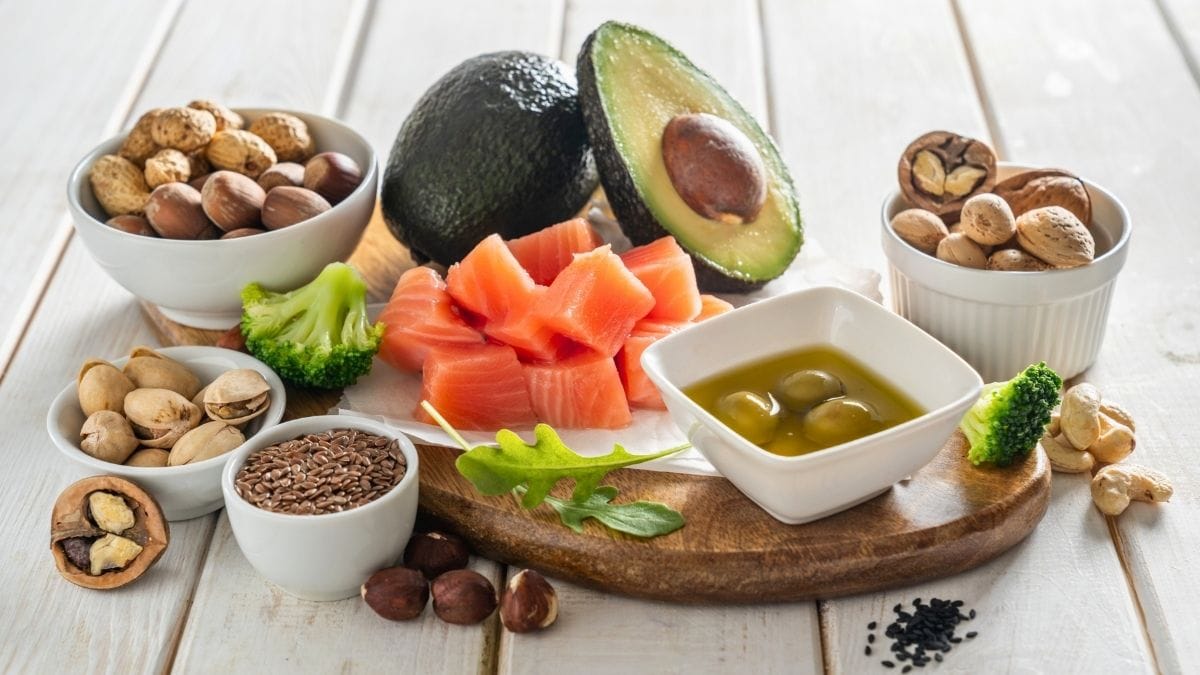
Salmon, sardines, and mackerel are the top sources of omega-3s. They give your body EPA and DHA in a form it can use right away. Aim for 2 to 3 servings per week.
Avocados are packed with monounsaturated fat, fiber, and potassium. Add half to any meal and you instantly improve the fat quality of your plate. It’s one of the easiest swaps you can make.
Walnuts have the highest omega-3 content of any tree nut. A small handful is a quick snack that supports your brain, joints, and mood all at once.
Extra virgin olive oil is rich in monounsaturated fats with natural anti-inflammatory properties. Use it for cooking and salad dressings every day.
Chia seeds and flaxseeds are plant-based omega-3 sources. Stir them into smoothies, oatmeal, or yogurt with no effort at all.
Whole eggs, yolk included, contain good fats and fat-soluble vitamins A, D, E, and K. Without fat in your diet, your body cannot absorb these vitamins properly, even if you take them as supplements.
You don’t need to eat all of these every day. Start with two or three. Rotate them through your week and you’ll cover your needs without overcomplicating it.
Lastly
Your body talks to you. Constant hunger, dry skin, brain fog, and stiff joints are all signals worth listening to. Adding good fats is one of the simplest changes you can make. Start with one food. Add it today. Your body will thank you.