
You’ve probably wondered why some people seem to outlive the rest of us by decades, sharp and active well past the age when most people start declining.
Most people believe living a long life is mostly a matter of luck or good genes, so they feel powerless to change their odds
This article is for adults who want to live longer and are willing to change small daily habits. By the end, you’ll know exactly which Blue Zones habits the world’s longest-lived people share and which one is worth starting today.
Five Places That Define Blue Zones Habits
You want to know what actually keeps people alive longer. Five communities around the world produce centenarians at rates up to 10 times higher than the United States, and researchers spent years studying exactly why.¹
The Five Blue Zones
Five places on Earth where people consistently
live past 90 — and what they share.
- Zone 01 · Japan Okinawa
Home of the world’s longest-lived women. A plant-forward diet, strong social bonds called moai, and a sense of ikigai define life here.
- Zone 02 · Italy Sardinia
The Barbagia highlands hold the world’s highest concentration of male centenarians — sustained by sheep’s milk, red wine, and daily walks.
- Zone 03 · Greece Ikaria
The Aegean island where people forget to die. Low rates of dementia and heart disease — credited to herbal teas, Mediterranean diet, and afternoon naps.
- Zone 04 · Costa Rica Nicoya Peninsula
Elders here have a plan de vida — a reason to live. Hard water rich in calcium and magnesium, beans and corn, and tight family networks.
- Zone 05 · California Loma Linda
A Seventh-day Adventist community living 10 years longer than surrounding Americans — through a plant-based diet, weekly Sabbath rest, and community faith.
Researchers funded by the National Institute on Aging worked with a team of demographers to verify the data, using census records and established methods to confirm that the longevity in these places was real, not a record-keeping quirk.³
What’s not in dispute is the pattern of Blue Zones habits these communities share. Those habits are documented, independently studied, and biologically consistent with what decades of separate research tells us about aging.
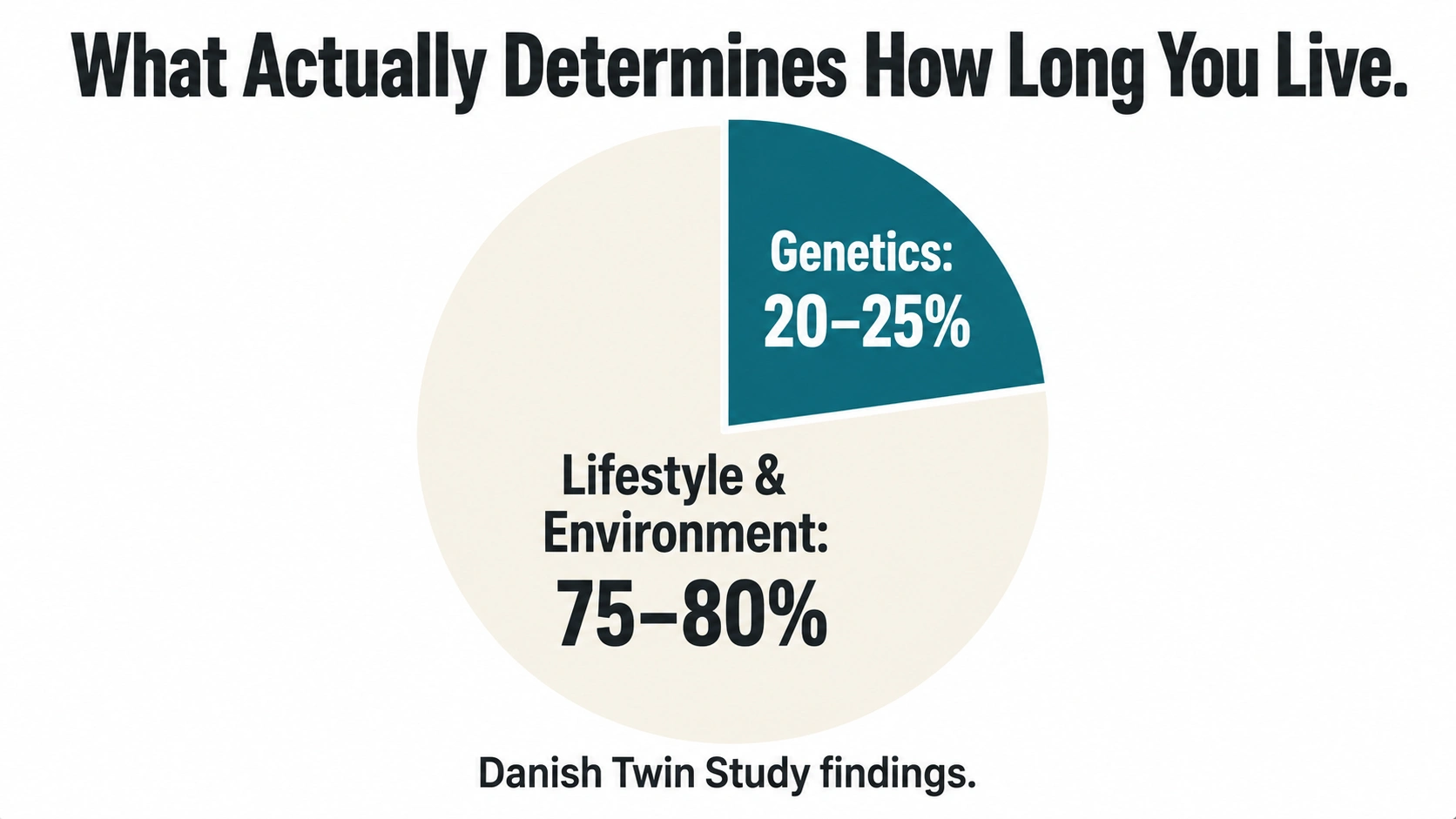
Your genes aren’t your destiny, at least not mostly. The Danish Twin Study found that roughly 20 to 25 percent of how long a person lives is shaped by genes. The remaining 75 to 80 percent comes from lifestyle and environment.⁴
That finding is what makes these five communities worth paying attention to. Their longevity isn’t a lucky accident of birth. It’s a product of how they live every single day.
What those daily habits look like is more surprising than most people expect. The one that matters most isn’t on anyone’s plate.
The Habit That Adds More Years Than Any Diet
Most people, when they think about living longer, think about food. But the Blue Zones habit most linked to extra years of life has nothing to do with what anyone eats for breakfast.
In Okinawa, it’s called ikigai [a reason for being, or the thing that makes getting up in the morning feel worth it]. In Nicoya, it’s called plan de vida [a life plan, the sense that your days are aimed at something that matters]. Both describe the same thing: a felt sense of purpose.
A study of 1,238 community-dwelling older adults published in Psychosomatic Medicine found that purpose in life is associated with a lower risk of all-cause mortality in older persons.⁵
A separate Japanese cohort study found that adults who reported a lack of ikigai had a higher risk of dying from cardiovascular disease and showed higher levels of inflammatory markers in their blood.⁶
The people eating beans and walking uphill every day are not outliving you because of the beans or the hills. They are outliving you because someone is waiting for them at the top.
Having a clear sense of purpose has been linked to up to seven additional years of life expectancy in population studies.⁷ That’s not a supplement you can buy. It’s a reason you can find.

How to start: Write down one honest answer to this question: what would you keep doing even if no one paid you and no one was watching? That answer is a starting point.
Purpose alone doesn’t explain the full picture. The next section covers what happens to the body when a person loses the people who make that purpose feel real.
How Loneliness Shortens Life as Much as Smoking
If you’ve ever felt genuinely alone, not just physically by yourself, but unseen by the people around you, your body already knows what the research took decades to prove.
In Okinawa, women maintain lifelong groups of five close friends called moai [a group of people committed to supporting each other for life, typically formed in childhood]. These groups show up for each other during illness, grief, and financial hardship, for decades. It’s a structured form of belonging built into the culture.
The numbers behind that feeling are striking. A meta-analysis of 148 prospective studies covering 308,849 participants found that lacking adequate social connection is associated with a mortality risk comparable in magnitude to smoking up to 15 cigarettes a day.⁸
That comparison benchmarks effect sizes across studies rather than running a direct clinical trial, and the researchers are clear about that distinction.⁸ But the direction of the finding is solid and has been replicated.

Weak social relationships are associated with a meaningfully higher risk of dying early.⁸
Of 263 centenarians interviewed by Buettner’s team, all but five belonged to a faith-based community.⁹ That’s not an argument for any particular religion. It’s an observation about what belonging to a group does for a person’s health over a lifetime.
Committed long-term partnerships [relationships where two people invest in each other’s wellbeing over many years] are associated with up to three additional years of life expectancy.¹⁰
The next section covers what these communities eat. But keep in mind that in Blue Zones, almost no one eats alone.
What Blue Zone Centenarians Actually Eat
Most people want a list of specific foods. The honest answer is more useful than a list, even if it’s less satisfying.
If you looked at what each of these communities put on the table, one pattern would be impossible to miss. Across all five Blue Zone communities, 90 to 95 percent of daily calories come from plants.¹¹
That doesn’t mean everyone is vegetarian. Sardinians eat meat and cheese. Nicoyans eat fish and chicken. But plants are the foundation of every meal, and the single food that appears in all five communities more consistently than any other is legumes.
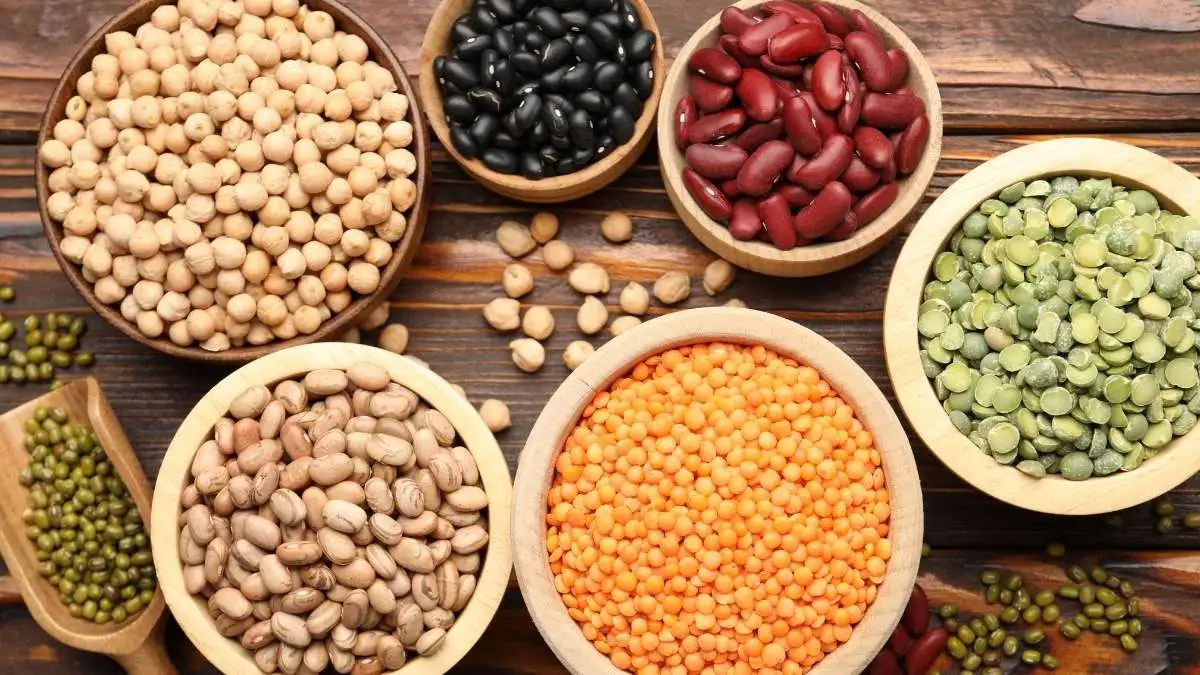
Legumes [beans, lentils, and chickpeas, the seeds of plants in the Fabaceae family] appear in all five Blue Zone communities. Black beans in Nicoya, tofu and edamame in Okinawa, lentils and chickpeas in Ikaria and Sardinia, and beans among Adventists in Loma Linda.¹¹
Older Costa Ricans in the Nicoya region who ate a traditional rice and beans diet showed longer leukocyte telomere length [the protective caps at the ends of chromosomes, which shorten as cells age and divide] in a population study.¹²
The gap is even visible within the United States. Vegetarian Adventist men in Loma Linda live an average of 9.5 years longer than other Californians.¹³ Adventist women who are vegetarian live an average of 6.1 years longer.¹³
Hara hachi bu [a Japanese phrase meaning “stop eating when you are 80 percent full”] is practiced daily in Okinawa. It’s not a diet rule. It’s a cultural habit that keeps portion sizes naturally smaller without calorie counting.
Meat is eaten in Blue Zone communities at about 2 ounces per serving, roughly five times per month on average.¹¹ It functions as a side dish or a flavoring, not a main event.
Before changing your eating habits significantly, talk to your doctor if you’re pregnant, taking medication, or managing a chronic condition.
The diet is part of the picture. But the way centenarians move through the day keeps the picture in focus.
Why They Never Go to the Gym (and Still Outlive You)
Most of us think about exercise as a block of time we schedule. We go to the gym. We run. We take a class. Then we sit for the rest of the day. Blue Zone residents never designed it that way, and that turns out to matter enormously.
Natural movement [physical activity embedded in daily tasks rather than scheduled as formal exercise] is the Blue Zones habit the fitness industry doesn’t have a product to sell you.
Sardinian shepherds walk several miles a day across rugged hillside terrain as part of their jobs, not as training.¹⁴ Okinawans tend gardens daily.¹⁴ Ikarians walk to visit neighbors.¹⁴ None of them think of this as working out.
The difference adds up to more than most people realize. Research at the Mayo Clinic found that NEAT can vary by up to 2,000 calories per day between two people of similar size and body composition.¹⁵
That gap isn’t closed by a gym membership. It’s explained by how much a person simply moves throughout the day.
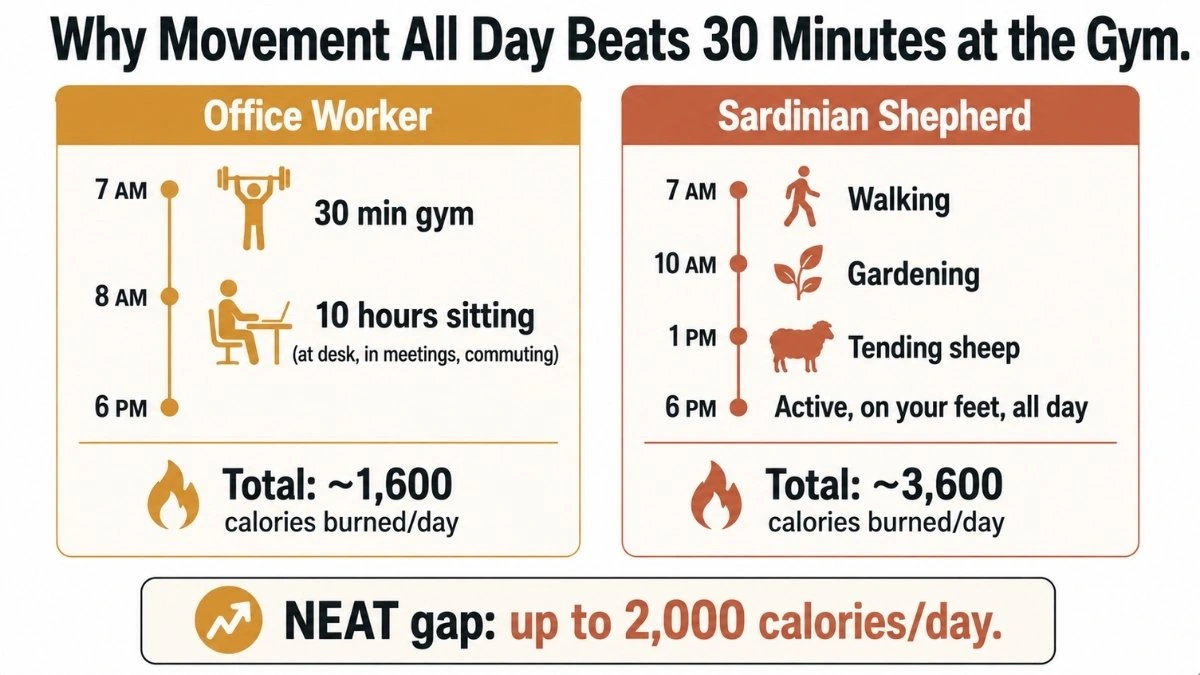
An office worker who runs for 30 minutes and then sits for 10 hours isn’t doing what a Sardinian shepherd does. The shepherd’s body is in near-constant low-intensity motion for most of the day.
What this looks like in a modern life:
- Walk or bike for short trips instead of driving
- Choose stairs over elevators
- Garden, clean the house, or do manual tasks instead of outsourcing them
- Stand while taking phone calls
- Walk to a coworker’s desk instead of sending a message
The daily stress rituals in Blue Zone communities work in the same spirit: simple, constant, and built into the day rather than scheduled for Saturday.
The Stress Ritual That Works Better Than a Vacation
You already know that stress doesn’t just go away, and the centenarians living in Blue Zone communities know it too.
People there face illness, loss, money trouble, and family conflict the same as anyone else. What’s different is that this Blue Zones habit is daily, not a weekend away, not an annual retreat.
In Ikaria, neighbors gather most afternoons for coffee and conversation.¹⁶ In Sardinia, many adults take a midday nap.¹⁶ In Okinawa, residents pause each day to quietly remember their ancestors.¹⁶ Among Adventists in Loma Linda, a 24-hour Sabbath each week provides a full stop from work and obligation.¹⁶

When stress never fully resolves, the body pays a price. Chronic inflammation [a persistent, low-level activation of the immune system that, over time, is associated with heart disease, Alzheimer’s disease, and other age-related conditions] is linked to that unresolved stress.¹⁶
Every Blue Zone has rituals that interrupt that cycle daily. The rituals are linked to lower cortisol [the body’s primary stress hormone, which when chronically elevated can raise blood pressure, disrupt sleep, and suppress immune function].¹⁶
The specific ritual matters less than the consistency of it. Okinawans aren’t healthier because they remember their ancestors and Ikarians aren’t healthier because of afternoon coffee.
Both are healthier because they stop, every single day, and let the stress of the morning dissolve before the afternoon begins.
That practice doesn’t require a plane ticket or a long weekend. It requires about five minutes and a habit that sticks, and the only question left is which one you’ll start with.
Start With One Thing
Pick the Blue Zones habit from this article that fits most easily into your life and try it today.
You don’t need to change everything at once. Purpose, social connection, legumes, daily movement, and a short daily stress ritual are each worth more than most supplements on any shelf.
Pick one habit from this article and try it today, starting with the one that fits most easily into your existing routine. That’s the longevity lesson every centenarian in every Blue Zone lived, one small thing, every day, until it became who they were.
References
- Centenarian rate up to 10 times the US average in Blue Zone communities. NutritionFacts.org, citing Buettner/Blue Zones research. 2024. https://nutritionfacts.org/topics/blue-zones/
- Five Blue Zone communities identified: Okinawa, Sardinia, Ikaria, Nicoya, Loma Linda. NCBI Bookshelf, “Lessons from the Blue Zones,” National Academies Press. 2015. https://www.ncbi.nlm.nih.gov/books/NBK298903/
- NIA-funded research; demographers used census data to verify longevity in five communities. NCBI Bookshelf, “Lessons from the Blue Zones,” National Academies Press. 2015. https://www.ncbi.nlm.nih.gov/books/NBK298903/
- Danish Twin Study: roughly 20-25% of lifespan is heritable; 75-80% shaped by lifestyle and environment. NCBI Bookshelf (citing Herskind et al., Human Genetics, 1996). 2015. https://www.ncbi.nlm.nih.gov/books/NBK298903/
- Boyle PA, Barnes LL, Buchman AS, Bennett DA. Purpose in life is associated with mortality among community-dwelling older persons. Psychosomatic Medicine. 2009;71(5):574-579. https://pubmed.ncbi.nlm.nih.gov/19414613/
- Sone T et al. (as cited in Kreouzi M et al.). Lack of ikigai associated with higher CVD mortality and elevated inflammatory markers in a Japanese cohort. Kreouzi M et al. SAGE Open Medicine. 2022. https://journals.sagepub.com/doi/10.1177/15598276221118494
- Having a clear sense of purpose associated with up to 7 additional years of life expectancy in population studies. Blue Zone Blueprint, citing Boyle et al. 2009 and Blue Zones Power 9 data. 2026. https://www.rrh.org/news-updates/2026/march/the-blue-zone-blueprint-what-the-worlds-longest-/
- Holt-Lunstad J, Smith TB, Layton JB. Social relationships and mortality risk: a meta-analytic review. 148 studies, 308,849 participants. PLOS Medicine. 2010;7(7):e1000316. https://www.ncbi.nlm.nih.gov/pmc/articles/PMC2910600/
- 258 of 263 centenarians interviewed by Buettner’s team belonged to a faith-based community. Blue Zone Blueprint, citing Buettner research. 2026. https://www.rrh.org/news-updates/2026/march/the-blue-zone-blueprint-what-the-worlds-longest-/
- Committed partnerships associated with up to 3 additional years of life expectancy. University of Florida Medical Physiology, citing Blue Zones research. 2024. https://distance.physiology.med.ufl.edu/about/articles/the-secrets-behind-blue-zones-why-people-are-living-longer/
- Blue Zone diets 90-95% plant-sourced; legumes present in all five zones; meat roughly 2 oz, five times per month. Smart Health Reporter, citing Buettner/Blue Zones research. 2026. https://smarthealthreporter.com/articles/blue-zones-longevity-secrets.php
- Traditional Costa Rican rice and beans dietary pattern associated with longer leukocyte telomere length in elderly Costa Ricans. Madrigal-Leer N et al. Diet and Leukocyte Telomere Length in a Population with Extended Longevity: The Costa Rican Longevity and Healthy Aging Study (CRELES). Nutrients. 2021;13(8):2585. https://www.ncbi.nlm.nih.gov/pmc/articles/PMC8401744/
- Adventist vegetarian men live 9.5 years longer and women 6.1 years longer than other Californians. Adventist Health Study. adventisthealthstudy.org. https://adventisthealthstudy.org/studies/AHS-1/findings-longevity
- Sardinian shepherds walk several miles daily; Okinawans garden daily; Ikarians walk to visit neighbors. Mayo Clinic Press, “The Blue Zone Diet and Lifestyle.” 2024. https://mcpress.mayoclinic.org/healthy-aging/the-blue-zone-diet-and-lifestyle-why-centenarians-are-anything-but-blue/
- NEAT varies by up to 2,000 calories per day between people of similar size. Slowingtheclock.com, citing Dr. James Levine, Mayo Clinic research. 2026. https://slowingtheclock.com/blue-zones-and-movement/
- Daily stress rituals in Blue Zone communities; chronic inflammation linked to unresolved stress; cortisol associated with stress rituals. NCBI Bookshelf, “Lessons from the Blue Zones.” 2015. https://www.ncbi.nlm.nih.gov/books/NBK298903/