

You are already doing something right by eating yogurt. Most people eating yogurt for gut health, though, are choosing the wrong kind, eating it at a time that reduces how many live bacteria actually reach their gut, and skipping the one pairing that makes those bacteria thrive.
The question of the best time to eat yogurt for gut health has a clear answer, and it comes with something more useful alongside it.
This article is for health-motivated adults who eat yogurt regularly and want to know if their habit is actually working. The answer to the timing question is in here. So is the reason it’s the last thing you should worry about.
What Yogurt Actually Does to Your Gut
If you have ever wondered whether yogurt is genuinely doing anything for your gut, the science says yes, and the change is measurable.
You can actually see what changes in your gut from yogurt, and a 2025 randomized controlled trial published in Frontiers in Nutrition shows exactly that. Researchers followed 47 healthy adults eating 180 grams of yogurt daily for four weeks.
By the end, yogurt eaters showed significant increases in gut microbial diversity, including higher counts of a bacterium called Akkermansia [a microorganism associated with a healthy gut lining] compared to the group that did not eat yogurt.¹

A separate 2022 study out of King’s College London found that people who regularly consumed yogurt had higher levels of the live starter bacteria from the yogurt itself detected in their gut, along with reduced visceral fat [fat stored around the internal organs, linked to metabolic disease].²
Those are real changes. They show up in fecal samples and in blood markers.
Both studies involved people eating yogurt consistently, choosing products with live cultures, and eating it as part of a regular diet. The gut response does not come from a single cup eaten at a specific hour. It comes from habit.
The best time to eat yogurt for gut health is whatever time you will eat it every day.
The Variable That Matters More Than the Best Time of Day
Asking when to eat yogurt for gut health is like asking what time to water a plant while ignoring whether the pot has holes in it.
The real variable is consistency. The bacteria in yogurt are transient probiotics [live microorganisms that pass through the digestive tract without permanently taking up residence]. They do not move in and stay. They do their work while passing through, then they are gone. That means yesterday’s serving is already spent.
Here is what a decade’s worth of research points to: sustained daily intake changes your gut in ways that occasional servings don’t. A 10-week randomized trial published in Cell by researchers at Stanford followed 36 healthy adults through either a high-fermented-food diet or a high-fiber diet.³
The fermented food group, which ate three to six daily servings of foods including yogurt, kefir, and fermented vegetables, showed measurable increases in gut microbial diversity and decreases in 19 inflammatory proteins. The fiber group showed no comparable diversity increase.

A UK study using National Diet and Nutrition Survey data from nearly 4,000 children and adults found that people eating yogurt regularly, defined as three to four days per week, had better nutrient adequacy and higher overall diet quality than those eating it occasionally.⁴
Daily yogurt consumption is the anchor. Timing of day is a secondary question, and a small one. Get the frequency right first.
Why Eating It Alone on an Empty Stomach Hurts More Than Helps

You might have heard that eating yogurt first thing in the morning on an empty stomach gives the bacteria the best chance to survive. That idea sounds logical. The research points in a different direction.
This is where the science gets practical for you. Your stomach produces gastric acid [a strong digestive acid that breaks down food and kills harmful bacteria, but can also destroy probiotic bacteria before they reach the intestine].
When your stomach is empty, that acid sits undiluted at a low pH. Sending probiotics through an empty stomach is the hardest route for them.
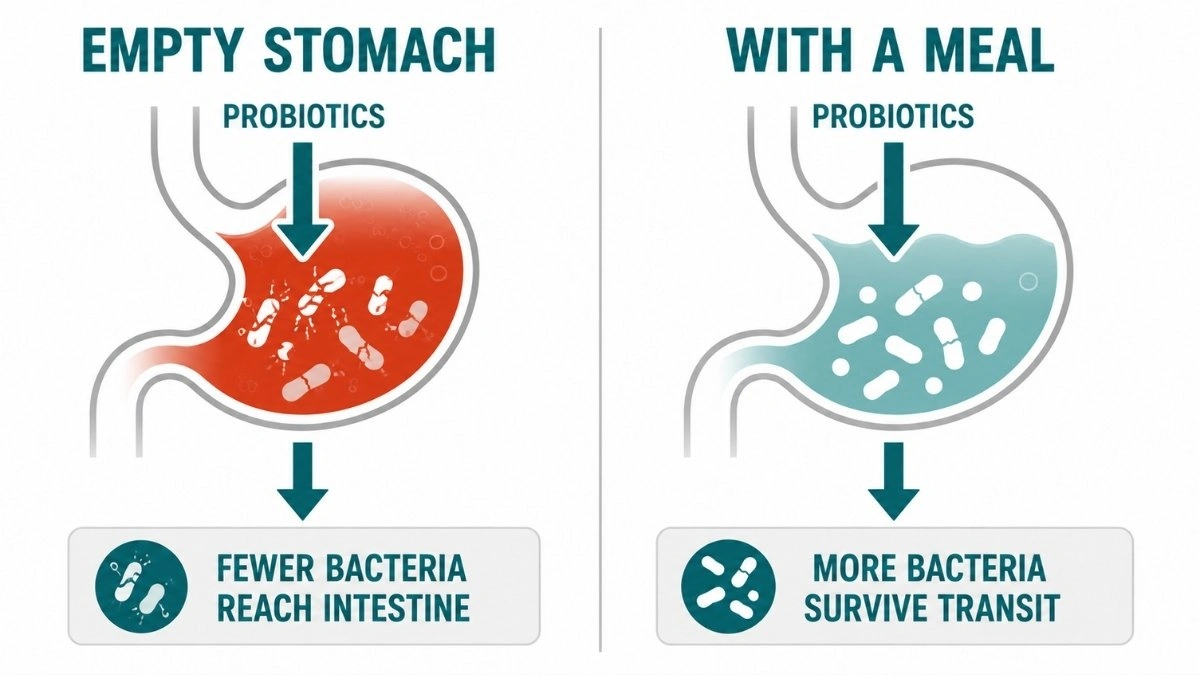
A study published in Beneficial Microbes used a validated in vitro model of the human upper gastrointestinal tract to test when probiotics survived best.⁵
The researchers tested a commercial multi-strain probiotic at three time points: with a meal, 30 minutes before a meal, and 30 minutes after. Survival was highest with a meal or 30 minutes before.
Survival dropped sharply 30 minutes after, precisely when gastric acid production peaks. A 2025 laboratory study testing Lactobacillus rhamnosus GG under simulated digestion conditions found the same pattern: consuming it with or after a meal improved bacterial viability compared to an empty-stomach scenario.⁶
Both of these studies used laboratory models, not human subjects eating yogurt specifically. They cannot prove the exact effect in every person. What they establish is the mechanism, and that mechanism applies to the bacteria in yogurt too.
Yogurt’s dairy matrix does offer some natural protection for its bacteria. But that protection gets stronger when food is already in your stomach.
What to Eat Alongside Yogurt to Make the Bacteria Survive

Talk to your doctor before changing your diet if you’re pregnant, on medication, or managing a chronic condition.
What you eat yogurt with changes how many bacteria actually make it to your intestine.
The Beneficial Microbes study tested two types of meals alongside the probiotic: milk with 1% fat and oatmeal cooked in milk.⁵ Both produced significantly better bacterial survival than apple juice or plain water.
The researchers found that fat content was the key variable, not protein content.
Fat protects bacteria. A small amount of dietary fat slows gastric emptying, keeps stomach pH from dropping as fast, and gives probiotic bacteria a better chance of surviving the trip to the small intestine.
Add Healthy Fat
to Your Yogurt Meal
Four practical ways to boost fat-soluble
nutrient absorption at any meal.
- Option 01 A Small Handful of Nuts or Seeds
Walnuts, almonds, or pumpkin seeds add healthy unsaturated fats plus crunch — and take zero prep time to include.
- Option 02 A Drizzle of Olive Oil
Extra-virgin olive oil on a side dish or salad brings monounsaturated fat and polyphenols to the meal with minimal effort.
- Option 03 Whole-Grain Toast + Nut Butter
A thin spread of almond or peanut butter adds fat and plant protein alongside the fibre of whole-grain bread.
- Option 04 Half an Avocado
One of the richest sources of oleic acid and potassium — eat it alongside or slice it into a savoury yogurt bowl.
The second upgrade is a prebiotic pairing [adding fiber-rich foods to the same meal that act as food for probiotic bacteria once they arrive in the colon].
Inulin-type fibers found in foods like banana, oats, garlic, and chia seeds have been studied for their ability to support Lactobacillus and Bifidobacterium growth once those bacteria reach the large intestine.⁷
The practical takeaway: eat yogurt as part of a meal that includes a small amount of fat and at least one fiber-rich food. Breakfast with oats, a handful of nuts, and plain yogurt checks both boxes. So does an evening meal where yogurt sits alongside a salad dressed with olive oil.

Choosing the right yogurt and eating it with a meal every day still only works if both of those things happen consistently enough to matter.
How to Read a Yogurt Label So the Bacteria Are Actually Alive
Here is the part that surprises most people. The word “yogurt” on the label does not guarantee there are live bacteria inside.
You have probably read that label without knowing what it means.
The FDA requires all yogurt to be fermented with two specific starter cultures: Streptococcus thermophilus [one of two bacteria required by the FDA to make yogurt] and Lactobacillus bulgaricus [the second required starter culture, which works with Streptococcus thermophilus to ferment milk into yogurt].

Some manufacturers heat-treat the finished yogurt to extend shelf life. That process kills the live cultures.⁸
What to look for:
- The phrase “live and active cultures” on the label, or the LAC seal from the International Dairy Foods Association, which certifies at least 100 million live cultures per gram at time of manufacture⁸
- Specific bacterial strain names listed in the ingredients
- No language saying “heat-treated after fermentation”
What to avoid:
- Yogurts with more than 10 grams of added sugar per serving. Research reviewing both human and animal data found that added sugars, including glucose, fructose, and sucrose, can be associated with depleted short-chain fatty acid-producing bacteria in the gut and altered microbial diversity.⁹
- Frozen yogurt, which does not meet the same standards
Greek yogurt is a fine choice if it carries live cultures. Straining concentrates the protein but does not change whether the bacteria survived the manufacturing process. Check the label the same way.
Even the best yogurt habit falls apart if you skip more days than you show up.
Why Once a Week Does Nothing and What Daily Actually Changes
Most people eat yogurt when they think about it. A cup on Sunday, maybe one Thursday, skipping the rest of the week. That pattern does not produce the gut changes the research shows.
The reason inconsistency fails you comes down to how these bacteria work. They do not move in and stay. Each serving passes through and is gone within a day or two. There is no accumulation effect. There is no benefit carried forward.
Both studies that showed meaningful gut changes used daily, sustained intake. The Kyushu University trial used 180 grams per day for four weeks.¹
The Stanford trial used three to six daily servings of fermented foods for ten weeks.³ More daily servings produced stronger diversity effects than fewer.
The daily habit that works:

One serving of plain yogurt with live and active cultures, around 150 to 180 grams, eaten as part of a regular meal. Do that Monday through Sunday, not Monday through Wednesday and then again Sunday when you remember. The gut does not store credit.
The best time of day is still the honest question you came here with. The answer is: the meal you will eat it with every single day without skipping.
Morning works if breakfast is your most consistent meal. Evening works if dinner is. Making this practical comes down to one thing that is simpler than it sounds.
Conclusion
Pick the meal you never skip and add plain yogurt with live and active cultures to it starting today. Switch from flavored yogurt to plain yogurt with live and active cultures, eat it daily alongside a meal rather than alone on an empty stomach, and add a prebiotic food to the same meal. The best time to eat yogurt for gut health is whatever time turns it from an occasional habit into a daily one. That shift is the one the research actually supports.
References
- Choi J, Takeda M, Managi S. Dietary and environmental modulation for the gut environment: yogurt promotes microbial diversity while chloride hot springs improve defecation status in healthy adults. Frontiers in Nutrition. 2025. https://www.ncbi.nlm.nih.gov/pmc/articles/PMC12273587/
- Le Roy CI, Kurilshikov A, Leeming ER, et al. Yoghurt consumption is associated with changes in the composition of the human gut microbiome and metabolome. BMC Microbiology. 2022. https://pubmed.ncbi.nlm.nih.gov/35114943/
- Wastyk HC, Fragiadakis GK, Perelman D, et al. Gut-microbiota-targeted diets modulate human immune status. Cell. 2021. https://pubmed.ncbi.nlm.nih.gov/34256014/
- Associations between frequency of yogurt consumption and nutrient intake and diet quality in the United Kingdom. British Journal of Nutrition (PMC). 2021. https://www.ncbi.nlm.nih.gov/pmc/articles/PMC8532067/
- Tompkins TA, Mainville I, Arcand Y. The impact of meals on a probiotic during transit through a model of the human upper gastrointestinal tract. Beneficial Microbes. 2011. https://pubmed.ncbi.nlm.nih.gov/22146689/
- Effect of Food Matrix and Administration Timing on the Survival of Lactobacillus rhamnosus GG During In Vitro Gastrointestinal Digestion. PMC. 2025. https://www.ncbi.nlm.nih.gov/pmc/articles/PMC12428712/
- Kumari S, et al. Synergistic role of prebiotics and probiotics in gut microbiome health: Mechanisms and clinical applications. Food Bioengineering. 2024. https://onlinelibrary.wiley.com/doi/full/10.1002/fbe2.12107
- International Dairy Foods Association. Live and Active Cultures Seal. https://www.idfa.org/live-active-cultures-seal
- Added sugars, gut microbiota, and host health. PMC. 2025. https://pmc.ncbi.nlm.nih.gov/articles/PMC12674407/