
You already know the basics: move more, eat better, sleep well. The problem isn’t knowing what to do.
Most adults in their 40s and 50s who want to know which habits are worth their time have no clear way to rank them, so they spread effort thin across everything and gain little from any of it. In 2024, researchers published findings from over 700,000 US veterans and identified eight specific habits linked to a longer life.
Each one was measured separately. Each one had a number attached. This article gives you those numbers so you can decide where to start.
Talk to your doctor before starting a new exercise routine if you have a heart condition, joint problems, or any chronic illness.
The Eight Habits, Ranked by What the Research Actually Found

You clicked this because you wanted a real answer, not another tie. Here it is: the habits are not equal, and the study measured exactly how unequal they are. This is the clearest research picture yet on which habits are actually linked to a longer life.
Researchers tracked 719,147 US veterans aged 40 to 99 enrolled in the VA Million Veteran Program between 2011 and 2019. They looked at eight lifestyle factors and measured how much each one changed the risk of dying during the study period.
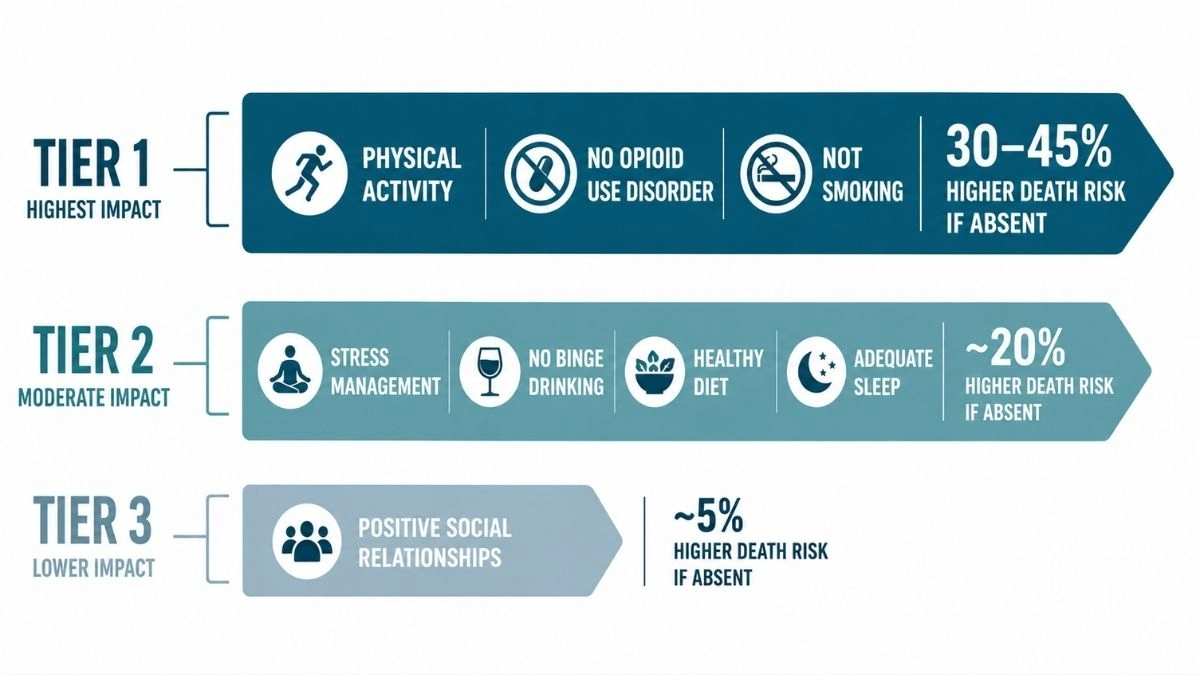
The eight habits, grouped by their impact:
Tier 1: High impact (30 to 45 percent higher death risk if absent)
- Being physically active
- Not having an opioid use disorder [a condition in which a person cannot control their use of opioid drugs despite serious harm to their health or life]
- Not smoking
Tier 2: Moderate impact (about 20 percent higher death risk if absent)
- Managing stress
- Not binge drinking
- Eating a good diet
- Getting enough sleep
Tier 3: Lower impact (about 5 percent higher death risk if absent)
- Having positive social relationships
Men with all eight habits at age 40 were projected to live 24 more years than men with none of them. Women gained 21 years.
What the tier structure tells you matters as much as the habits themselves. The next section explains why the gap between Tier 1 and everything else is as large as it is.
Why the Top Three Are in a Different Category
Most people treat healthy habits like a buffet: take a little of each and call it balanced. The research does not support that.
Not all healthy habits carry the same weight. Skipping the top three is roughly nine times more dangerous than skipping the one at the bottom of the list.
In the veteran study, physical activity, no opioid use disorder, and not smoking were each independently linked to a 30 to 45 percent higher risk of dying during the study period when absent. The habits in Tier 2 each added about 20 percent. Weak social connections added around 5 percent.
The exercise finding is backed by other research.
A 2020 meta-analysis of 15 cohort studies using device-measured physical activity found that adults in the highest activity category had up to 56 percent lower mortality risk compared to those in the lowest category for moderate-to-vigorous activity.
That figure uses accelerometers, not self-reported questionnaires, which tend to undercount the benefit.
Exercise and longevity research consistently places physical activity at or near the top of any ranked list. This is not a coincidence or a quirk of the veteran study. It holds across populations, ages, and countries.

Smoking is linked to a loss of at least a decade of life expectancy compared to never smoking, based on a large US cohort study.
If you smoke and you’re also trying to build better sleep habits, the order matters. But first, it helps to understand what the study actually counted as exercise.
What Physical Activity Actually Means in These Studies
You might already move a lot. Walking the dog, taking the stairs, being on your feet most of the day. That might not be enough.
The research defines physical activity [any movement that raises your heart rate above its resting level for a sustained period] in a specific way when studying mortality risk.
The standard benchmark used in the field is 150 minutes per week of moderate intensity exercise or 75 minutes per week of vigorous intensity exercise, as set by the US Physical Activity Guidelines for Americans.
A 30-year prospective study of US adults published in Circulation found that meeting the long-term moderate activity guideline was linked to 19 to 25 percent lower mortality risk compared to no activity. Meeting the vigorous activity guideline was linked to 19 percent lower all-cause mortality risk.
What counts:
- Brisk walking (where you can talk but not sing)
- Cycling
- Swimming
- Running or jogging
- Dancing
- Heavy yard work or gardening that raises your heart rate
What does not count toward this standard:
- Standing at a desk
- Slow walking
- Light housework
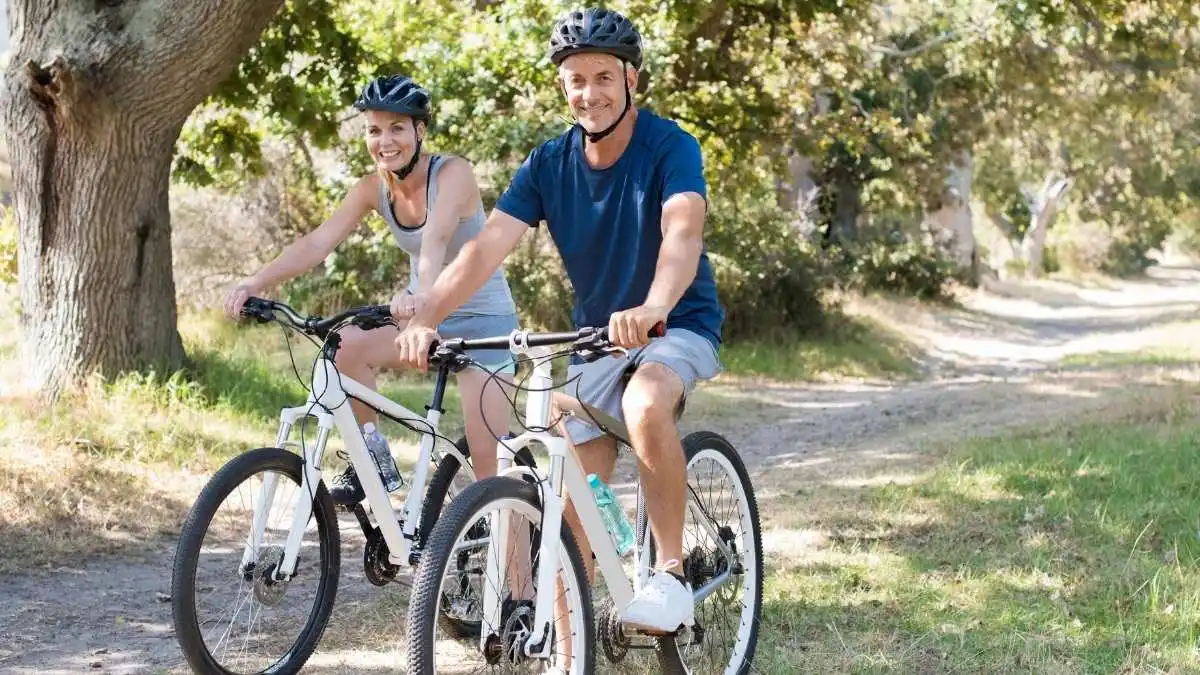
The good news: you don’t need to start at 150 minutes. The research shows that even small amounts of activity reduce death risk, and the veteran study found benefits at every level, including for people who adopted their first habit at 60.
What each section of this article is building toward is which habit to add when you have limited time and energy. That answer is coming. But Tier 2 deserves its own look first.
The Four Habits in the Middle
You’ve probably heard that stress and sleep matter. Here’s what the numbers actually say about how much.
These four habits each added about 20 percent to death risk when absent in the veteran study. That is not a small number. It is just smaller than the top three.
Sleep is the most underrated habit on this list among adults who think of themselves as already healthy. A meta-analysis covering 1.5 million adults found that both short and long sleep are linked to higher all-cause mortality, with seven hours per night associated with the lowest risk.
Sleeping four hours per night was linked to a 7 percent higher mortality risk compared to seven hours; sleeping 11 hours per night was linked to 55 percent higher risk.
You don’t need a specific diet. The study measured overall nutritional adequacy, not any particular eating plan. A prospective analysis of US adults aged 40 and older from NHANES data found that those with the highest diet quality were linked to 30 percent lower all-cause mortality risk compared to those with the lowest.
Stress is often treated as vague in wellness content, as though managing it is obvious.
A 2022 population-based cohort study of 189,757 people found that stress-related disorders were linked to increased all-cause mortality independent of lifestyle behaviors, with the elevated risk holding even after controlling for family history.
Binge drinking is the habit most people undercount. The study specifically measured excessive alcohol consumption, not any drinking at all.

One callout worth saving:
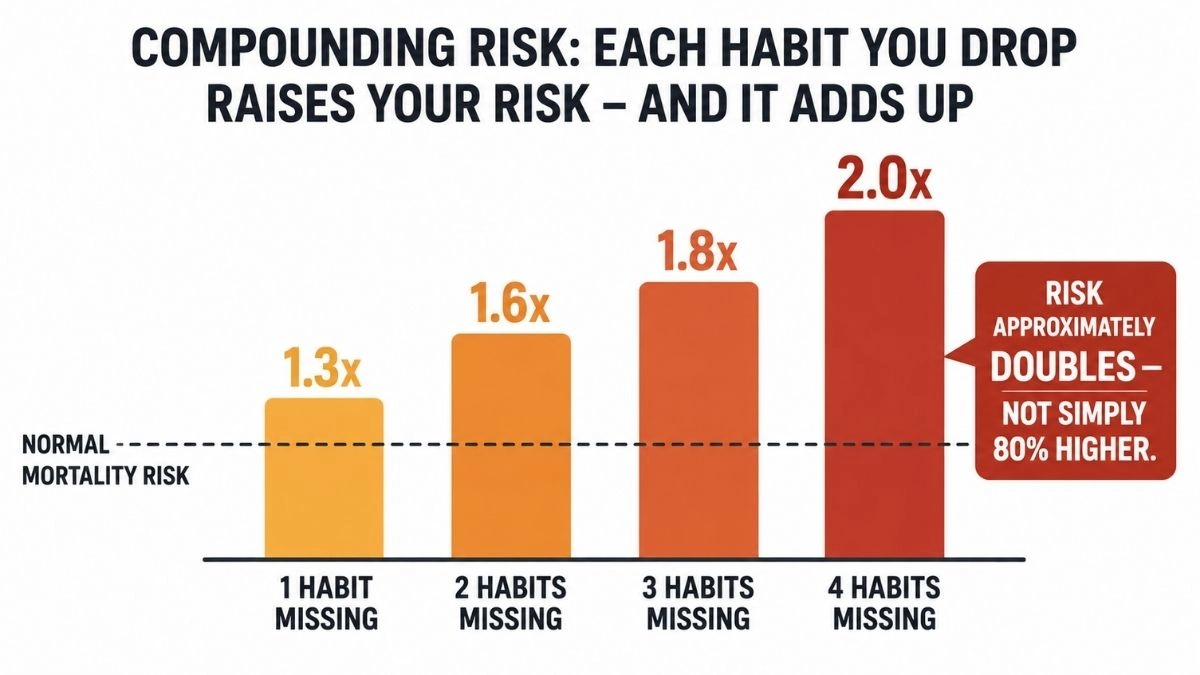
The 20 percent rule. Each of the four middle habits adds roughly 20 percent to your mortality risk when missing. If you have none of them, the combined effect is not simply additive. The veteran study shows hazard ratios that compound with each missing habit.
Four missing habits does not mean 80 percent higher risk. It means something closer to doubling it, based on the progression of hazard ratios in the study data.
What these four habits share tells you something about how the body accumulates risk, but the last item on the list breaks that pattern entirely.
Social Connections: Last on the List, and What That Actually Means
Social connection is the most talked-about longevity habit of the past five years. It ranked eighth in this study.
The veteran study found that lacking positive social relationships was linked to about 5 percent higher mortality risk during the study period. That is real. It is not nothing. But it is the smallest effect of all eight habits by a significant margin.
There are two reasonable explanations: veterans may already have strong social networks through military service and VA communities, and the study measured each habit’s independent contribution after controlling for the others.
Other research on social connection and longevity in non-veteran populations finds larger effects.
A 2024 meta-analysis of 86 prospective studies found loneliness linked to a 14 percent higher all-cause mortality risk among older adults. Social isolation was linked to 35 percent higher risk.

What this means practically: social connection matters. It belongs on the list. But if you’re working on your first or second habit and choosing between joining a gym and joining a book club, the mortality data says start with the gym.
The last section puts all of this into a usable order.
How to Start Building Habits Linked to a Longer Life
Seeing eight habits ranked by mortality risk is only useful if you know which one to try first.
The veteran researchers said it plainly: the earlier the better, but a change made in your 40s, 50s, or 60s still helps. A 40-year-old who adopts four of the eight habits gains about 10 extra years of life expectancy compared to someone with none. A 60-year-old still gains nearly 20 years with all eight.
If you currently smoke, quitting is the highest-priority single change. Smoking is linked to a loss of at least a decade of life expectancy compared to never smoking, and adults who quit between ages 25 and 34 regain about 10 of those years.
For non-smokers, physical activity gives you the highest return. Start with 20 to 30 minutes of brisk walking three times per week and build toward 150 minutes.
Already exercising and not smoking? The four middle habits are roughly equal in weight, so pick the one that has deteriorated most. Poor sleep often has the highest impact because it degrades your ability to make better choices in every other area.
A one-question shortcut: Which of the eight habits is most absent from your life right now? Start there, not with the one that sounds most manageable.
Final Thought:
Start with physical activity this week, even if it is only a 20-minute walk. Pick one habit from the list and start it this week, beginning with whichever one feels most manageable. The research on habits linked to a longer life is clear: adding even a single factor moves the number, at any age.