

You’ve been taking your probiotic. Maybe every morning with breakfast, maybe whenever you remember, maybe at night before bed.
And you’re still not sure it’s working. Adults over 50 who take or are considering morning and night probiotics deserve a straight answer on this, because the timing question is not as simple as most articles make it.
Your gut after 50 does not work the same way it did at 35. That changes everything about when you should take a probiotic and why. By the end of this article, you’ll know which timing window fits your gut’s specific problem right now.
Why Your Gut After 50 Is a Different Animal
You’re not imagining it. Your gut actually is harder to manage after 50, and the bacteria inside it are a big part of why.
The gut you had at 35 is not the gut you have now, and research on more than 9,000 people aged 18 to 101 shows exactly why. The gut microbiome begins to shift noticeably starting in the 50s, and the changes that mark healthy aging are very different from what most people expect.
What actually declines is the group of bacteria most associated with gut health and regularity. In older adults, beneficial bacteria including Bifidobacterium and Lactobacillus decrease, while harmful species tend to increase.

A separate study tracking gut Bifidobacterium species across 441 healthy subjects aged 0 to 104 found that certain Bifidobacterium species decline specifically in subjects over 50 years old.
This matters for probiotics because you are not adding good bacteria to a neutral environment. You are adding them to a gut that has already changed. So the gut you are adding probiotics to is lower in beneficial bacteria and less predictable about when it does what.
There is one more shift worth knowing about, and it affects when your probiotic works best. More than half of the total gut microbial composition fluctuates rhythmically throughout the day, tracking with the body’s internal clock. After 50, that internal clock weakens too.
That sets up the central question this article answers about morning and night probiotics: if your gut has two problems, can one probiotic fix both at once?
The Two Jobs Your Probiotic Can Do (And Why They Need Different Clocks)
Most people think of a probiotic as one thing that does one thing. Take it, gut gets better, done. But once you’re past 50, that’s not quite how it works.
When it comes to morning and night probiotics, this is the frame most people are missing. Your probiotic does not have one job after 50. It has two, and each job has its own best window.
Job one is motility. Motility [the movement of food and waste through the digestive tract] is what keeps digestion regular. If your main gut complaint is bloating, slow digestion, or constipation, this is the job you need your probiotic focused on.
Constipation affects 30% to 40% of adults over 65, making it one of the most common gut problems in this age group. A probiotic aimed at motility works best when the gut is already active and moving, which points toward a specific time of day.
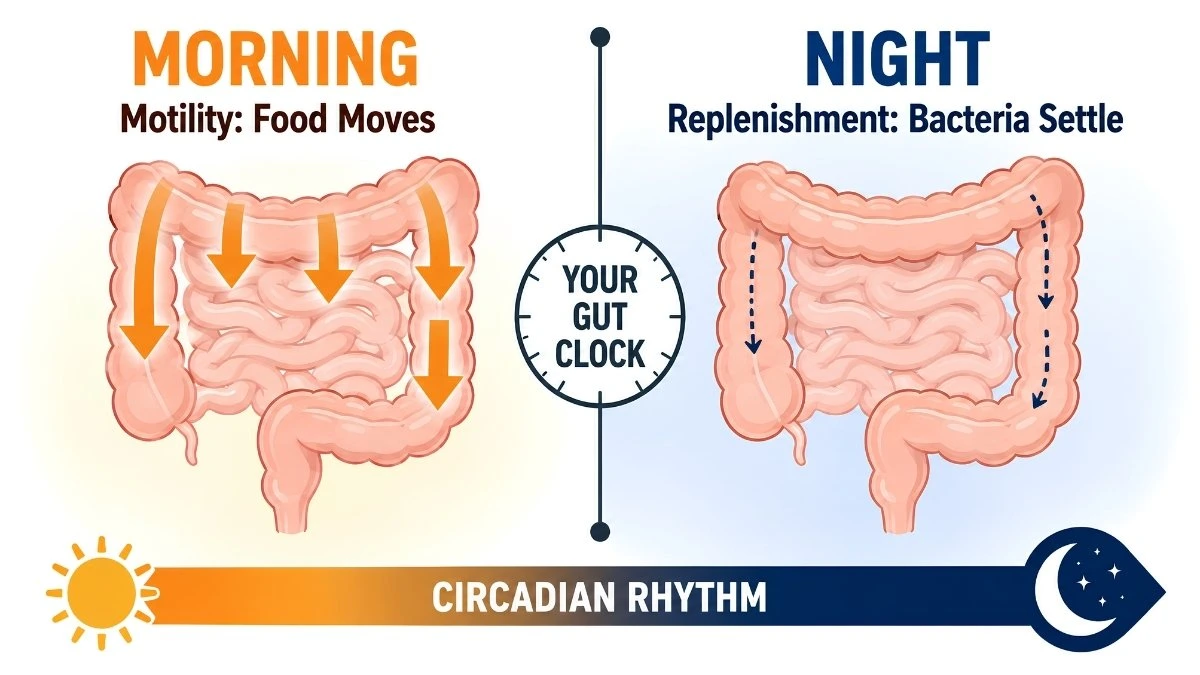
Job two is replenishment. This means adding back the bacteria the aging gut has lost, especially Bifidobacterium [a group of beneficial bacteria that declines with age and plays a key role in gut barrier strength and immune function].
This job does not require speed. It requires time. The bacteria need a slower, calmer gut environment to settle and establish, which also points toward a specific time of day.
Here is the part no other article on this topic says plainly: the gut clock, which tracks your body’s circadian rhythm [the 24-hour internal cycle that governs when your body is active, resting, digesting, and repairing], means these two jobs are not available at the same time.
Research confirms that more than half of gut microbial composition fluctuates rhythmically throughout the day. Morning and night are genuinely different biological environments for bacteria.
The gut you want to support at 7 a.m. is not the same gut you are working with at 10 p.m.
Morning Probiotics: Helping Food Move Through Faster

If your gut’s biggest problem right now is slow digestion, inconsistent bowel movements, or that sluggish, full feeling that lingers too long after meals, morning timing was built for you.
Talk to your doctor before changing your supplement routine if you’re pregnant, on medication, or managing a chronic condition.
Here is what morning has going for it. The gut is more physically active when you are up and moving. Motility increases during waking hours, which means bacteria introduced in the morning enter a moving environment, one that is already set up to push things through.
The timing within the morning also matters. In a study using a model of the human upper digestive tract, probiotic survival was highest when the supplement was taken with a meal or 30 minutes before eating.
Food raises the stomach’s pH [the measure of acidity, with lower numbers being more acidic and harder for bacteria to survive], which gives more bacteria a better chance of making it through the stomach alive and reaching the intestines where they do their work.

Take with breakfast, not after, not an hour later. A clinical trial of 100 adults including a subgroup aged 51 to 65 found that a specific Bifidobacterium strain (B. lactis HN019) significantly reduced whole gut transit time compared to placebo, with the high-dose group dropping from a mean of 49 hours to 21 hours over 14 days.
Transit time is how long it takes food to travel from your mouth to exit. Shorter is generally better for gut comfort and regularity.
Morning Probiotic Protocol
Four steps for consistent, effective probiotic use.
- Step 01 · Timing Take It 30 Minutes Before Breakfast
Or at the very start of your meal — stomach acid is lower before eating, giving bacteria a better chance to survive transit.
- Step 02 · Pairing Pair with a Small Amount of Fat
Eggs, yogurt, or avocado buffer stomach acid and improve probiotic survival through the digestive tract.
- Step 03 · Consistency Same Meal, Same Time, Every Day
Routine is the protocol. Consistent daily timing builds the habit and keeps gut bacteria populations more stable.
- Step 04 · Patience Wait at Least Four Weeks to Evaluate
Gut microbiome changes take time. Give it a full month before deciding whether your probiotic is working.
The morning window supports motility. But if regularity is not your main problem, morning timing may not be the right starting point.
Night Timing: Rebuilding the Bacteria That Aging Quietly Removes
If your gut’s biggest problem is not slow digestion but something harder to name, a general sense that your gut balance is off, disrupted sleep, or a feeling that your system just isn’t as resilient as it used to be, night timing deserves a serious look.
Night probiotics work differently from morning probiotics, and that difference matters most for one specific group of bacteria. Here’s the Bifidobacterium after 50 reality most people never hear.
A study tracking gut Bifidobacterium species in 441 healthy subjects found that specific beneficial Bifidobacterium species decline in subjects over 50 years old.
These are not minor bacteria. Bifidobacterium strains play a central role in gut barrier strength, immune signaling, and producing compounds that reduce gut inflammation.
Replenishment is a slow job. The gut at night is calmer and slower-moving than during the day. Gastric emptying slows during sleep, which means bacteria introduced at night have more time to reach the lower intestine without being rushed through. This longer exposure time is exactly what replenishment requires.

Night timing also connects to sleep. A meta-analysis of 11 randomized controlled trials found that probiotic supplementation improves sleep quality to some extent in adults with sleep disorders and in healthy adults with condition-induced sleep disturbances.
The connection runs through the gut-brain axis [the two-way communication pathway between the digestive system and the brain, which influences mood, stress response, and sleep signals]. Bacteria that produce calming compounds do so in an environment that is quieter at night.
Night Probiotic Protocol
Four steps for effective overnight replenishment.
- Step 01 · Timing Take It 30–60 Minutes Before Bed
The gut is most receptive during rest — taking your probiotic before sleep gives bacteria time to colonise without digestive competition.
- Step 02 · Strain Choose a Bifidobacterium Formula
Bifidobacterium strains are most active overnight and are specifically linked to regularity and gut lining repair during sleep.
- Step 03 · Food Skip the Heavy Meal
A light snack is fine — it buffers the stomach without triggering the kind of heavy digestion that competes with probiotic absorption.
- Step 04 · Consistency Same Time, Every Night
Your gut microbiome runs on a circadian rhythm too — consistent nightly timing amplifies the protocol’s long-term effectiveness.
The two windows do different things, and the next section shows what happens when you use the wrong one for the wrong goal.
What Happens When You Take Your Probiotic at the Wrong Time for Your Goal
Most probiotic timing articles skip this section entirely. They tell you morning is good, night is also fine, and consistency is what matters most. All of that is true. But it leaves out the part that actually affects your results.
Mismatched timing does not make your probiotic useless. What it does is reduce how well it serves the specific goal you have.
If your goal is regularity and you’re taking your probiotic at night, you are introducing it into a gut that is slowing down for sleep.
Motility decreases during sleep. The environment that helps push things through is not active. Your probiotic is present, but the gut conditions that support its motility-related work are at their lowest.
If your goal is bacterial replenishment and you are taking your probiotic first thing in the morning on an empty stomach, the faster transit works against you.
Bacteria have less time to reach the lower intestine and establish before they are moved along. The probiotic is alive, but the window for settling is shorter than it would be at night.
This is true whether you choose morning probiotics for regularity or night probiotics for replenishment: the window and the goal need to match.

Your gut’s internal clock backs this up. Research on circadian biology in adults confirms that circadian disruption is associated with altered microbial composition and reduced microbial rhythmicity.
Working with the gut’s natural rhythm, rather than against it, supports better conditions for the bacteria you’re introducing.
Consistency still comes first. The strongest single predictor of probiotic effectiveness is taking it every day at the same time.
But when you pair daily consistency with the right timing window for your goal, you are giving the same probiotic a better shot at doing what you actually need it to do.
The question is: which goal are you trying to reach?
How to Pick Your Timing Based on Your Gut’s Biggest Problem Right Now
You don’t need a complicated quiz to figure this out. You need two honest answers.
Question one: What bothers you most right now? Choose the one that fits best.
- Slow digestion, bloating, constipation, or feeling like food sits too long
- Disrupted sleep, a general sense of gut imbalance, or lower resilience than you used to have
If you chose the first option, morning timing is your starting point. If you chose the second, night timing is where you begin.
Question two: Can you take it at that time every single day? If the answer is no, pick the time you will actually do consistently. A probiotic at the slightly suboptimal time every day outperforms the perfect timing three days a week every time.
Here is the full decision:
| Your main gut problem | Your timing window | When exactly |
|---|---|---|
| Slow digestion or constipation | Morning | 30 min before or at the start of breakfast |
| Sleep disruption or gut imbalance | Night | 30-60 min before bed |
| Both in equal measure | Morning | Consistency matters more than splitting doses |

Splitting your dose, taking half in the morning and half at night, is a common instinct. There is not yet strong clinical evidence that this approach is more effective than a single consistent dose. Pick one window and commit to it for at least four weeks before deciding whether to adjust.
Once you’ve made your choice, the probiotics after 50 question shifts from timing to patience. Four weeks is the minimum. Eight weeks is when most studies see meaningful changes.
Conclusion
Pick the one gut problem that bothers you most right now, slow digestion or disrupted sleep, match it to the right timing window from the table above, and take your probiotic at that same time every single day.
The goal is not perfect timing. The goal is the right timing for your gut’s biggest problem, done consistently enough that it can actually work. Your gut after 50 has changed. Your strategy for morning and night probiotics should match it.