

You slept seven, maybe eight hours. And you still woke up foggy.
The problem isn’t that you didn’t sleep enough hours. The problem is that most people treat sleep as a quantity, when the brain’s overnight cleaning system depends on something much more specific: the depth and continuity of slow waves during the first half of the night.
This article is for adults who sleep seven or eight hours but still wake up foggy, forgetful, or tired. By the end, you’ll understand the connection between deep sleep and brain health, why hours alone don’t measure it, and what to do differently tonight.
Your Brain Runs a Waste System That Only Switches On While You Sleep
You’ve probably never thought about how your brain gets rid of its own trash. For most of the twentieth century, neither had scientists. The brain was the one organ no one could explain.
That changed in 2012 when researcher Maiken Nedergaard’s team described a previously unknown system.¹
The brain uses channels that wrap around blood vessels to push cerebrospinal fluid [the clear liquid that surrounds and cushions the brain and spinal cord] through brain tissue during sleep. This fluid acts like a rinse cycle: it moves through, picks up waste proteins, and carries them out.
The waste it targets includes the same proteins found in high amounts in Alzheimer’s disease.
Specifically, it clears beta-amyloid [a sticky protein that builds up between brain cells and is found in high amounts in Alzheimer’s disease] and tau [a protein that can tangle inside nerve cells and damage them in diseases including Alzheimer’s].
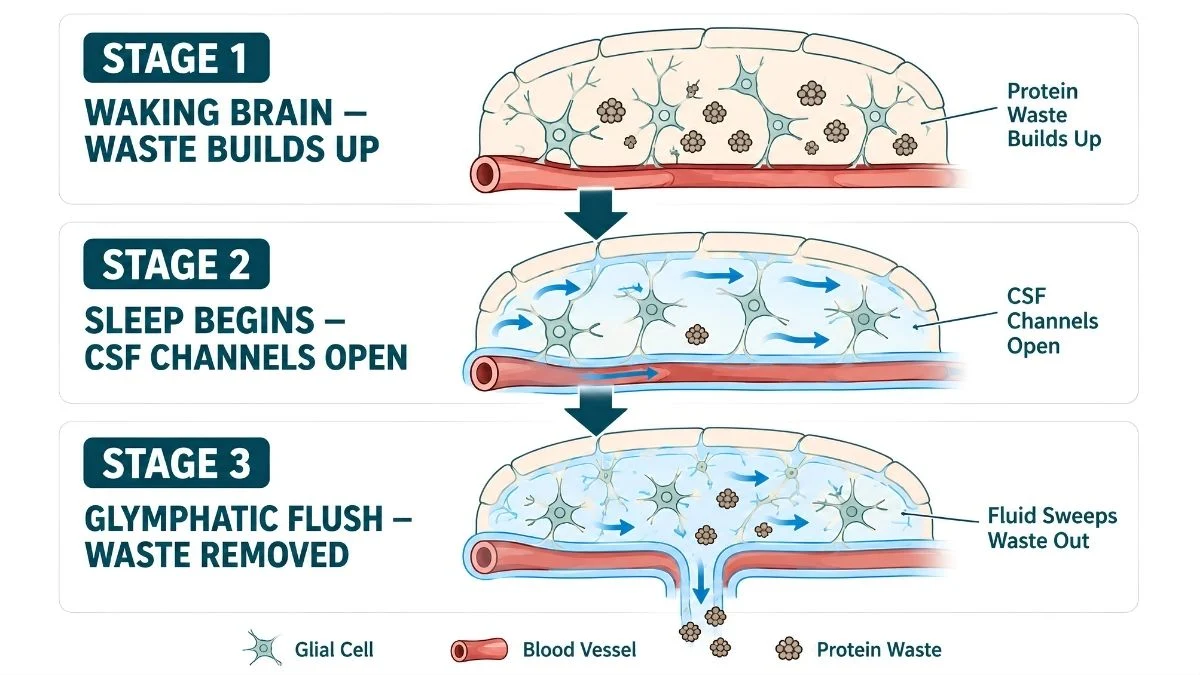
This system is called the glymphatic system [the brain’s waste-clearance network, named because it works like the body’s lymphatic system but is driven by glial cells in the brain]. It is largely switched off while you’re awake.
Research shows glymphatic clearance rises 80 to 90 percent during slow-wave sleep compared to the waking state.² This connection between deep sleep and brain health is what researchers have spent the last decade trying to map.
The brain is doing maintenance every night. Whether it finishes that work depends on something the next section explains.
The Specific Sleep Stage That Cleans Your Brain
You could spend eight hours in bed and still miss most of your brain’s cleaning window. Not all sleep counts equally for this system. That’s the part most articles skip, and it’s the part that explains why you can feel like you didn’t rest even after a full night.
Sleep runs through cycles. Deep sleep — called slow-wave sleep or N3 [the third and deepest stage of non-rapid eye movement sleep, named for the large, slow brain waves that appear during it] — is the stage where the glymphatic system does most of its work.
During N3, your brain generates slow waves that pulse at roughly 0.5 to four cycles per second. These waves drive cerebrospinal fluid [the same clear liquid described in the previous section] in rhythmic pulses through brain tissue.
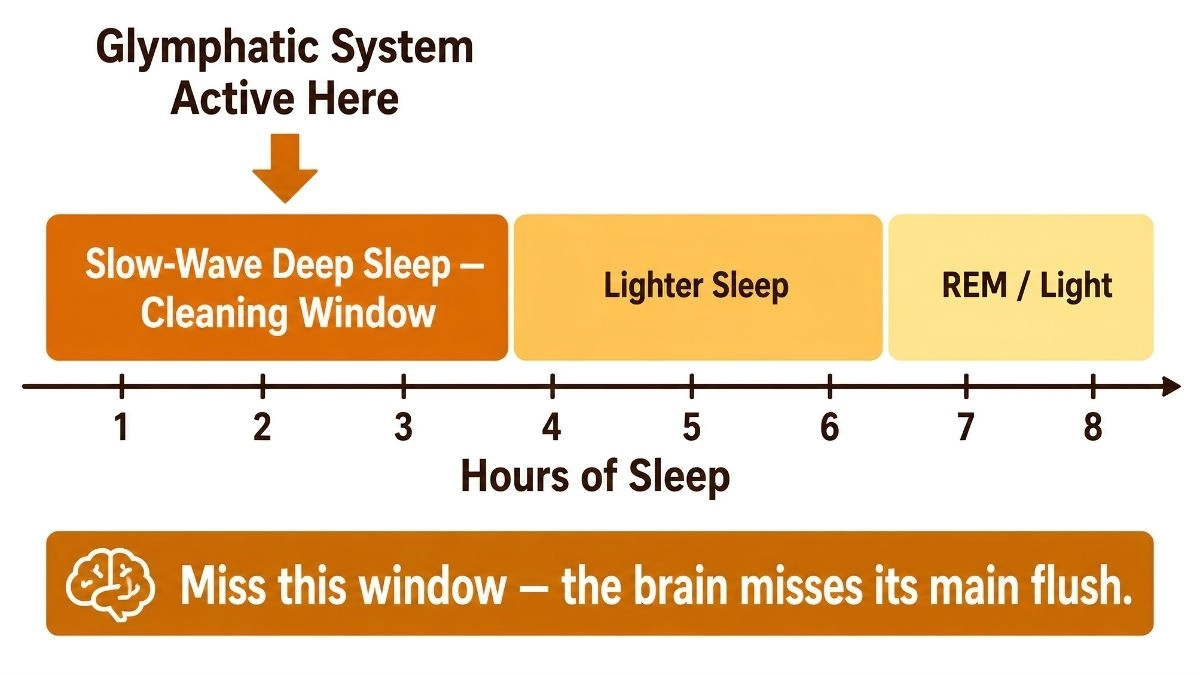
The space between brain cells expands by roughly 60 percent during this stage compared to when you’re awake, allowing fluid to move through more freely.³ This isn’t background maintenance. It’s a full flush.
Here is the part worth saving:
You can sleep eight hours and still miss almost all of your brain’s cleaning window if your slow waves are too shallow to drive the flush.
Slow-wave sleep is concentrated in the first half of the night, roughly the first three to four hours. If that window is disrupted, the brain misses its main cleaning cycle. The rest of the night, dominated by lighter sleep, does not compensate for it.
A 2019 study published in Science demonstrated for the first time in humans that slow-wave activity during deep sleep directly drives cerebrospinal fluid movement through the brain.⁴ Sleep architecture [the pattern and sequence of sleep stages across a night] isn’t a technical detail. It’s the mechanism.
The hours you sleep tell you almost nothing about whether your brain cleaned itself.
What Happens to the Waste When Deep Sleep Breaks Down
You know that feeling the morning after a rough night: the mental fog, the slow thinking, the words that won’t come. That’s not just tiredness. Something measurable happened in your brain overnight.
What One Night of Poor
Sleep Does to Your Brain
A National Institutes of Health study measured
beta-amyloid buildup after a single sleepless night.
“Five percent after one night. Not after years of poor sleep.
One night.”
- The Study NIH Brain Imaging in Healthy Adults
Researchers used PET brain scans to directly measure beta-amyloid accumulation — the protein associated with Alzheimer’s disease — before and after sleep deprivation.
- The Location Thalamus and Hippocampus
The buildup was concentrated in regions that are first to be damaged in Alzheimer’s — not random accumulation, but precisely where it matters most.
- The Urgency One Night Is Enough to Matter
This is not a long-term lifestyle finding. A single night of deprivation produced measurable amyloid increases — making each night of sleep a meaningful health decision.
A separate randomized clinical trial found that in healthy middle-aged men, one night of total sleep deprivation blocked the normal morning decrease in beta-amyloid-42 [a specific form of the beta-amyloid protein, measured in spinal fluid as a marker of Alzheimer’s-related changes in the brain] in cerebrospinal fluid. The researchers concluded that chronic sleep deprivation may gradually raise amyloid levels over time.⁶

Beta-amyloid [the same sticky protein described in the first section] doesn’t just build up because of poor sleep. Once it accumulates, it disrupts sleep. That disruption reduces clearing. Which allows more buildup.
To be clear: one bad night does not cause Alzheimer’s disease. The research shows a link, not a sentence. But the mechanism is specific, it is measurable, and it runs in the wrong direction every time slow-wave sleep is cut short.
What the studies show is what one bad night does. What the next section explains is why the problem gets harder to fix as you get older.
Why Your Brain’s Cleaning Window Is Shrinking as You Get Older
If you’re over 50 and sleeping the same hours you always did but waking up less sharp, there’s a specific reason for it. It isn’t that sleep stopped working. It’s that the quality of the deep sleep you’re getting has changed, and the cleaning system has changed with it.
Aging and deep sleep are more closely connected than most people realize. Slow-wave sleep declines with age. That’s not a disorder. It’s a documented shift that happens in healthy adults. As people get older, the slow waves that drive glymphatic clearance become shorter, less frequent, and tend to occur in isolated pulses rather than the sustained trains that produce the most efficient brain flush.⁷
A 2024 study published in Molecular Psychiatry analyzed data from 72 older adults and found that poor sleep quality was linked to reduced glymphatic function, measured directly in the brain using MRI. That reduction was in turn linked to worse memory performance.⁸

The glymphatic system’s efficiency also declines with age through a separate pathway. The aquaporin-4 channels [protein water channels in the brain’s support cells that control how cerebrospinal fluid moves through brain tissue] gradually lose their precise positioning, which slows fluid movement even when sleep is undisturbed.²
This isn’t a reason to panic. It’s a reason to treat sleep quality differently as you get older. The hours you slept at 30 delivered more slow-wave depth than the same hours at 55. Protecting the quality of what remains becomes more important, not less.
The good news is that slow-wave sleep is not fixed. What you do during the day and in the hour before bed has a direct effect on how deep your sleep goes that night.
Talk to your doctor before making significant changes to your routine if you’re managing a chronic condition, on medication, or pregnant.
Five Habits That Directly Cut Into Your Slow-Wave Depth
Some of these habits feel completely harmless. But each one targets the specific depth of slow waves, and once you know why, stopping them is a lot easier.
1. Alcohol within three hours of bedtime
Alcohol feels like it helps you sleep. It does help you fall asleep faster. What it does next is the problem. It removes the first slow-wave cycle and then causes a rebound arousal in the second half of the night as it metabolizes. A systematic review of 27 studies found that alcohol consistently reduces slow-wave sleep and fragments the second half of sleep.⁹ The brain doesn’t get its main cleaning window. It gets sedation followed by disruption.
2. Caffeine past early afternoon
Caffeine doesn’t keep most people awake. It keeps them from reaching depth.
Caffeine works by blocking adenosine [a chemical that builds up in the brain during waking hours and creates the pressure that drives you into slow-wave sleep].¹⁰ Even when caffeine doesn’t prevent sleep onset, it reduces the pressure that produces deep slow waves. The half-life of caffeine in most adults is five to seven hours. A coffee at 3 p.m. still has roughly half its effect at 9 p.m.
3. Irregular sleep timing
Slow-wave sleep is concentrated in the first part of the night biologically. Shifting your bedtime by 90 minutes or more moves the slow-wave window to a different position in the cycle, and often cuts it short. Consistency matters not because of habit, but because of where in the clock the deep sleep lands.
4. High evening cortisol
Cortisol [the body’s primary stress hormone] is linked to reduced slow-wave activity during sleep.¹¹ Stress, rumination, and vigorous exercise within two hours of bedtime can all keep cortisol elevated into the sleep window, flattening the first slow-wave cycle before it fully forms.
5. Screens in the hour before bed
Blue-wavelength light suppresses melatonin [a hormone released by the brain that signals nighttime and helps trigger the transition into sleep]. Delaying melatonin delays sleep onset. Delaying sleep onset compresses the slow-wave window, because the first deep sleep cycle still arrives roughly 90 minutes after you fall asleep, but now it starts later and ends earlier relative to your wake time.
Every one of these habits is mechanical, not motivational. The next section shows what to add once you’ve removed them.
What Deep Sleep and Brain Health Research Says to Do
You’ve already got a list of what to cut. Now here’s what research shows actually increases slow-wave depth.
Lock in a consistent bedtime
This is the single most reliable tool. Going to bed at the same time each night places slow-wave sleep in the same biological position in the cycle, maximizing what you get. Variation is the enemy. Even one night of a significantly later bedtime shifts the window and reduces depth that night.
Add moderate aerobic exercise during the day
A crossover study of 14 healthy men found that multiple sessions of moderate aerobic exercise during the day produced a 33-percent increase in slow-wave sleep that night.¹²

The timing matters. Exercise 4 to 8 hours before bed improves slow-wave depth. Exercise within two hours of bedtime can delay sleep onset and cut into the first cycle.
Cool the bedroom
Core body temperature [the internal temperature of the body’s trunk and organs] drops during slow-wave sleep. A bedroom kept around 65 to 68 degrees Fahrenheit supports this natural drop. A room that stays warm competes with the process.
Protect the first 90-minute cycle
The first sleep cycle carries the heaviest slow-wave load of the night. Alcohol, late caffeine, and stress before bed all target this first cycle specifically. If the first 90 minutes of sleep are undisturbed and deep, the brain gets most of what it needs from the cleaning window.
Consider your sleep position
Animal research published in the Journal of Neuroscience found that lateral (side) sleeping produced the most efficient glymphatic clearance in rodents compared to sleeping on the back or stomach.¹³ Human studies have not yet confirmed whether this translates directly to people sleeping naturally. It is biologically plausible and worth knowing, with that limitation stated clearly.
These adjustments are small. The conclusion tells you exactly where to start.
What to Do Tonight
The single most useful thing you can do right now is protect the first three hours of sleep. Everything else builds from there. Track when you fall asleep and when you wake up for seven days, then use that baseline to protect the first three hours of sleep: the window when most slow-wave deep sleep occurs.
Pick one habit from the previous section and remove it this week. Not all five. One. See what one change does to how you feel at 9 a.m. Protecting brain health during sleep is not a luxury. It’s maintenance.
References
- Iliff JJ, Wang M, Liao Y, et al. A paravascular pathway facilitates CSF flow through the brain parenchyma and the clearance of interstitial solutes, including amyloid beta. Science Translational Medicine. 2012;4(147):147ra111. https://doi.org/10.1126/scitranslmed.3003748
- Hablitz LM, et al. The Sleeping Brain: Harnessing the Power of the Glymphatic System through Lifestyle Choices. PubMed Central. 2020. https://pmc.ncbi.nlm.nih.gov/articles/PMC7698404/
- Glymphatic system dysfunction in young adults hospitalized for an acute psychotic episode. PubMed Central. 2026. https://www.ncbi.nlm.nih.gov/pmc/articles/PMC12396198/
- Fultz NE, Bonmassar G, Setsompop K, et al. Coupled electrophysiological, hemodynamic, and cerebrospinal fluid oscillations in human sleep. Science. 2019;366:628-631. Referenced and confirmed in: Norepinephrine-mediated slow vasomotion drives glymphatic clearance during sleep. Cell. 2025. https://www.cell.com/cell/fulltext/S0092-8674(24)01343-6
- Shokri-Kojori E, Wang GJ, Wiers CE, et al. Beta-amyloid accumulation in the human brain after one night of sleep deprivation. Proceedings of the National Academy of Sciences. 2018;115(17):4483-4488. https://www.pnas.org/doi/10.1073/pnas.1721694115
- Ju YES, Ooms SJ, Sutphen C, et al. Slow wave sleep disruption increases cerebrospinal fluid amyloid-beta levels. Brain. 2017;140(8):2104-2111. https://academic.oup.com/brain/article/140/8/2104/3933862
- Changes in Brain Oscillatory Dynamics in Elderly Adults as a Consequence of Natural Aging. PubMed Central. 2026. https://www.ncbi.nlm.nih.gov/pmc/articles/PMC12742908/
- Li Z, et al. Effects of sleep on the glymphatic functioning and multimodal human brain network affecting memory in older adults. Molecular Psychiatry. 2024. https://www.nature.com/articles/s41380-024-02778-0
- Simou E, et al. Alcohol, Wine, and Sleep in Adults: Insights from a Narrative Review. PubMed Central. 2025. https://pmc.ncbi.nlm.nih.gov/articles/PMC12942847/
- Landolt HP, Dijk DJ, Gaus SE, Borbely AA. Caffeine reduces low-frequency delta activity in the human sleep EEG. Neuropsychopharmacology. 1995. https://www.nature.com/articles/1380255
- Alfonsi V, et al. Psychosocial Stress Before a Nap Increases Sleep Latency and Decreases Early Slow-Wave Activity. PubMed Central. 2019. https://www.ncbi.nlm.nih.gov/pmc/articles/PMC6355712/
- Park I, et al. Diurnal repeated exercise promotes slow-wave activity and fast-sigma power during sleep with increase in body temperature: a human crossover trial. Journal of Applied Physiology. 2019. https://journals.physiology.org/doi/full/10.1152/japplphysiol.00765.2018
- Lee H, Xie L, Yu M, et al. The effect of body posture on brain glymphatic transport. Journal of Neuroscience. 2015. Referenced in: Could Body Posture During Sleep Affect How Your Brain Clears Waste? Stony Brook University. https://news.stonybrook.edu/newsroom/press-release/general/150804sleeping/