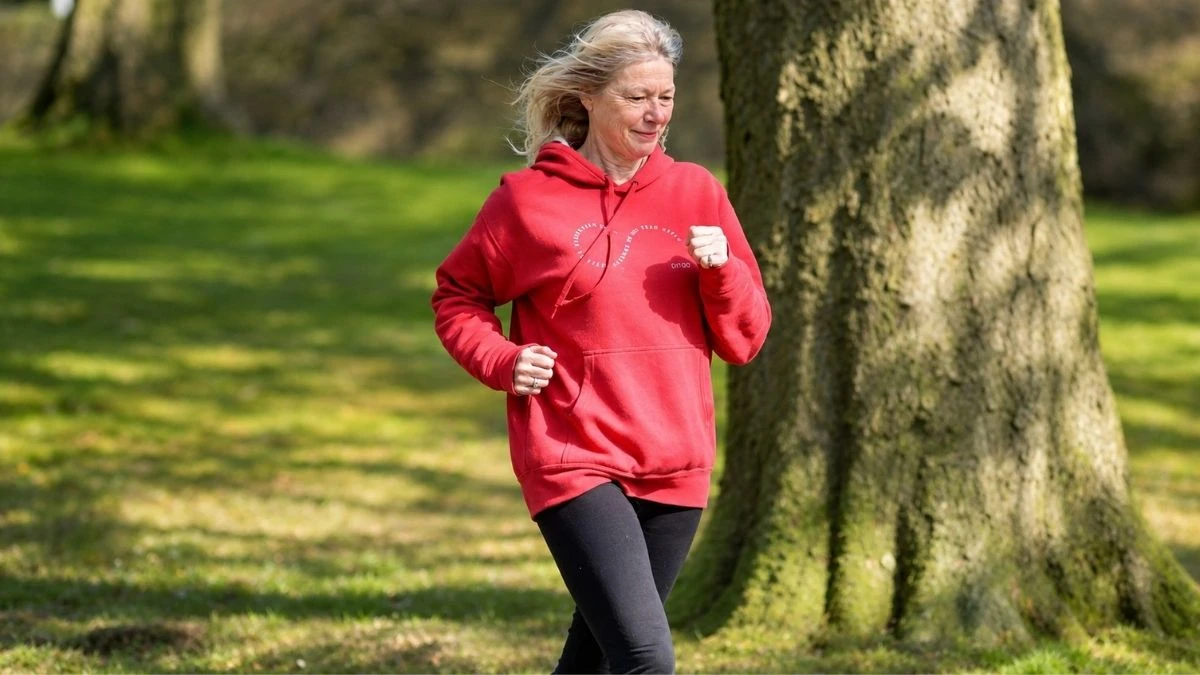
You’re already walking. That’s the part that makes this so frustrating.
Adults over 50 who already walk and can’t seem to lose fat are usually not doing anything wrong.
Their body has quietly changed how it burns fuel, and no one told them. Obesity rates are highest among Americans in their 40s and 50s, with nearly half of adults in that age group carrying excess weight, according to CDC data.¹
This article is for active adults over 50 who already walk and want to understand why walking after 50 for fat loss requires a different approach, and what four small changes make that difference.
Why the Walk You’re Already Doing Isn’t Burning Fat
You’re doing everything you were told to do. You walk. You’re consistent. The scale won’t move.
Here’s what changed: your body did. As people age, the body shifts toward burning more carbohydrate for fuel and less fat, even at rest.
Research reviewing energy metabolism in aging adults found that this shift happens alongside a drop in resting metabolic rate that is bigger than the loss of muscle mass alone can explain.²
The efficiency trap is the second problem. Repeat the same walk enough times and your body burns fewer calories doing it.³ It’s not a failure. It’s your body doing its job.
Less Muscle Means
a Slower Engine
What sarcopenia does to the calories you burn — at rest and in motion.
Muscle Loss Begins at 30
Starting around age 30 and picking up speed after 50, the body gradually loses muscle mass and strength over time — a process known as sarcopenia.Sarcopenia Slows Your Calorie Burn
Sarcopenia is associated with a drop in calories burned during movement and at rest. The effect builds gradually and accelerates through the later decades.Less Muscle, Slower Engine
Muscle is metabolically active tissue. Less of it means fewer calories burned — both when you move and when you simply sit still. It is the engine running at lower power.
Muscle loss makes it worse. Starting around age 30, and picking up speed after 50, the body loses muscle over time. Sarcopenia [the gradual loss of muscle mass and strength that comes with aging] is associated with a decrease in the calories your body burns during movement and at rest.⁴ Less muscle means a slower engine.
This is not a motivation problem. It’s a biology problem, and anyone focused on walking after 50 for fat loss needs to know which specific changes reset that biology.
Knowing why it stopped working is only half of it. The next section shows you the first specific change that breaks the cycle.
Talk to your doctor before adding new exercise routines if you have a joint condition, heart disease, diabetes, or are on medication that affects your heart rate or blood sugar.
Upgrade 1- Use Pace Intervals to Switch Your Body Into Fat-Burning Mode
Most people walk at one pace for their whole walk. That steadiness is exactly what trains the body to become efficient, and it stops the fat burn.
Walking more does not fix the problem when your body has already learned to run on less. The fix is not more miles. It’s a different kind of mile.
Pace intervals mean alternating between a comfortable pace and a brisker one during the same walk. You don’t need to run. You don’t need a hill. You need about three minutes of one speed followed by three minutes of the other.
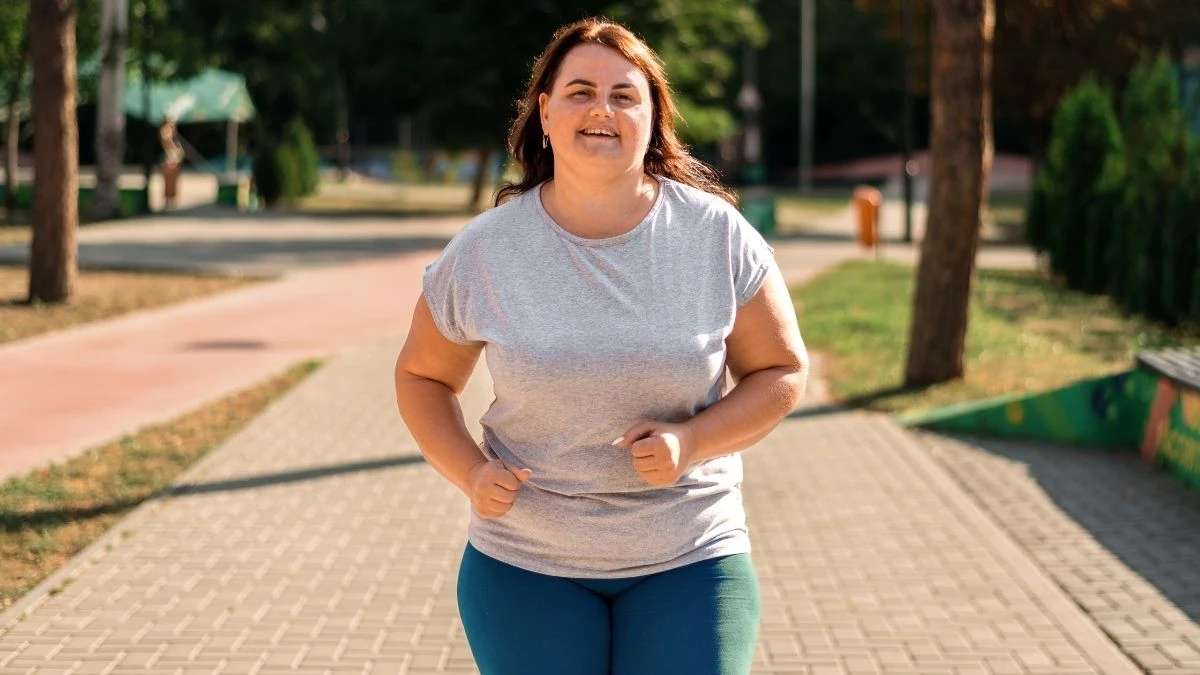
Here is the protocol:
- Walk at a comfortable, easy pace for three minutes. You should be able to speak a full sentence without stopping.
- Pick up your pace until breathing becomes noticeably deeper but you can still say a few words. Hold that for three minutes.
- Return to your comfortable pace. Repeat four or five times.
- Cool down with five minutes at your easiest pace.
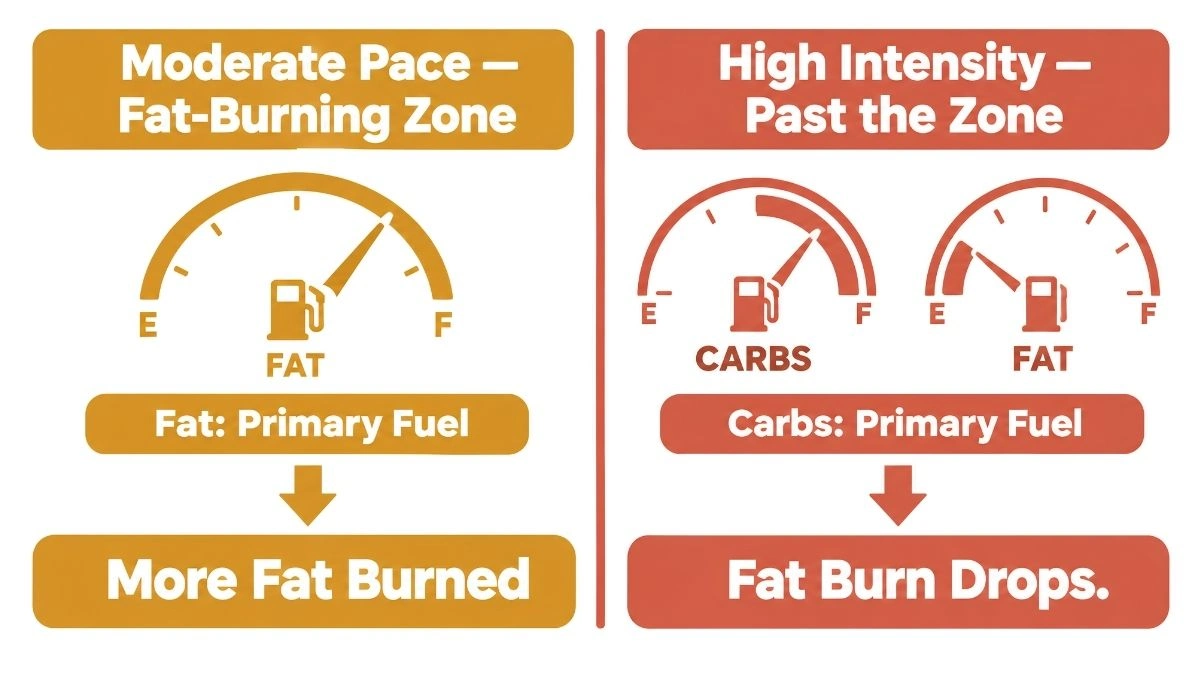
You might expect that walking faster burns more fat. A 2022 study published in Nutrients found the opposite: postmenopausal women who walked at a moderate pace lost more total body fat over 30 weeks than those who walked faster, with the slower group showing progressive fat loss throughout the study.⁵
The reason connects to the fat-burning zone [the moderate-intensity aerobic range where the body uses fat as its primary fuel source rather than carbohydrates]. Your body burns the most fat as a percentage of fuel when you stay in that zone, not when you push past it.
A three-month interval walking program in middle-aged sedentary adults was associated with a significant increase in aerobic capacity and improvements in cardiovascular risk factors.⁶
But pace alone is only one of the four levers. The next upgrade adds something most walkers never think about.
Upgrade 2- Work Your Arms to Burn More Without Going Further
Right now, there is a good chance your arms are hanging loose or pumping gently while your legs do all the work. That’s wasted effort.
Active arm drive changes that. When you consciously work your arms during a walk, you recruit your core muscles and your upper back. More muscle working means more fuel burned.
Here is the protocol:
- Bend your elbows to a 90-degree angle. Keep them there for the whole walk.
- Drive your elbow straight back on each stride, not out to the side.
- Let the arm swing forward naturally after the drive. Don’t force it.
- Keep your fists soft — no gripping. Shoulders relaxed, not raised.
- Your arms and legs should swing in opposite rhythm: left arm forward, right leg forward.
The payoff is real, even if the research behind it comes from younger adults.
Research on arm swing found that restricting arm movement during walking significantly increased oxygen consumption in a study of young healthy men, by 8 to 34 percent, pointing to how much energy arm movement can add or subtract from any walk.⁷
The biomechanical principle: when arms are passive, other muscles compensate and use more energy less efficiently. Active arm drive channels that energy into forward movement instead.
Engaged arms also improve your posture. A straighter spine during walking allows the hip flexors and glutes to fire more fully, which means the legs are doing more work too.
More of your body is working on every step you already take. What the next section adds is something those extra muscles need to stay strong.
Upgrade 3- Add Short Strength Stops to Protect Muscle While Losing Fat
Here is what happens when you only walk and nothing else: you lose fat, but you also lose some muscle. Losing muscle slows the engine that burns the fat in the first place.
Strength stops are brief pauses during your walk where you do one bodyweight movement before continuing. No gym. No equipment. No extra trip out.
What changed outcomes in research was resistance. A study of older adults with a mean age of 72 to 73 years found that combining walking with home-based resistance training improved muscle quality compared to walking alone, with the combined group showing measurable differences in muscle composition.⁸
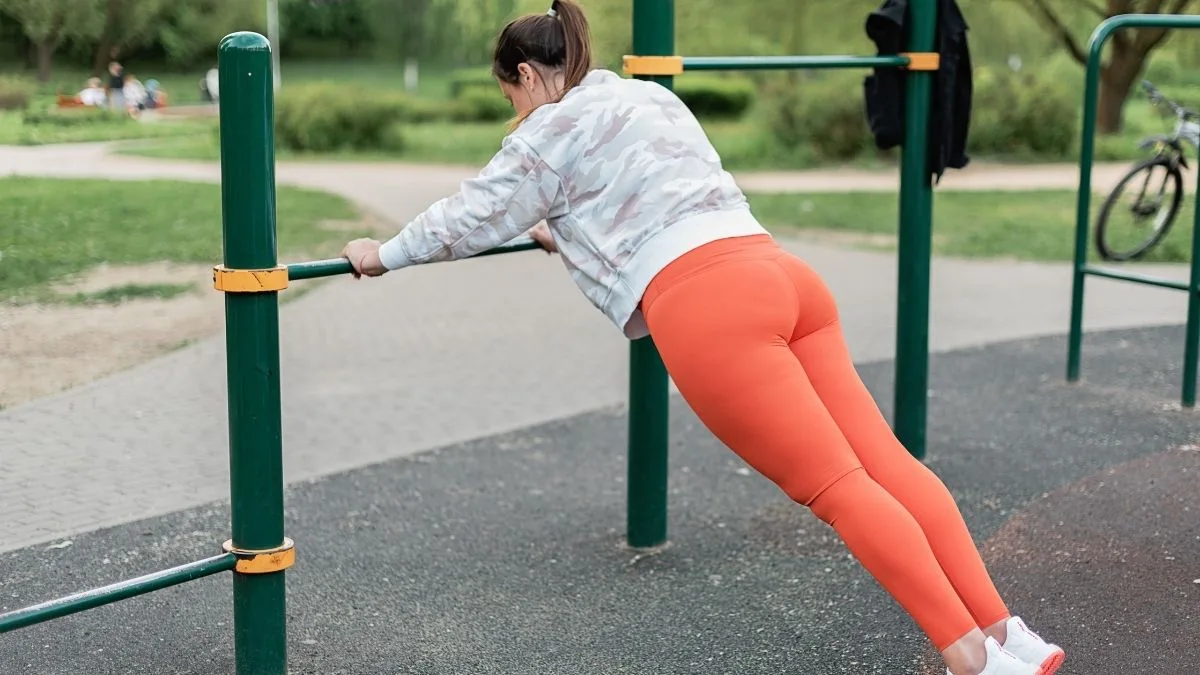
Here is the protocol:
- Every 10 to 12 minutes of walking, find a wall, a bench, or an open patch of ground.
- Do 10 to 15 reps of one movement. Choose from:
- Wall push-ups (hands flat on a wall, feet stepped back)
- Bench squats (lower toward a bench seat, stand back up before touching)
- Standing calf raises (rise onto the balls of your feet, lower slowly)
- Step-ups on a curb or low step
- Rest for 30 seconds, then keep walking.
Start with one stop per walk. Build to two or three as it gets comfortable.
Combating muscle loss after 50 doesn’t require a weight room. It requires consistent mechanical loading, which tells the muscle it is still needed.
A study looking at the combination of daily walking and resistance exercise found that adding resistance exercise was associated with preventing both muscle loss and bone loss over time in elderly participants.⁹
Your joints decide the range. The next upgrade changes not what your walk looks like but when you take it.
Upgrade 4- Walk After Eating to Flatten Blood Sugar and Reduce Fat Storage
After every meal, your blood sugar rises. That’s normal. What happens next is the part worth understanding.
You feel it sometimes, that heaviness that settles in after a big meal. When blood sugar rises, your body releases insulin [a hormone made in the pancreas that signals cells to absorb glucose from the blood]. After 50, cells become less responsive to insulin’s signal, so excess glucose gets stored as fat instead.
A 10-to-15-minute walk after eating sends that glucose somewhere else first: into your muscles.
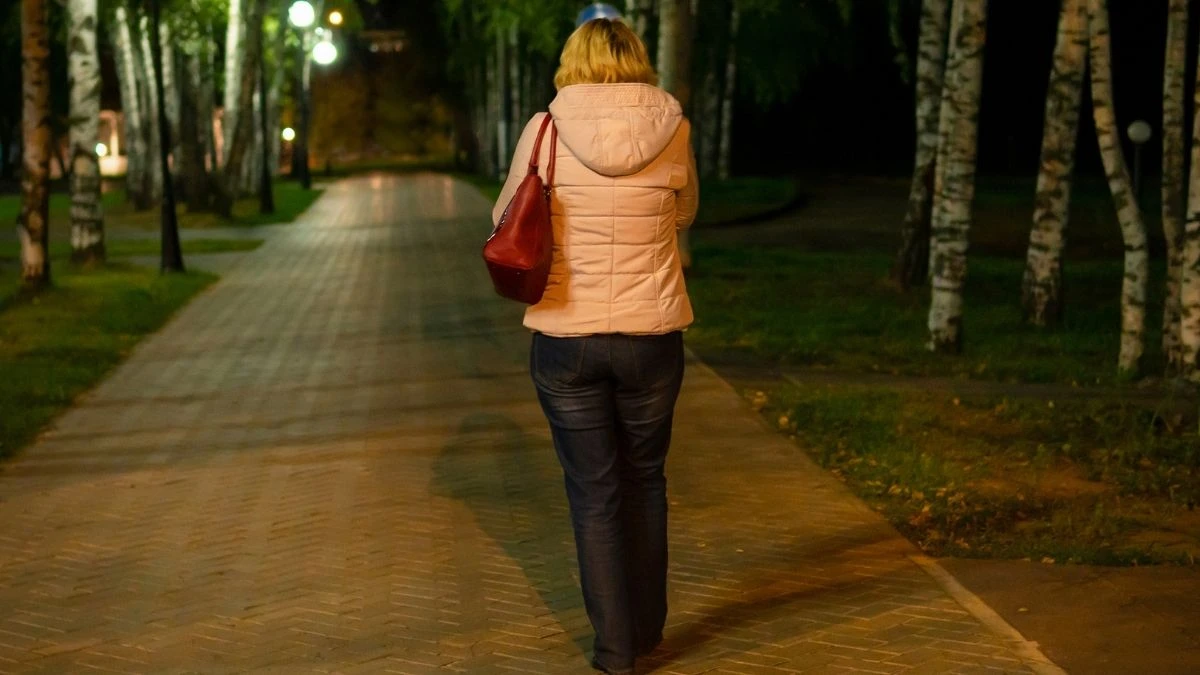
A landmark study published in Diabetes Care found that three 15-minute bouts of moderate post-meal walking significantly improved 24-hour blood glucose control in inactive older adults aged 60 and over at risk for impaired glucose tolerance, and was more effective than 45 minutes of sustained morning walking at controlling blood sugar after the evening meal.¹⁰
The dinner walk matters most. Evening is when insulin sensitivity is naturally at its lowest. A 10-to-15-minute walk within 30 minutes of finishing dinner is the single highest-leverage upgrade on this list.
Here is the protocol:
- Finish your meal. Wait five minutes if you need to, then start walking.
- Walk at a comfortable, easy pace — not slow enough to stop, not fast enough to huff.
- Aim for 10 to 15 minutes. A single loop around the block counts.
- Do this after dinner first. Add lunch and breakfast walks as the habit builds.
This one alone changes what your body does with every meal. The next section shows you how to stack all four without adding time.
How to Put All Four Upgrades Together for Fat Loss After 50
You don’t need a new block of time. You need to change what happens inside the walk you already take.
Here is how all four upgrades fit in one 30-minute walk, plus a short post-dinner walk later:
The walk structure:
- Minutes 0-5: comfortable warm-up pace, active arm drive at 90-degree elbows
- Minutes 5-11: first pace interval set (three minutes easy, three minutes brisker)
- Minute 11: first strength stop (10-15 reps of one movement, 30-second rest)
- Minutes 12-18: second pace interval set
- Minute 18: second strength stop if you choose
- Minutes 18-25: third pace interval set
- Minutes 25-30: cool-down pace, arms relax
Then, 30 minutes after dinner: a 10-to-15-minute easy walk.
Your current walks already count toward something. The U.S. physical activity guidelines recommend at least 150 minutes of moderate-intensity activity per week for adults.¹¹ This structure, done five days a week, meets that target and does it in a way that addresses the specific metabolic challenges of walking after 50 for fat loss.
Start with one upgrade. If adding all four feels like too much, begin with the post-dinner walk. It requires no changes to your existing routine, asks nothing extra of your joints, and has the strongest specific evidence in older adults. Add the others one week at a time.
Let your joints lead. If a pace interval causes knee pain, slow down. If a strength stop causes hip discomfort, swap the movement.
Consistency over 12 weeks does more than intensity over two, and the one upgrade that starts tonight asks the least of your joints and delivers the most.
Conclusion
Start with tonight’s dinner. Walk for 10 to 15 minutes afterward, at whatever pace feels easy. Pick one upgrade from this article and add it to your next walk this week, then add a second the week after. Walking after 50 for fat loss is not about going further. It’s about giving your body a reason to change what it does with every step. The four upgrades here do exactly that.
References
- National Center for Health Statistics. Obesity and severe obesity prevalence in adults: United States, August 2021–August 2023. NCHS Data Brief No. 508. CDC. 2024. https://www.cdc.gov/nchs/products/databriefs/db508.htm
- Bauer J et al. Review of age-related changes in energy metabolism including resting metabolic rate and fat oxidation in aging adults. PMC. 2010. https://pmc.ncbi.nlm.nih.gov/articles/PMC2885712/
- Ortega JD, Farley CT. Running for exercise mitigates age-related deterioration of walking economy. PLoS ONE. 2014. https://pmc.ncbi.nlm.nih.gov/articles/PMC4239061/
- Kamel HK. Sarcopenia and aging. Nutrition Reviews. 2005. https://pubmed.ncbi.nlm.nih.gov/16124998/
- La New JM, Borer KT. Effects of walking speed on total and regional body fat in healthy postmenopausal women. Nutrients. 2022. https://pubmed.ncbi.nlm.nih.gov/35276986/
- Tjønna AE et al. Effects of interval walking on physical fitness in middle-aged individuals. Journal of Science and Medicine in Sport. 2010. https://pubmed.ncbi.nlm.nih.gov/23804371/
- Yizhar Z, Boulos S, Inbar O, Carmeli E. The effect of restricted arm swing on energy expenditure in healthy men. International Journal of Rehabilitation Research. 2009. https://pubmed.ncbi.nlm.nih.gov/19065107/
- Yoshiko A et al. Effects of 10-week walking and walking with home-based resistance training on muscle quality, muscle size, and physical functional tests in healthy older individuals. Journal of Clinical Medicine. 2018. https://pubmed.ncbi.nlm.nih.gov/30473735/
- Inoue T et al. Daily walking accompanied with intermittent resistance exercise prevents osteosarcopenia: a large cohort study. BMC Geriatrics. 2022. https://pubmed.ncbi.nlm.nih.gov/36529868/
- DiPietro L, Gribok A, Stevens MS, Hamm LF, Rumpler W. Three 15-min bouts of moderate postmeal walking significantly improves 24-h glycemic control in older people at risk for impaired glucose tolerance. Diabetes Care. 2013. https://diabetesjournals.org/care/article/36/10/3262/30770/
- U.S. Department of Health and Human Services. Physical Activity Guidelines for Americans, 2nd edition. 2018. https://odphp.health.gov/sites/default/files/2019-09/Physical_Activity_Guidelines_2nd_edition.pdf