

You worked for decades. You planned, you saved, you looked forward to this. Then retirement arrived, and instead of relief, something darker settled in. The emptiness was not what you expected. Neither was the sadness that came with it. Many people quietly blame retirement itself for how they feel. But a growing body of psychological research points to something more specific, and understanding it changes everything about how to move forward.
The Retirement Myth That’s Leaving People Worse Off
Retirement carries a powerful cultural story. You earn it. You deserve it. It is supposed to be the reward at the end of a long road. That story makes post-retirement depression feel not just painful but confusing, even shameful.
So most people reach for the obvious explanation: retirement must be the problem. If leaving work made you feel this way, then work must have been the solution. It seems logical. It is also, for many people, the wrong conclusion.

Research shows that retirees experience depression at higher rates than working adults of similar age. But the mechanism behind that finding is rarely discussed honestly. The culprit is not the absence of a job. It is the absence of a self that was built around one.
Well-meaning advice misses this entirely. “Travel more.” “Pick up a hobby.” “Keep busy.” These suggestions address boredom. They do not touch identity-level grief, which operates at a deeper level entirely. Busyness can fill hours. It cannot fill the psychological space left behind by a role that once told you who you were.
Naming the real cause is the first step toward addressing it.
When Your Career Was Your Identity, Retirement Feels Like a Loss of Self
Think about the last time someone asked who you are. Chances are, you answered with what you do. That is not accidental. Over decades, professional roles become deeply fused with personal identity. They provide far more than income.
A career gives you a daily structure. It gives you a social world, a sense of competence, a recognizable place in a community. It answers the question “who are you?” without any effort. You are a nurse, an engineer, a teacher, a manager. The role does the identity work for you.

Sociologist Helen Rose Ebaugh studied this phenomenon extensively. Her role exit theory describes what happens when a person leaves a central role they have occupied for years. They do not simply stop performing a function. They lose a primary framework through which they understood themselves.
The role shaped how others saw them and, critically, how they saw themselves. This psychological disruption happens even when someone was glad to leave their job. The relief of retirement does not cancel the loss of the role. Both things can be true at once.
Developmental psychologist Erik Erikson mapped the territory of later life through the conflict of integrity versus despair. Without a rebuilt sense of self, the despair side of that equation becomes more than theoretical.
Role Identity Salience
Understanding psychological risk during career transitions
High Role Attachment
The more deeply you identify with your professional role, the stronger your self-concept is anchored to it.
Elevated Vulnerability
When that central role ends, high identity salience causes greater psychological risk and disorientation.
Not Personal Weakness
Experiencing distress after role loss is not a character flaw or personal weakness.
Predictable Consequence
It is a predictable result of dedicated living around a role that has now come to a close.
Is It Depression, or Is It Grief? Why the Difference Matters
The line between grief and clinical depression is real, and crossing it changes what kind of help actually works. Many retirees experience both at different times, or in overlapping ways. Knowing the difference is not about labeling yourself. It is about choosing the right path forward.
Adjustment disorder with depressed mood is a recognized clinical condition. It describes a strong emotional response to a major life change that causes real distress and ties directly to a specific transition. Retirement is one of the most common triggers. This is different from major depressive disorder in its duration, its origin, and its treatment needs.
Both can look similar from the outside. Low mood, withdrawal from friends, disrupted sleep, loss of motivation. These symptoms appear in grief, adjustment disorder, and clinical depression alike. The overlap makes self-diagnosis unreliable and often unhelpful.
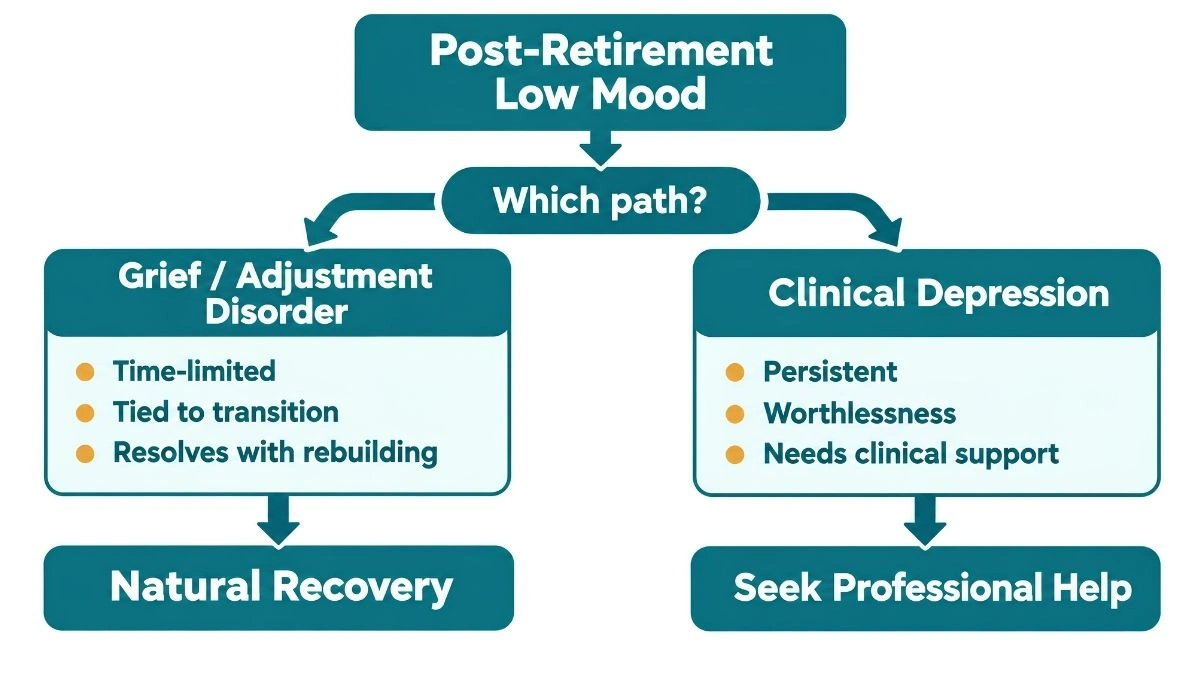
Grief over identity loss is legitimate. It deserves to be named as such, not explained away or pushed through with forced positivity. Most people move through this adjustment within several months as they begin to rebuild structure and meaning.
But some signs point toward something that needs clinical attention. Persistent inability to feel any positive emotion, even briefly, is one of them. So is a growing sense of worthlessness, or functional impairment in basic daily tasks. These are not signs of weakness. They are signals that the brain needs support beyond what self-directed effort can provide.
If any of those signs resonate, speaking with a physician or therapist is not an overreaction. It is an accurate response to what the evidence shows.
Rebuilding Who You Are (Not Just What You Do)
Here is what research on recovery from retirement depression shows that most general advice skips entirely. Activity alone does not rebuild identity. What rebuilds identity is structured roles with social meaning.
Inhabiting a Role vs. Filling Time
Filling Time vs. Active Engagement
Joining routine recreational activities (like a weekly golf game) simply fills time without establishing a deeper sense of identity or purpose.
Inhabiting a Meaningful Role
Taking on responsibilities as a mentor, board member, or community leader allows retirees to inhabit a new role with distinct identity and impact.
The Power of Contributory Roles
Research confirms that contributory roles—offering value and service to others—foster long-term psychological fulfillment.
Superior Well-Being Outcomes
Giving back creates significantly stronger well-being outcomes compared to relying solely on passive leisure activities.
There is a clear difference between filling time and inhabiting a role. A retiree who joins a weekly golf game fills time. A retiree who becomes a mentor, a board member, or a community organizer inhabits a new role. Research on older adults shows that contributory roles, ones that involve giving something of value to others, produce stronger wellbeing outcomes than passive leisure.
Three identity-rebuilding pathways have real research support. The first is contributory engagement: volunteering, mentoring, or community leadership. These restore social recognition and a sense of mattering. People who take on regular volunteer roles report greater life satisfaction and lower rates of depression than those who do not.
The second pathway is mastery pursuits: learning something genuinely difficult, whether a language, an instrument, or a craft. Building new competence creates a new self-concept. The third is relational deepening: investing deliberately in relationships that offer mutual meaning, not just social contact. All three work through the same mechanism. They give you a role again.

Psychologists who study narrative identity offer another key finding. People who actively build a new personal story around retirement, one that frames it as a beginning rather than an ending, show better mental health outcomes. This is a specific mental and emotional process, and it can be guided.
This rebuilding takes time. Early discomfort is not failure. It is the normal cost of genuine identity reconstruction.
A therapist trained in life transitions can help move this process along more effectively than working through it alone. That is not a sign that something is seriously wrong. It is a sign of clarity about what the task actually requires.
Conclusion
What you felt after retirement was not ingratitude and not weakness. It was a real response to a real loss, and it has a name. That matters, because named things can be addressed. This week, try one concrete step: identify one role, not one activity, that you want to inhabit in this chapter of your life. Not what you will do, but who you will be. That is where the path back to yourself begins.