
If you’ve been trying to eat more to hold onto muscle and it just isn’t working, you’re not doing anything wrong. Most advice about eating to build muscle assumes you have a young appetite and a young metabolism, so it does not work once you are past 50.
This guide is for adults over 50 who want to protect or build muscle but find they are eating less than they used to. By the end, you will know exactly which calorie-dense foods to build muscle after 50, and why a smaller plate can still do the job.
Why “Eat More” Advice Doesn’t Work: Calorie-Dense Foods to Build Muscle After 50
You’ve probably heard it before: eat more protein, eat more calories, eat more overall. If you’ve tried that and still feel like you’re losing ground, the problem isn’t effort.
It’s that your body now needs more protein in a single sitting to build muscle, at the exact time your appetite has naturally started to shrink.
Research comparing older and younger adults found that healthy older adults [people without major illness, simply further along in age] eat noticeably less and feel less hungry than people in their twenties. This isn’t a personal failure or a sign something is wrong.
It’s a documented pattern that shows up again and again in research on aging.
That pattern creates a real conflict. You need a bigger protein “dose” per meal than you used to, but you have less room in your day to eat it. The rest of this guide is built to solve that exact problem, one meal at a time.
The Real Reason You Need More Protein Per Meal Now
Here’s the part almost nobody explains clearly: your muscles have become harder to convince. Scientists call this anabolic resistance [a change in the body where muscles need a bigger amount of protein at once to start building new muscle tissue].

It’s not that your muscles stopped working. They just need a stronger signal to get started.
Your body isn’t asking you to eat more food, it’s asking for more protein in the same sitting, and that’s a completely different problem to solve.
A study measuring this directly found that older adults get the strongest muscle-building response from around 0.4 grams of protein per kilogram of body weight in one meal. For a person weighing 160 pounds, that works out to roughly 29 grams of protein in a single sitting, not spread across the whole day.
That’s more than a lot of people eat in an entire meal without realizing it. The real skill isn’t eating more overall, it’s knowing which foods actually get you there without a bigger plate.
Foods That Hit the Threshold Without a Huge Plate
You don’t need to force down a bigger plate to get there. You need foods that carry more protein and more usable calories in a smaller amount of food, so your stomach isn’t doing extra work for the same result.
Talk to your doctor before changing your eating pattern if you’re managing diabetes, kidney disease, or another condition affected by protein or calorie intake.
A few foods stand out because they deliver a lot in a small volume:
Protein & Calorie Boosters
Easy, spoonable foods that pack in more nutrition per bite.
Eggs
Soft, easy to prepare, and among the most digestible protein sources studied — your body absorbs and uses more of what you eat.
Greek Yogurt
or Cottage Cheese
Protein and calories in one spoonable food — perfect when chewing feels like a chore.
Salmon &
Fatty Fish
Protein plus calorie-dense fat in the very same bite.
Cheese, Added In
Into eggs, veggies, or soup — raises protein and calories without adding volume.
Nut Butter
Stirred In
Into oatmeal or yogurt — dense calories in just a small spoonful.
One large egg holds about 500 milligrams of a specific amino acid your body uses to trigger muscle building, packed into just 72 calories. That’s a lot of signal for very little food, which matters most on days when eating feels like effort rather than pleasure.
Choosing the right foods solves half the problem. The other half is when you eat them.
Building a Day Around Three Anchored Meals
If most of your protein shows up at dinner and almost none at breakfast, you’re not alone, and it’s working against you. Data from a national nutrition survey found that women in their fifties, sixties, and early seventies ate about 12 grams of protein at breakfast, 18 grams at lunch, and over 30 grams at dinner.
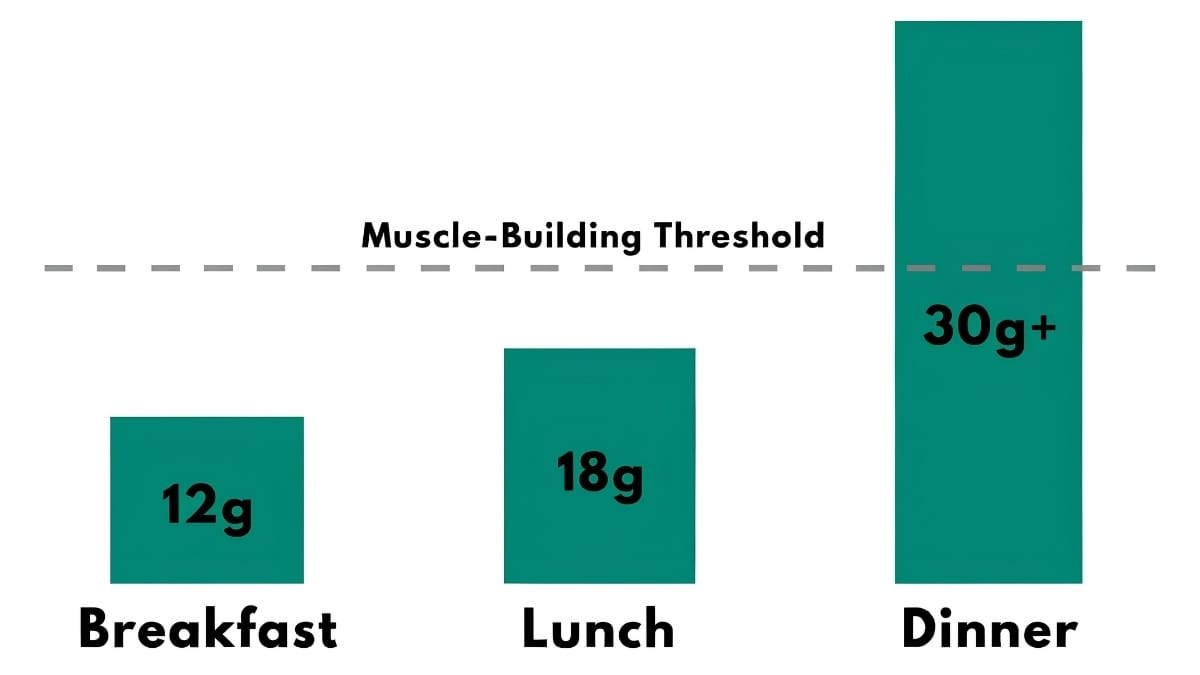
That’s a steep climb through the day, and it leaves your first two meals well under the amount your muscles need to respond.
Better protein distribution across the day gives your body three real chances to trigger muscle building instead of one.
A simple way to picture this: think of each meal as needing its own protein anchor [a single food or combination chosen specifically to reach the per-meal protein amount your body responds to], rather than saving your effort for one big meal.

- Breakfast anchor: two to three eggs, or Greek yogurt with a scoop of cottage cheese mixed in
- Lunch anchor: a canned fish, chicken, or bean-based salad with cheese added
- Dinner anchor: whatever protein you already tend to eat there, since this meal is rarely the problem
Anchoring breakfast and lunch solves part of the puzzle, but some days the bigger obstacle isn’t the plan at all.
When Appetite Is the Real Blocker
Sometimes the honest answer isn’t which food to pick. It’s that you don’t feel like eating at all, and no food list fixes that on its own.
A decline in hunger and appetite as people age is a well-documented, physical pattern, not just a sign that something is wrong. Researchers describe several everyday causes behind it, including a slower-emptying stomach, a duller sense of taste and smell, and simply feeling full sooner than you used to.
If that sounds familiar, the fix isn’t forcing down bigger meals. It’s making smaller amounts count for more.
- Add a spoonful of olive oil, butter, or nut butter to food you’re already eating
- Choose full-fat versions of dairy instead of low-fat when appetite is low
- Eat smaller amounts more often instead of three large sit-down meals
- Keep protein-rich snacks within easy reach, so eating doesn’t require a decision each time

Knowing this helps, but it still leaves one question: where do you actually start.
One Meal to Start With Today
You don’t need to overhaul how you eat. Pick one meal today and rebuild it around a protein anchor food you can actually finish without a struggle.
Build one protein-anchored, calorie-dense meal today using foods that clear the higher per-meal protein threshold your body now needs. Start with whichever meal currently has the least protein in it, since that’s where the biggest gain is waiting.
A meal built this way does more for your muscles than a bigger version of what you’re already eating.
Research combining protein intake with light strength exercise in adults over 50 suggests meaningfully greater muscle gains than protein alone, so if movement is part of your routine already, this pairs directly with it. One well-built meal today is a real, measurable start toward calorie-dense foods to build muscle after 50, and it costs you nothing but a little planning.