

You check it every morning. Your watch buzzes, the number pops up, and you either feel a small wave of relief or a flicker of worry before you move on with your day. That morning glance feels like it should mean something.
Most people over 50 check their resting heart rate once, compare it to a chart, and either relax or panic based on a single number that means far less than they think.
This article is for adults 50 and older who track their heart rate on a smartwatch or fitness tracker but don’t know what the number actually means for their health long term.
By the end, you’ll know why that daily number matters less than the pattern behind it, and what to actually watch for.
The Resting Heart Rate Number Everyone Checks (and the Question Nobody Asks)
You glance at your watch, see a number, and either exhale or brace yourself. Here’s the direct answer: your resting heart rate matters far less as a single number than it does as a pattern over time.
A normal resting heart rate [the number of times your heart beats per minute while you’re calm and not moving] for most adults falls between 60 and 100 beats per minute.
That range is wide on purpose, because a “good” number for you depends on your fitness, your medications, and your own baseline, not a chart built for everyone.

Knowing where you fall in that range is useful. But it’s the first layer of a much bigger picture, and most people stop right there.
Why One Reading Tells You Almost Nothing
You check your heart rate one morning and it’s five beats higher than usual. Your stomach drops a little, even though you have no idea if that number means anything at all.
A single reading can shift with something as ordinary as a rough night’s sleep or a stressful morning, and none of that reflects your long-term health.
Your heart rate isn’t trying to tell you something in one beat, it’s trying to tell you something over two years, and almost nobody is listening long enough to hear it.
That’s not just a feeling. Researchers followed 5,691 adults aged 65 and older for six years, checking their resting heart rate every single year.
Each time someone’s resting heart rate climbed by about 10 beats over those years, their risk of dying from any cause during the study went up by a third.
That’s not about the number on any one morning. That’s about the heart rate trend behind it, tracked over time.
The Pattern That Actually Predicts Your Risk
You probably assume your heart rate just quietly does its own thing as you get older, and for most people, that’s true.
Nearly nine out of ten adults have a resting heart rate that stays steady or drifts slightly downward with age, and they never think twice about it. It’s the other one in ten you need to understand.
- Researchers tracked heart rate patterns in 5,794 adults over 25 years and found that a steadily climbing resting heart rate, even a slight one, was associated with a 69% higher risk of dying from any cause compared with a heart rate that held steady or eased down.
- That same rising pattern was linked to a 65% higher risk of developing heart failure.
- These findings come from research presented at a major cardiology conference and are still considered preliminary until fully published, so treat the exact numbers as directional rather than final.
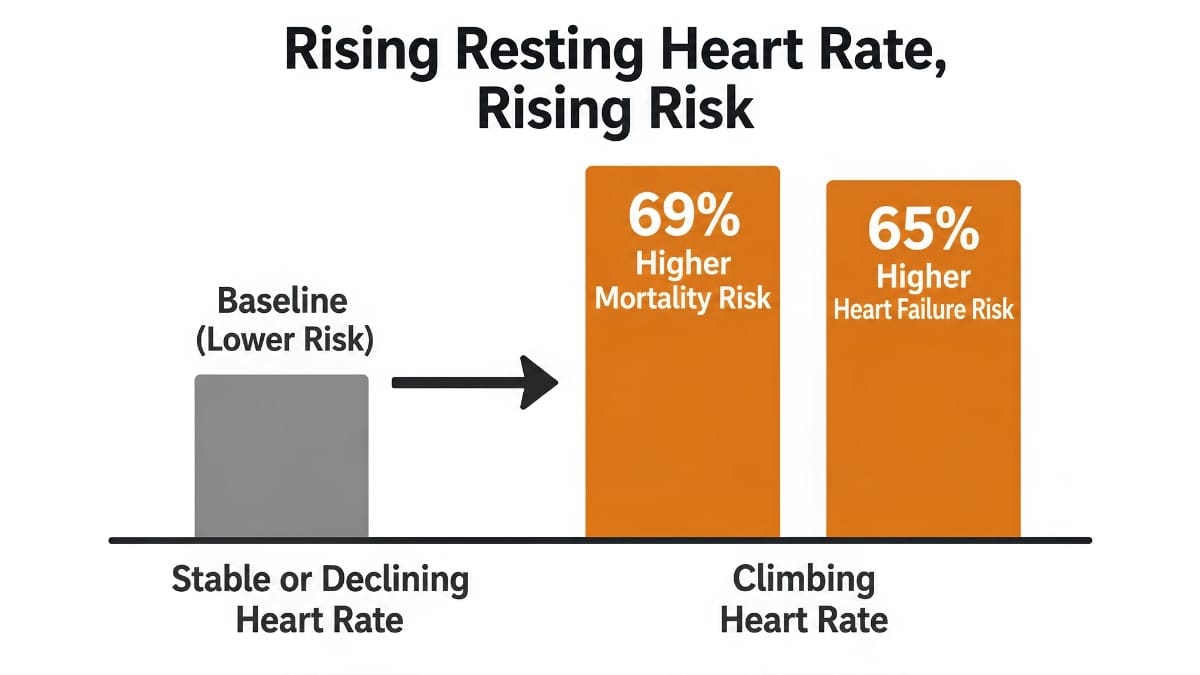
The takeaway isn’t to panic if your number ticks up one week. It’s to notice if it keeps climbing, month after month, without you doing anything differently.
What Counts as a Concerning Trend (Not a Concerning Number)
One high reading after a bad night’s sleep isn’t a trend. It’s just a bad night’s sleep. What matters is whether your resting heart rate is climbing steadily over months, not spiking once and returning to normal.
Based on the research above, a sustained rise of roughly 10 beats per minute over a period of years is the kind of change linked to meaningfully higher risk, not a single rough week.
A short-term bump tied to illness, a new medication, travel, or poor sleep is usually temporary, and it’s the kind of change worth watching rather than worrying over.

A trend that keeps climbing without an obvious cause is the one worth paying attention to, and paying attention starts with knowing you’re measuring it right in the first place.
How to Track Yours the Right Way
If you’re not sure whether your number is actually changing or you’re just noticing it more, the problem usually isn’t your heart. It’s how you’re measuring it.
Talk to your doctor before making any changes based on your heart rate readings if you’re pregnant, on medication, or managing a chronic condition.
Your Daily Pulse Ritual
Consistency is everything. Here’s how to get a reading you can actually trust.
Same Time, Every Day
Ideally first thing in the morning, before you even get out of bed.
Same Position
Sitting up vs. lying down changes the reading — stay consistent.
Same Device
Don’t switch between your watch and a manual pulse check.
Track the History
Write it down or use an app that saves trends, not just today.
Consumer wearables are more reliable for this than most people assume.
A study comparing optical heart rate sensors in wearable trackers across both younger and older adults found the devices generally produced accurate readings regardless of the wearer’s age, though it also noted occasional outlier readings, so one odd number is worth double-checking rather than acting on.
You don’t need medical equipment to track this well. You just need consistency, and once you have a real trend logged, the next question is what to actually do with it.
What to Do If Your Trend Is Climbing
If you’ve been logging your numbers and you’re seeing a real upward pattern, this isn’t something to self-diagnose. It’s something to bring to your doctor.

Start tracking your own resting heart rate at the same time, same way, at least once a week, and watch the trend over months, not the number on any one day.
Bring the actual logged numbers to your next appointment instead of just saying your watch says your heart rate feels higher lately.
A few months of consistent data gives your doctor something real to work with, and it turns a vague worry into a conversation with substance behind it.
Conclusion
Start logging your resting heart rate once a week, at the same time and in the same position, and give it a few months before drawing any conclusions.
That single habit tells you more than any one morning reading ever could. Watch the direction it moves over time, not the number itself, and bring that pattern to your doctor if it keeps climbing. Your resting heart rate has a story to tell. Give it enough time to say it.