

You’re not imagining it. That slow, thick feeling in your head every morning is real, and it’s not just your age. Adults in their 50s and 60s who feel mentally slow in the morning often assume their brain is simply getting older.
Here is what Penn State researchers actually found: adults who began their morning anticipating a stressful day had measurably worse working memory for the rest of that day, even when nothing stressful happened at all.
If you want to clear brain fog after 50, the window that matters most may be the one you are already losing before you get out of bed.
By the end of this article, you’ll know exactly what to do in those 10 minutes and why the order matters.
The Window That Sets Your Day
If you’ve been waking up feeling foggy and slow, you’ve probably blamed poor sleep, age, or both. This is what the research says instead: Penn State researchers tracked 240 adults over two weeks, measuring their stress anticipation in the morning and their working memory later in the day.
Adults who woke up expecting a stressful day scored significantly lower on working memory [the brain system that holds and uses information in real time, covering focus, planning, and problem-solving] tasks, regardless of whether anything stressful actually occurred.

That last part is the one that changes everything. The fog was not caused by a hard day. It was caused by expecting one, before the day had even started.
You already know that for many adults over 50, foggy mornings feel routine. That number reflects something real: more than 11% of U.S. adults aged 45 and older already report worsening confusion or memory problems in the past year, according to CDC data.
And that number rises to more than 15% among those managing a chronic condition. Understanding where to clear brain fog after 50 begins means knowing the window exists.
The Penn State team found something specific that is easy to miss: stress anticipation from the night before did not produce the same effect. Only morning anticipation did.
That means there is a narrow window right after waking when your brain is especially open to what you feed it. Fill that window with a stressful thought, and working memory takes the hit all day. Fill it with something else, and it doesn’t.
The next section explains what is happening in the brain during that window, and why the timing is not a coincidence.
What’s Happening Inside Your Brain Right After You Wake Up
You already know that groggy, not-quite-there feeling in the first few minutes after waking. What you may not know is that your brain is doing something specific and important during those exact minutes, whether you cooperate or not.
You wake up and your brain immediately begins a timed process. Every morning, your body produces a natural surge of cortisol in the 20 to 30 minutes after waking.
This is called the cortisol awakening response [the natural, sharp rise in the stress hormone cortisol that occurs shortly after waking and helps the brain shift into an alert, functional state].
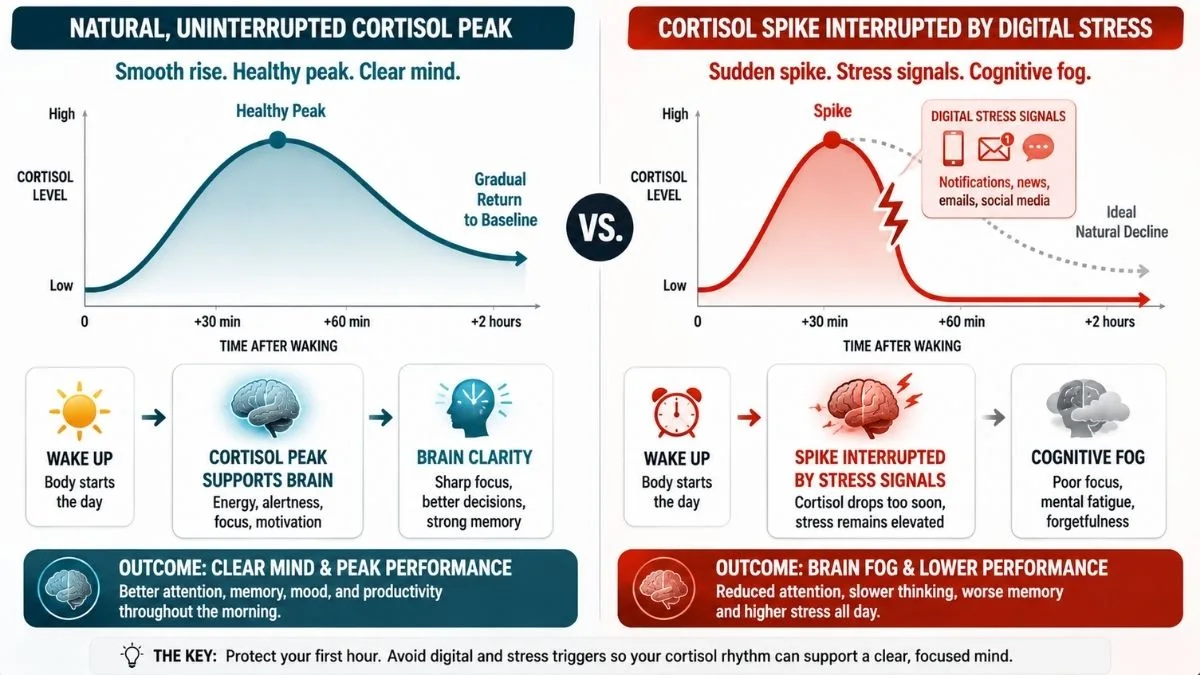
In healthy older adults, a well-timed and appropriately sized cortisol awakening response is associated with better executive function, including attention, mental flexibility, and the ability to hold a plan in your head.
Your brain fog is not a symptom of aging. It is a symptom of what happened in the first ten minutes after your alarm went off.
When you wake up and immediately reach for your phone, scroll through news, or start rehearsing everything you have to do today, your brain registers a stress signal before the cortisol awakening response has finished its job.
Research on the cortisol awakening response and cognitive function links disrupted morning cortisol patterns to reduced attention and executive performance in older adults. The window gets hijacked before it has a chance to close normally.
The fix is not complicated. But it requires knowing what to do first, and in what order. That is exactly what the next section covers.
The 10-Minute Protocol to Clear Brain Fog After 50
If you have a heart condition, are on medication that affects blood pressure or cortisol, or are managing another chronic condition, check with your doctor before adding morning exercise to your routine.
The protocol below is built around one goal: protect the cortisol awakening response window before a stress signal can interrupt it. The order is not optional. Each step is designed to work because of what came before it.
Your 10-minute morning protocol:
- Don’t touch the phone (minutes 0 to 2).
Leave it across the room the night before. The first two minutes after waking are inside the cortisol awakening response window. A single notification is enough to register a threat signal before your brain has oriented itself.
2. Walk outside, even briefly (minutes 2 to 7).

Walk to the end of the block and back. A 2025 systematic review of randomized controlled trials found that walking interventions improved attention and processing speed in older adults without dementia. You don’t need a trail or a plan. You need movement and outdoor light.
3. One minute of slow breathing (minutes 7 to 9).

Four counts in. Six counts out. Do this before you come back inside. Brief mindfulness and breathing practice has been linked to lower morning cortisol levels in research comparing meditators and non-meditators. One minute is enough to begin the shift.
4. Only now, check your phone (minute 10). By this point the cortisol awakening response window has closed, your brain has had movement, light, and a moment of calm before the day’s demands arrive. You haven’t missed anything. You’ve protected something.
The protocol takes 10 minutes. The reason most people skip it is not that they lack time. The next section explains what actually keeps it working, especially on mornings when nothing feels like it’s helping.
Why the Habit Works Even on the Hard Mornings
Some mornings you’ll do the walk and still feel foggy. Some mornings you’ll take the slow breath and still feel anxious. You may wonder if it’s worth continuing.
You’re not the only one who assumed older adults can’t build new habits.
Research on habit formation in older adults tells a different story: older adults have strong self-regulation and a well-developed ability to delay gratification, which makes them especially well-suited to building new routines. The common assumption that older brains can’t form new habits is not supported by evidence.

The benefit of this 10-minute routine is not felt fully on day one. It accumulates. A study on routine formation confirmed that success in maintaining new daily habits was linked to experienced automaticity, meaning the habit became easier and more natural over time, not immediately.
The foggy mornings where you do the walk anyway are the ones doing the most work.
Consistency matters more than feeling it. On the mornings when the protocol feels pointless, even completing three of the four steps preserves more of the cognitive protection than stopping entirely. The brain is still not receiving a stress signal first. That alone is the win.
What destroys this accumulation faster than any bad morning is a single behavioral mistake that most people make before they are fully awake. That is what the next section covers.
The One Mistake That Cancels the Benefit Before It Starts
Most people who try a morning routine fail not because the routine is wrong, but because they make one mistake before the routine even begins. They check their phone in bed.
You might not feel stressed when you do it. But your brain registers the input before it has fully oriented itself.

The Penn State study found that only morning stress anticipation, not stress anticipation from the night before, was linked to lower working memory throughout the day.
A 90-second scroll through email lands directly inside the cortisol awakening response window.
A glance at news counts. Even reading a text that says nothing urgent counts, if your brain interprets it as something to process or respond to.
The mistake is not laziness. The phone is designed to pull your attention the moment it is visible. Research on automaticity and routine formation shows that environmental cues are associated with stronger habitual behavior.
If the phone is within reach when you open your eyes, reaching for it is not a failure of willpower. It is a predictable response to a predictable cue.
Moving the phone to another room to charge overnight removes the cue entirely. The habit cannot fire without the cue. The next section gives you the one placement decision that makes the whole protocol work without relying on willpower at all.
Conclusion
The single most important action you can take today is this: decide tonight where your phone will charge, and it should not be within arm’s reach of your bed. Set a 10-minute morning routine that combines a brief walk and a one-minute mental reset before checking email or news.
Start tomorrow. One morning of doing this will not clear brain fog after 50 for good, but it will show you what the window feels like when you protect it instead of interrupt it.