
Waking up to pee at night is wrecking your sleep, and you probably blame your bladder.
Night after night, those broken hours add up to daytime fog, bad moods, and a real risk of falling on the way to the bathroom in the dark.
Here is the twist: for many people over 50, the bladder is not what wakes them first.
If you want to stop waking up to pee at night, you need to know which one is pulling the alarm: your bladder, your kidneys, or your sleep itself. Each one needs a different fix, and guessing wrong wastes months.
This guide walks you through the three suspects, a simple two minute check you can run tonight, and the habits that actually help. You will also learn which warning signs mean it is time to call your doctor. No guesswork, no gadgets, just a clearer picture of your own nights.
Before making any changes based on this article, talk to your doctor, especially if you take medication or have a diagnosed condition.
How to Stop Waking Up to Pee at Night Starts With Finding the Trigger
Doctors call this nocturia. It means waking from sleep to urinate, with sleep both before and after the trip.
It is extremely common. A review of Canadian population data found that about half of adults over 65 get up at least once a night. About 24% get up two or more times.
Most people assume a weak or overactive bladder is the culprit. Sometimes it is. But clinical reviews describe nocturia as multifactorial, meaning several systems can be involved at once.
Researchers group the causes into four broad buckets: a bladder that cannot store enough, kidneys that make too much urine at night, urine overproduction around the clock, and a sleep problem. Nocturia is often a symptom of something happening elsewhere in the body, not just a bladder issue.
That is why one friend’s fix may do nothing for you. Let’s meet the main suspects.
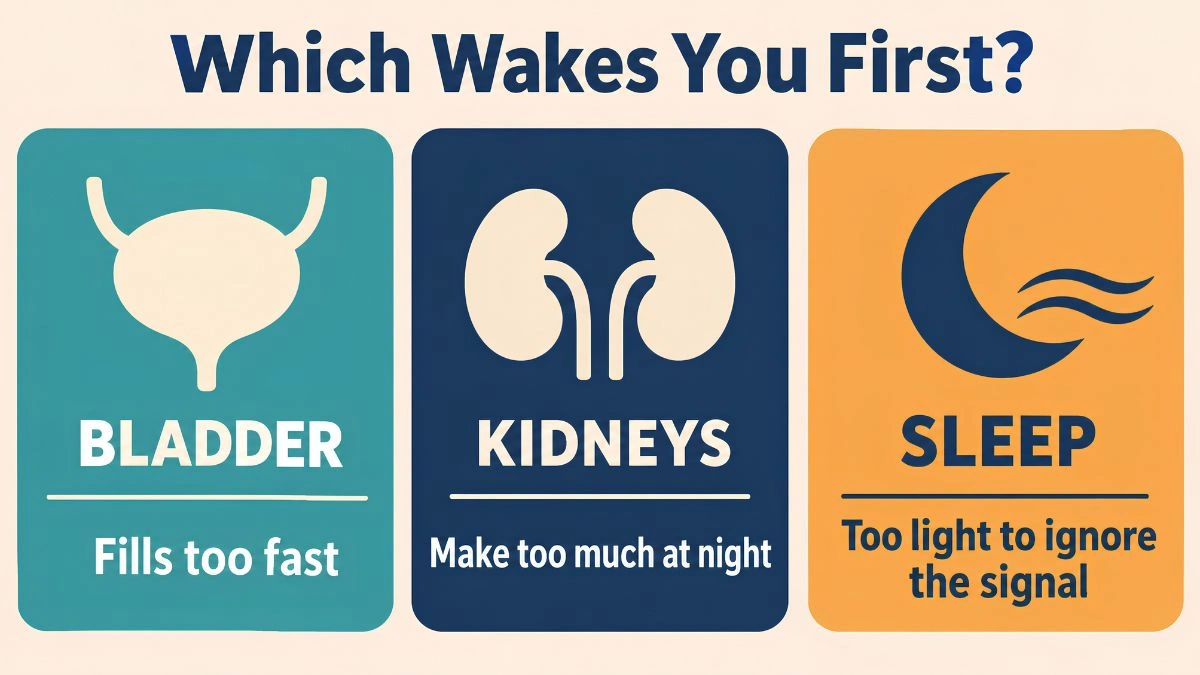
Suspect 1: A Bladder That Fills Up Too Fast
This is the classic story. Conditions such as overactive bladder and an enlarged prostate (benign prostatic hyperplasia) shrink the amount of urine your bladder can comfortably hold overnight.
In men, an enlarged prostate can also prevent the bladder from emptying fully. That leaves less room for the night’s urine.
In women, the drop in estrogen after menopause can change bladder and urethral tissue. Clinicians refer to this as genitourinary syndrome of menopause, and it can contribute to urgency and night trips.
The telltale sign is the volume. With a storage problem, you tend to pass small amounts, often with a strong sense of urgency, and you may return to bed only to feel the urge again.
Suspect 2: Kidneys That Make Too Much Urine After Dark
This one surprises people. It is called nocturnal polyuria, and reviews describe it as the most common cause of nocturia in adults, found in up to 88% of patients in some reports.
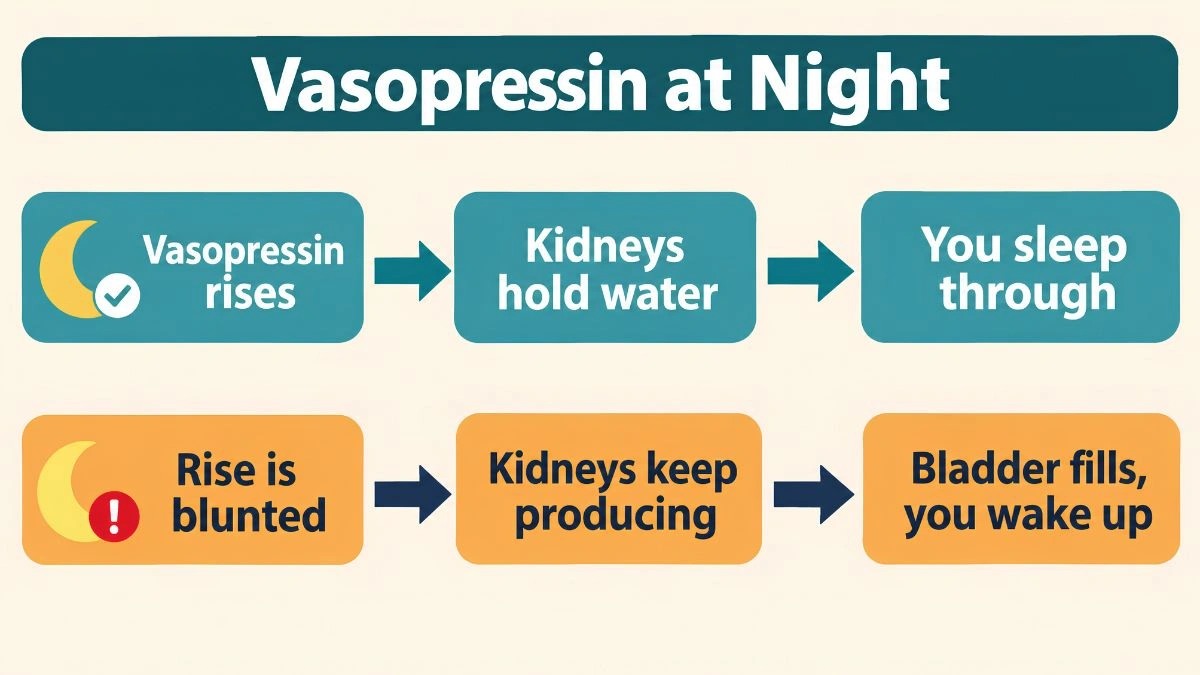
Normally, your body releases more of a hormone called vasopressin (also called antidiuretic hormone) at night. It tells your kidneys to slow down and hold water so you can sleep through.
In some people that nighttime rise is blunted. The kidneys keep producing, the bladder fills to its limit, and you wake up.
Other contributors include heart failure, poorly controlled diabetes, sleep apnea, and fluid pooling in the legs from venous insufficiency. When you lie down, that pooled fluid returns to circulation and the kidneys filter it out.
The giveaway here is a large volume at your night trips, not a few drops.
Suspect 3: Sleep That Is Too Light to Ignore the Signal
Nighttime Signals and Waking Before a Bathroom Trip
An Overlooked Suspect
Here is the suspect almost nobody checks.
Order of Waking
Sometimes something else wakes you first, and the bathroom trip comes second.
Nighttime Bladder Signals
Your bladder sends mild fullness signals through the night.
Effect of Deep Sleep
Deep sleep tends to mute them.
Effect of Lighter, Fragmented Sleep
Lighter, fragmented sleep lets those ordinary signals break through.
Sleep apnea is a major example. Reviews note it can both raise nighttime urine production and disrupt sleep depth, which creates a double hit. Cleveland Clinic notes that people with obstructive sleep apnea who skip their CPAP machine can see more night trips.
Insomnia, chronic pain, and restless sleep can have the same effect. A Japanese cohort of older adults (the HEIJO KYO study) found that more nighttime voiding was linked to poorer objectively measured sleep quality.

The clue: you wake with a mild urge, or no real urge, and you may stay awake long after you return to bed.
Quick Clue Guide: Match Your Night to the Likely Suspect
| What you notice | Likely suspect | Smart next step |
|---|---|---|
| Strong urgency, small amounts | Bladder storage | Ask about overactive bladder or prostate |
| Big volume, mostly after midnight | Nighttime urine overproduction | Track fluids, salt, and leg swelling |
| Mild urge, hard to fall back asleep | Light or broken sleep | Ask about sleep apnea screening |
| Weak stream, dribbling | Prostate or incomplete emptying | Book a urology or primary care visit |
| Heavy snoring, morning headaches | Possible sleep apnea | Request a sleep evaluation |
Try This Tonight: The Two Minute “Which Wakes You First?” Check
Tonight, before the trip to the bathroom, pause for a few seconds. Then use these steps over three nights.
- Note what you felt first. Did you wake already alert, with only a mild urge? Or did a strong, urgent need pull you out of sleep?
- Note the amount. Keep a clean measuring cup near the toilet. Write down roughly how much you pass each time.
- Note the timing. Record what time you woke and whether you fell back asleep within 20 minutes.
- Add your first morning void. Urine you pass at night, plus the first morning void, counts as night production.
- Compare with your day. Over 24 hours, write down total urine. The International Continence Society describes nocturnal polyuria as night production above about 20% of the 24 hour total in younger adults, and above about 33% in older adults.
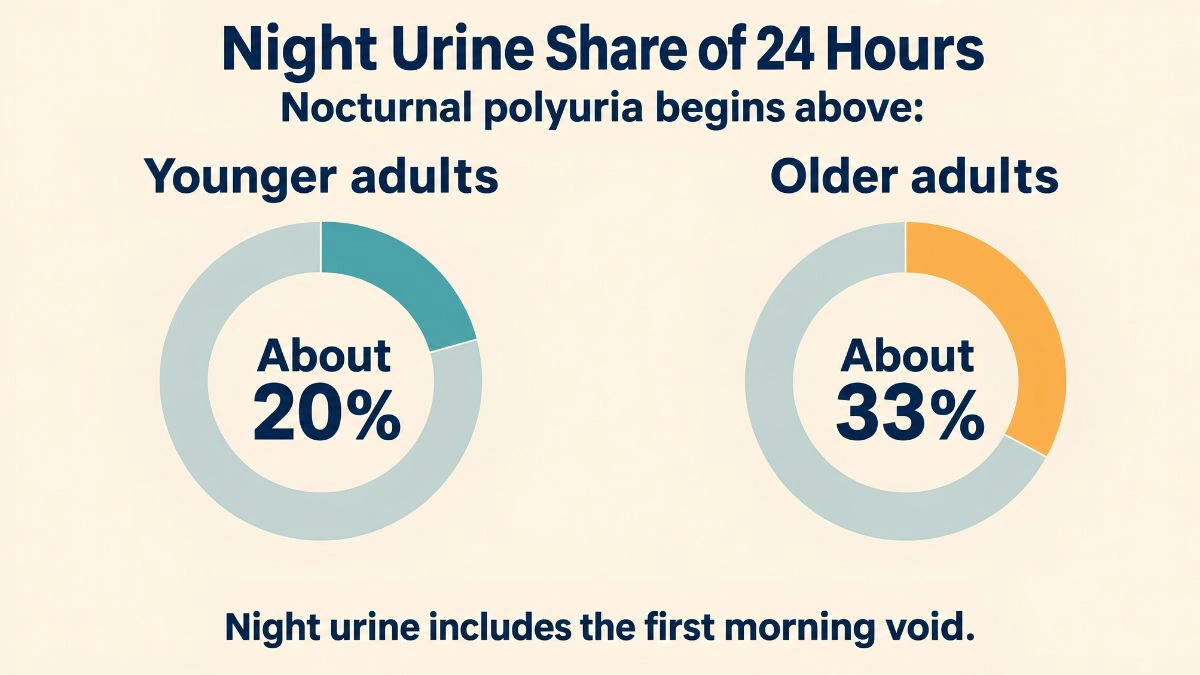
What the results mean: a high night percentage points toward the kidney side. Small amounts with urgency point toward the bladder side. Mild urges with poor sleep point toward the sleep side.
Bring your notes to your appointment. Doctors often use a frequency volume chart like this because it separates causes that feel identical.
Everyone’s body responds differently, so measurements like these are a conversation starter with your doctor, not a diagnosis.
Medications and Evening Habits That Quietly Add Night Trips
Reviews of nocturia list several common medicines that increase urine output or change sleep. Diuretics (water pills), some blood pressure medicines such as ACE inhibitors, and lithium are named examples.
Timing matters as much as the drug. A water pill taken late in the day can still be working at 1 a.m. Ask your doctor or pharmacist whether your schedule can be moved earlier. Never change or stop a prescribed medicine on your own.
Evening drinks matter too. Cleveland Clinic lists alcohol, caffeine, and carbonated drinks, plus simply drinking a lot of fluid close to bedtime, as everyday triggers.

Salt is a quieter factor. Some small studies suggest that cutting back on salt may reduce night trips, since the body holds extra water to balance salt and later releases it. The evidence is still early, so treat it as a reasonable experiment, not a promise.
Try This Today
The Daily Habit That Actually Works
- Keep a three day bladder and sleep diary before you change anything else.
- Move most of your fluids to the morning and afternoon, and taper off in the evening.
- Swap evening alcohol and caffeine for a warm, non caffeinated drink with a small sip.
- Raise your legs for 30 minutes in the late afternoon if your ankles swell.
- Ask your pharmacist whether any medicine you take can be moved to the morning.
What Helps, What Hurts, and What Is Still Unproven
| Helps | Hurts |
|---|---|
| Front loading fluids earlier in the day | Large drinks right before bed |
| Using CPAP as prescribed for apnea | Skipping CPAP on “good” nights |
| Treating the actual cause (prostate, bladder, heart) | Self treating with random supplements |
| Morning dosing of water pills when approved | Taking diuretics in the evening |
| A calm, dark, cool bedroom | Bright phone light during each trip |
Not every fix works for every cause. Treatment is meant to match the suspect.
For a bladder or prostate cause, doctors may use medicines such as alpha blockers or anticholinergic type drugs, or recommend procedures. For nocturnal polyuria, one option is desmopressin, a synthetic version of vasopressin.
Be careful with that last one. A meta analysis in the journal Neurourology and Urodynamics examined the risk of low sodium (hyponatremia) in older adults using desmopressin for nocturia. This is why it needs a doctor’s supervision and blood tests, not a casual trial.
For sleep related causes, treating the sleep problem itself often matters most. Expert guidance on sleep disorders and nocturia suggests that primary care can start with screening questions and conservative steps. Referral to a sleep clinic makes sense if daytime function stays impaired.
Why Dark Hallway Trips Deserve Respect
Waking to pee is not only a sleep issue. A systematic review and meta analysis published in The Journal of Urology in 2020 examined the impact of nocturia on falls and fractures.
That connection is why practical safety steps are worth taking. Add a dim motion sensing night light, clear the path, and sit for a moment on the edge of the bed before standing. Dizziness on standing up quickly is common at night.

Red Flags: When to Stop Reading and Call a Doctor
Do not wait if you notice any of these:
- Blood in your urine, or burning with pain when you urinate
- Sudden, severe swelling in the legs, or new shortness of breath when lying flat
- Extreme thirst with a sudden jump in urination, which can signal uncontrolled diabetes
- Being unable to urinate, or a stream that has nearly stopped
Common Questions
How many trips are “normal”? Many adults wake once, especially with age. Two or more trips a night is the level at which doctors usually take it seriously, because sleep loss builds up.
Is it just aging? Age raises the odds, but reviews are clear that it is not simply a normal part of aging to ignore. There is often a treatable cause underneath.
How long until I see a change? It depends on the cause. Evening habits may help within a couple of weeks for some people. Medical causes can take longer, and some need ongoing treatment.
Should I drink less all day to fix this? Not necessarily. Cutting fluids too far can irritate the bladder and cause other problems. Shifting when you drink, rather than how much, is the safer first experiment.
The Short Version
The question is not only how to stop waking up to pee at night. It is which system triggers it first.
If the volume is big, think kidneys, heart, and hormones. If it is small and urgent, think bladder or prostate. If you wake with barely an urge, think sleep.
Track it for three nights, make a few evening changes, and bring your notes to your doctor. That small effort can turn a vague problem into a targeted plan.