

You cut out gluten. You added probiotics. You started eating slower and stopped eating late. And yet, most mornings, you still wake up bloated. If this sounds familiar, you are not imagining it, and you are not failing at your diet. Something real is happening in your body, and for many people over 50, it has very little to do with what they ate for dinner.
Persistent, unexplained bloating after 50 often signals changes that run deeper than food choices. Knowing the difference between dietary bloating and something that needs medical attention could be one of the most important health distinctions you make this decade.
Your Gut at 50 Is Not the Same Gut It Was at 30
Most bloating advice assumes your digestive system works the same way it always did. After 50, that assumption is often wrong. Several measurable biological changes make your gut slower, more sensitive, and harder to manage with diet alone.
The first change is gut motility. The muscles lining your intestinal wall contract in rhythmic waves to move food through your system. With age, the nerve cells controlling those contractions gradually decline. Food moves more slowly, giving gut bacteria more time to ferment it, and that fermentation produces gas.
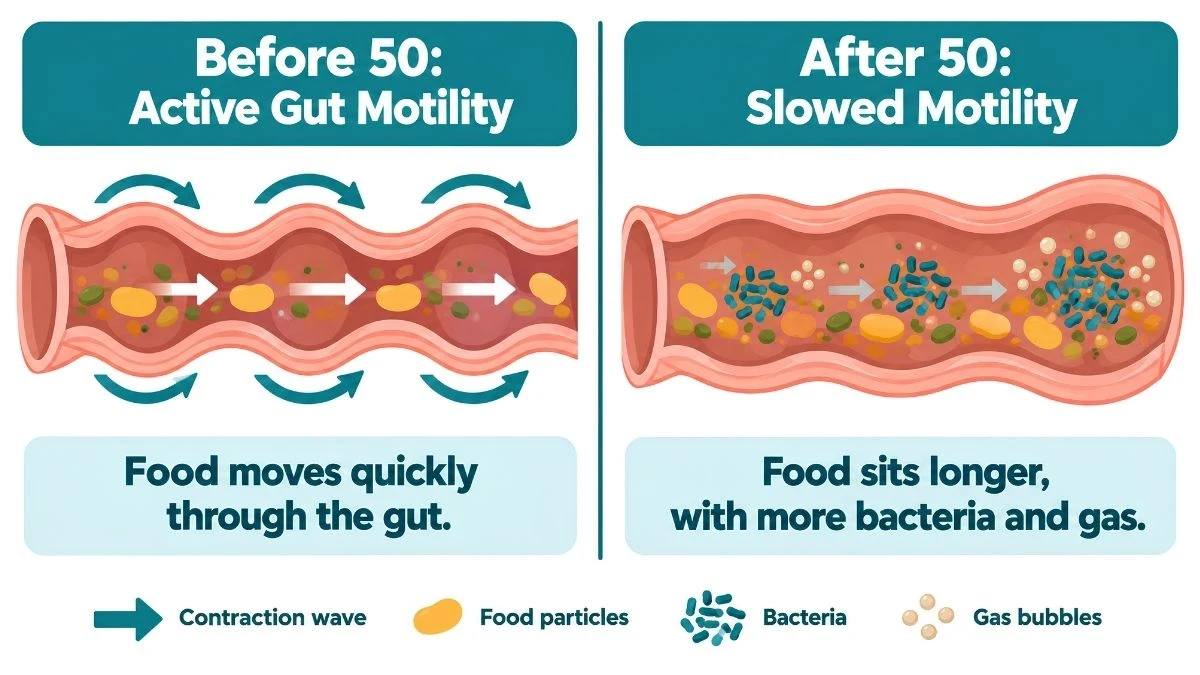
The second shift is a drop in stomach acid production. This condition, called hypochlorhydria, is well-documented in older adults. Less acid means proteins break down less completely. The gut environment becomes friendlier to bacteria that should not thrive there. No dietary adjustment will reverse this on its own.
Your gut microbiome also shifts after 50. Beneficial bacteria, especially species from the Bifidobacterium family, decrease in number. Opportunistic bacteria increase. A 2021 study in Nature Aging found that older adults with more unique, diverse gut microbiomes had better health outcomes and longevity markers than those with less diversity. When that diversity drops, bloating and digestive discomfort often follow, regardless of how clean the diet is.
For women, there is one more factor that rarely gets discussed: estrogen. Estrogen receptors exist throughout the gastrointestinal tract. As estrogen declines during perimenopause and menopause, gut motility slows further and gut sensitivity increases.
This helps explain why many women in their late 40s and 50s notice GI symptoms they never had before. These changes are real, measurable, and often have nothing to do with diet.

Understanding this shifts the focus from self-blame to biology, and from generic eating advice to targeted medical care.
Medical Conditions That Wear the Mask of Dietary Bloating
When bloating persists despite dietary changes, the gut is often signaling something clinical. Several medical conditions in people over 50 look exactly like food sensitivity on the surface but require diagnosis and treatment, not elimination diets.
SIBO, or Small Intestinal Bacterial Overgrowth, is one of the most common and most missed. Normally, the small intestine contains very few bacteria. In SIBO, bacteria colonize it in large numbers, fermenting food before it is properly digested and producing significant bloating and gas.¹ No dietary change will clear this colonization. Diagnosis requires a hydrogen and methane breath test, and treatment involves targeted antibiotic therapy under medical supervision.
Adult-onset celiac disease is frequently overlooked because many clinicians still think of it as a childhood condition. In adults over 50, celiac often presents without classic diarrhea. Instead, bloating becomes the primary and sometimes only visible symptom.² Blood antibody testing using the tTG-IgA test is the right first step, followed by endoscopic biopsy if results are positive.

Pelvic floor dysfunction is a less obvious but real cause of bloating in women over 50. Weakened or poorly coordinated pelvic floor muscles can trap gas and create a persistent sense of distension, even when no excess gas is present. This is a mechanical problem. Diet changes will not fix it. Pelvic floor physiotherapy can.
Ovarian cancer is worth a careful mention here. Persistent abdominal bloating is one of four recognized early symptoms, alongside pelvic or abdominal pain, difficulty eating or feeling full quickly, and new urinary urgency or frequency.³ Bloating alone is not a diagnosis. But daily, progressive bloating paired with any of these companion symptoms, lasting more than two to three weeks, warrants prompt gynecological evaluation.
Microscopic Colitis:
Hidden in Plain Sight
only a biopsy reveals it, making it easy to miss.
Microscopic colitis is more common in women over 50 and is one of those conditions that often goes undetected for years due to its invisible profile on standard tests.
It causes bloating, cramping, and watery diarrhea — symptoms that are easy to attribute to other digestive issues, which is part of why the diagnosis is often delayed.
Common medications can trigger it — including NSAIDs, proton pump inhibitors, and SSRIs. If you take any of these and have persistent gut symptoms, this connection is worth raising with your doctor.
It does not show up on a standard colonoscopy without a biopsy. Without thorough investigation — specifically requesting biopsy samples — it is routinely missed even during otherwise normal procedures.
Red Flag Symptoms That Require Medical Evaluation, Not More Dietary Experiments
Diet changes are a reasonable first response to bloating. But some symptoms tell you clearly that the problem is beyond what food choices can fix. The list below is not meant to alarm you. It is meant to help you recognize when waiting is no longer the right call.

If you are currently experiencing any of the symptoms below, please speak with a healthcare provider before attempting further dietary changes on your own.
1. Bloating that is daily and progressively worsening.
Bloating that fluctuates with meals is common and usually benign. Bloating that arrives every day, grows worse over weeks, and does not ease is a different picture. That pattern needs investigation.
2. Unintentional weight loss.
Losing weight without trying, alongside new or worsening bloating, is a pairing clinicians take seriously. These two symptoms together should prompt a medical visit within days, not weeks.
3. Blood in the stool.
Whether bright red or dark and tarry, blood in the stool requires prompt evaluation. Do not attribute this to hemorrhoids without a clinical exam. When combined with bloating, it warrants immediate attention.
4. Bloating with no recent colorectal screening.
The American Cancer Society updated its guidelines in 2021, recommending that average-risk individuals begin colorectal cancer screening at age 45.⁴ If you are over 50 and have not been screened, a new onset of bloating is a reasonable reason to stop waiting and schedule one.
5. Bloating plus pelvic pain, early satiety, or new urinary frequency.
This symptom cluster is the one gynecological oncologists point to when describing the early presentation of ovarian cancer.³ If these symptoms are new, occur frequently, and have lasted more than two to three weeks, see a gynecologist. Do not wait.
6. Bloating that started after a new medication.
NSAIDs, proton pump inhibitors, SSRIs, and antibiotics can each alter gut function in ways that produce significant bloating. If your bloating began near the time you started a new prescription, bring this timeline to your prescribing physician before changing your diet further.
7. Systemic symptoms alongside bloating.
Night sweats, low-grade fever, or unexplained fatigue appearing alongside GI changes can suggest inflammatory bowel disease or another whole-body condition. These symptoms together are not simply a digestive issue. They deserve clinical evaluation.
What a Proper Medical Evaluation for Persistent Bloating Looks Like
If any of the above applies to you, knowing what to expect at your appointment can help you walk in prepared rather than passive. Understanding the basic process puts you in a position to ask the right questions and leave with real answers.
The visit will likely begin with a detailed history. A thorough clinician will ask how long the bloating has been present and how your bowel habits have changed. They will also ask about your medications and, for women, your hormonal history. If these questions are not raised, volunteer the information. Bring a written record of your symptoms, including when they started and how often they occur.

A basic blood panel is a standard starting point. This should include a complete blood count, a metabolic panel, thyroid function tests (hypothyroidism is a common and underdiagnosed cause of slowed gut motility in women over 50, and celiac antibody screening via the tTG-IgA test.
Imaging may follow, typically beginning with an abdominal or pelvic ultrasound. For women, this is useful for evaluating ovarian and uterine structures. A CT scan may be ordered if the ultrasound raises questions.
If SIBO is suspected, ask your physician about the hydrogen and methane breath test. It is not always ordered automatically, even when SIBO is a likely explanation.⁵ Asking for it specifically can make a meaningful difference in whether a diagnosis is reached.
Your primary care provider may refer you to a gastroenterologist or gynecologist for further evaluation. Feel confident requesting the appropriate referral if your initial visit does not produce a clear direction forward.
A Final Word
You have already done the work of trying. Now it may be time to take the next step. This week, write down your symptoms: when they started, how often they occur, and whether any of the warning signs in this article apply to you. Bring that list to your doctor. Asking for a real answer about your own body is not overreacting. It is the smartest thing you can do.
References
1. American College of Gastroenterology — “Small Intestinal Bacterial Overgrowth (SIBO)” — https://gi.org/topics/small-intestinal-bacterial-overgrowth/
2. National Institute of Diabetes and Digestive and Kidney Diseases — “Celiac Disease” — https://www.niddk.nih.gov/health-information/digestive-diseases/celiac-disease
3. American Cancer Society — “Signs and Symptoms of Ovarian Cancer” — https://www.cancer.org/cancer/types/ovarian-cancer/detection-diagnosis-staging/signs-and-symptoms.html
4. American Cancer Society — “Colorectal Cancer Screening Guidelines” (updated 2021) — https://www.cancer.org/cancer/types/colon-rectal-cancer/detection-diagnosis-staging/acs-recommendations.html
5. Pimentel M, et al. — “ACG Clinical Guideline: Small Intestinal Bacterial Overgrowth” — American Journal of Gastroenterology, 2020 — https://journals.lww.com/ajg/fulltext/2020/02000/acg_clinical_guideline__small_intestinal_bacterial.9.aspx [Verify access before publishing]