

You train smart. You stretch. You rest between runs. And you still end up sidelined. Runners over 50 who train consistently but ignore sleep are unknowingly raising their injury risk with every short night.
This is not about effort. It is about what your body needs to do while you are asleep and what happens when it does not get the chance.
By the end of this article, you will understand the link between sleep and running injuries well enough to make one change this week that costs nothing.
| # | Section | What’s Coming |
|---|---|---|
| 1 | Already Behind Before Bed | Why your injury risk starts before any missed night |
| 2 | The Overnight Repair Window | What happens in your body that no stretch can replicate |
| 3 | What the Numbers Actually Show | The research finding that surprised even the scientists |
| 4 | The Warning Sign You Are Ignoring | It has nothing to do with sore muscles |
| 5 | The Profile of an Injured Runner | Three sleep habits that predict who gets hurt |
| 6 | Three Changes You Can Start Tonight | The first one takes less than 60 seconds |
The Injury Risk That Shows Up Before You Skip a Single Night
You might already be behind, and you do not know it yet. The link between sleep and running injuries starts not with a bad night but with a slow, invisible shift that happens to almost every runner over 50.
As you age, your body spends less time in the deep stages of sleep, even when you lie in bed for a full eight hours.
Research published in Sleep Medicine Clinics confirms that healthy older adults show a measurable decline in their ability to reach and stay in deep, restorative slow-wave sleep [the deepest stage of non-REM sleep, when tissue repair is most active].
This is not insomnia. It is a structural change in how sleep is organized. More of your night is spent in lighter stages, and less in the stage where real repair happens.
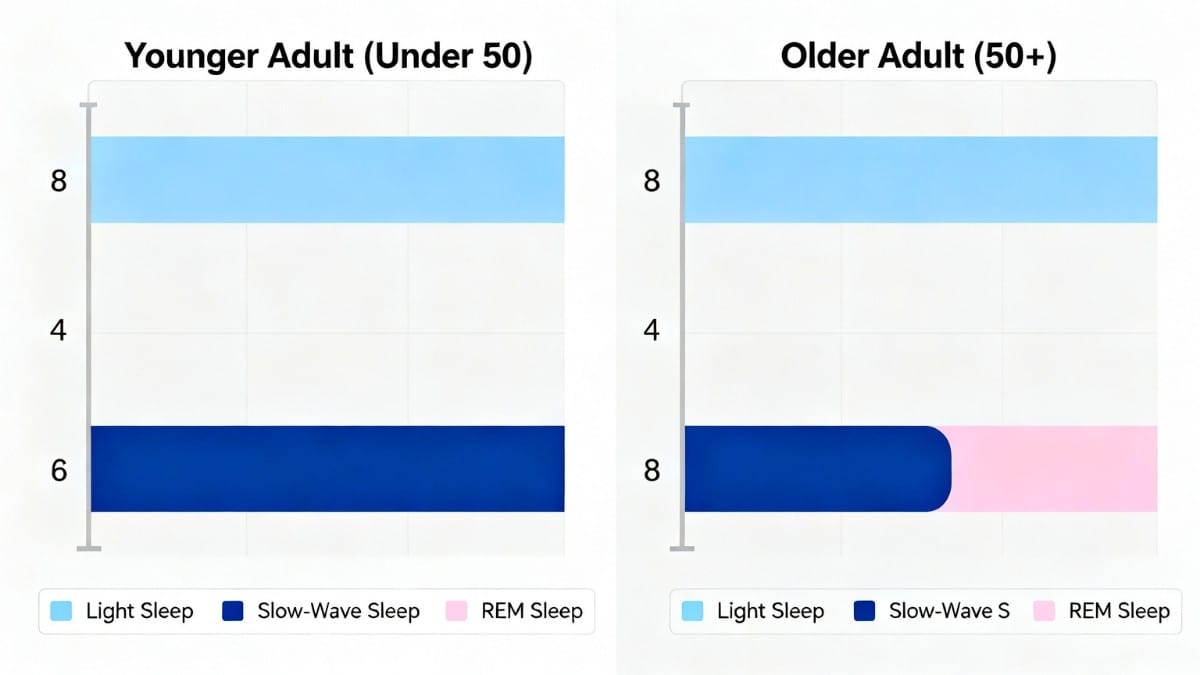
Here is why that matters for your runs:
- Slow-wave sleep is front-loaded in the night. Most of it happens in the first half.
- As you age, that first deep-sleep window becomes shorter and lighter.
- The result is less repair time per night, even when total sleep looks normal on paper.
This is the baseline problem. It is not dramatic. You will not feel it as insomnia. You will feel it as a knee that does not quite bounce back, a tendon that stays tight, or a strain that came from nowhere.
The next section explains what is actually happening inside that repair window and why no foam roller, ice bath, or stretching routine replaces it.
What Your Body Does Between 10 PM and 2 AM That Your Training Cannot Replace
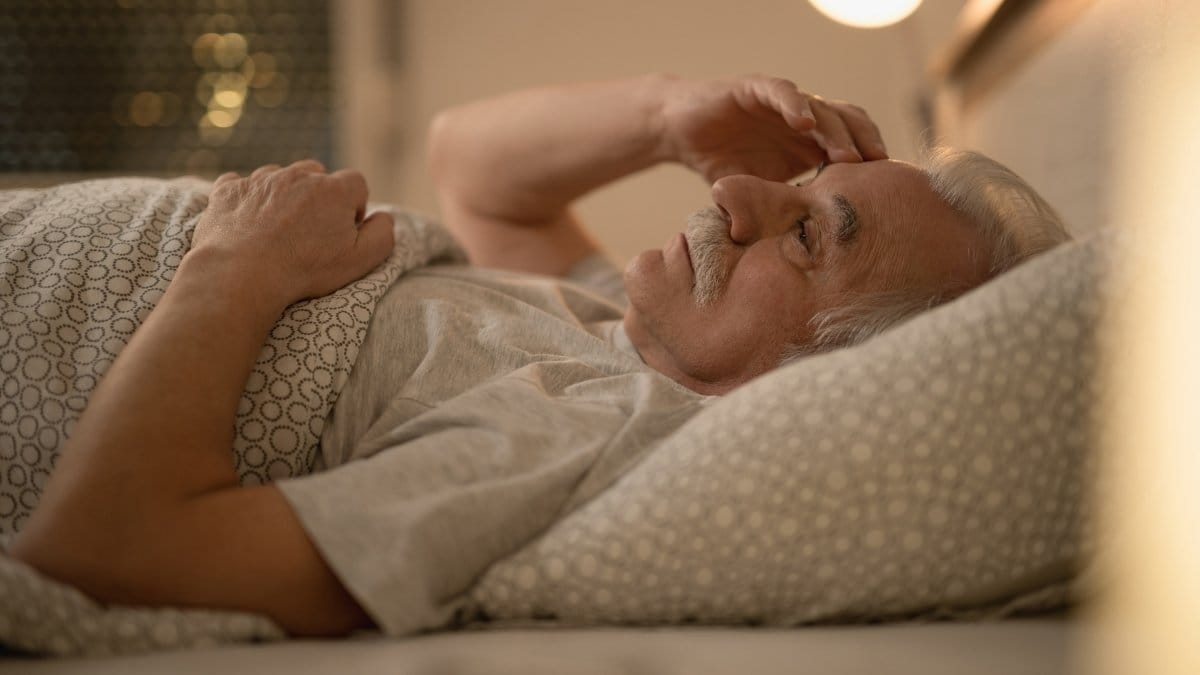
Most of what you need to know about sleep and running injuries lives in one two-hour window at the start of your night.
The repair happens in bed, not on the road. Sleep muscle repair follows a specific biological schedule that begins with deep sleep and ends when you wake up.
After 50, you are not starting from a full tank of deep sleep. You are already running low, and every short night tips the balance faster than it would for a younger runner.
Your body does not wait for you to foam roll or stretch. The repair starts the moment deep sleep begins. During deep Stage 3 sleep, your pituitary gland [a small gland at the base of the brain that controls hormone release] releases pulses of growth hormone.
This hormone drives muscle protein synthesis and collagen repair in tendons and ligaments. About 70% of your daily growth hormone is released during this stage alone.
When sleep is cut short, the hormonal picture flips:
⚠️ The Body’s Shift With Aging
From building muscle to gradually breaking tissue down
Growth Hormone Drops
Production declines, reducing the body’s ability to build and repair muscle tissue efficiently.
Cortisol Rises
Chronically elevated stress hormone levels can accelerate muscle breakdown over time.
Catabolic Shift
The body moves away from tissue-building and increasingly toward tissue breakdown.
One study referenced in exercise recovery literature reported that a single night of poor sleep reduced muscle protein synthesis by 18% and raised cortisol by 21% compared to normal sleep.
The math is simple. Less deep sleep means less hormone output. Less hormone output means less repair. Less repair means the small tears from Tuesday’s run are still there on Thursday, and adding more on top of them.
The next section shows what happens when researchers tracked this in real runners over a full year.
The Numbers Behind Sleep and Running Injuries
Most runners accept that sleep affects energy. Fewer know that it predicts injury. A study of 425 recreational runners found that those classified as poor sleepers had a 68% probability of being injured over the following year.
Steady sleepers had a 52% probability. That 16-percentage-point gap was driven entirely by sleep habits, not training load.
The finding that matters most is this: sleep problems appeared before the injuries, not after. That makes sleep a cause, not a side effect.
A separate review published on PubMed found that getting fewer than seven hours for at least 14 consecutive days is linked to 1.7 times greater risk of musculoskeletal injury [damage to muscles, tendons, ligaments, or bones from physical stress].

What the research says in plain numbers:
- Fewer than 7 hours per night, sustained for 2 or more weeks: 1.7x greater musculoskeletal injury risk
- Poor sleeper profile (short duration + low quality + frequent disturbances): 68% injury probability over one year
- Steady sleeper profile: 52% injury probability over the same period
The critical detail in both studies is the word “sustained.” One bad night is not the trigger. Two or more weeks of short nights is where the numbers change. If you have been cutting sleep short to fit in an early run, you may already be inside that window.
What the numbers do not tell you is the specific physical failure that causes the injury. The next section names it, and it is not the mechanism most runners expect.
Why Tired Legs Are Not the Biggest Warning Sign
When runners think about sleep deprivation and injury, they picture heavy legs and poor form. That is part of it. But the research points to a different, more precise failure: the brain’s movement-control system slows down before the muscles do.
Sleep reaction time in athletes is measurably slower after even one night of restricted sleep. This means that when your foot hits an uneven patch of ground, the signal to correct your ankle arrives a fraction of a second late. That fraction is enough.
Research confirms that sleep deprivation slows reaction time, reduces coordination, and degrades decision-making, all of which are required for safe running, not just fast running.
This is why the research on sleep and running injuries consistently names coordination failure as a key injury pathway, not just tissue damage.

Here is what that looks like in practice:
- A familiar trail feels harder to read.
- Your foot placement becomes slightly less precise.
- A surface you have run dozens of times catches you off-guard.
This is not about being tired. It is about a specific failure in neuromuscular control [the brain’s ability to send fast, accurate signals to muscles to coordinate movement]. The muscle is not weak. The signal is slow.
The practical implication: sleep-deprived runners do not just have less recovery. They also have reduced mechanical protection during the run itself.
The next section looks at the specific sleep habits that predict who gets hurt, and the profile is more precise than most people expect.
The Specific Sleep Habits That Separate Injured Runners From Uninjured Ones
Most runners think of sleep as one variable: hours. The research shows it is three. The 425-runner study that produced the 68% injury figure identified a “poor sleeper” profile built from three separate dimensions, each of which independently raised injury risk.
The three-part poor sleeper profile:
- Short duration: Consistently fewer than seven hours per night
- Low quality: Sleep that does not feel restorative, regardless of how long it lasts
- Frequent disturbances: Trouble falling asleep, waking during the night, or waking unrefreshed
Runners who scored poorly on all three had the highest injury rates. But runners who scored poorly on just one still had elevated risk.
Researchers studying sleep and running injuries have found that the risk is not driven by hours alone. It is driven by the full picture of how you sleep.
This matters because many runners over 50 assume they sleep fine because they are in bed for seven or eight hours. If that sleep is light, fragmented, or unrefreshing, the repair window described in the second section is still being cut short.
For runners over 50, this is the compounding problem. The age-related decline in deep sleep means the margin is already narrow. Any one of these three disturbances can push a night from borderline-adequate to genuinely insufficient.
The next section gives three specific changes, backed by the NIH, that runners over 50 can start tonight.
Three Changes Runners Over 50 Can Make Tonight
Talk to your doctor before making changes to your sleep routine if you are managing a health condition, taking medications that affect sleep, or if you suspect you have a sleep disorder such as sleep apnea.
If you have been brushing off sleep as the easy variable, the research says it’s the first place to look. The National Institute on Aging backs three behavioral changes as the first step for older adults struggling with sleep quality.
3 Powerful Habits For Deeper Sleep & Better Recovery
Small evening adjustments can improve your body’s natural sleep cycle and maximize overnight repair.
Lock Your Sleep Schedule
Go to bed and wake up at the same time daily to strengthen your circadian rhythm.
Exercise Earlier
Avoid intense workouts close to bedtime so your body can cool down for deeper sleep.
Cool Room + No Screens
Reduce blue light exposure and keep the room cool to support melatonin release.
Start with one change. Add the next after a week. Stacking all three at once makes it harder to see what is working. When you know which hour of sleep matters most, the single most useful change becomes obvious.
The Injury-Prevention Step Most Runners Skip
Your training plan has a rest day. It should also have a sleep target. Going to bed 30 minutes earlier protects the deep-sleep window that happens first in the night.
Track your sleep this week. If you are getting less than seven hours on most nights, add 30 minutes to your bedtime before your next run. Sleep and running injuries are connected in ways that show up not as a single bad night but as a pattern that builds quietly over weeks. Protecting your sleep quality after 50 is not a luxury. It belongs in the same category as your training plan.