

You’ve done everything right, and nothing is working.
Most seniors with constipation keep eating more prunes and fiber while missing the actual cause: a medication side effect, a low-hydration issue they can’t feel, a sluggish thyroid, or muscles that have stopped coordinating properly.
Senior constipation isn’t usually a fiber problem, but that’s almost always the only advice you get. If you’re one of the adults over 60 who are tired of trying every fiber product on the shelf, this article names the four causes that don’t show up in any standard list.
By the end, you’ll know exactly which questions to bring to your doctor.
Why Prunes Don’t Fix Senior Constipation
You’ve probably felt like you’re doing everything right and nothing is moving. Fiber helps when the colon is moving too slowly, but that’s just one reason for senior constipation.
Four other causes show up regularly in adults over 65. None of them respond to prunes, fiber, or laxatives.
You’re not alone in this. Studies find senior constipation affects 24% to 30% of adults over 65. Many in that group are dealing with a cause unrelated to diet.

Every doctor probably leads with fiber advice. It’s safe and easy to suggest, but it’s only right when low fiber is actually the cause.
If you’re adding more fiber, it can only do one thing: add bulk so the colon can push stool through. If the colon isn’t the problem, more bulk doesn’t help.
When the cause is a drug, a hydration gap, or a thyroid issue, fiber can make things worse.
Prune juice, bran flakes, and psyllium husk address one cause. The other four don’t respond to any of them.
What’s actually behind your constipation depends on which trigger below applies to you.
Trigger 1: Your Medication List May Be Running Your Gut
Think about every pill you take in the morning. Most people over 60 are on at least a few, and they rarely think to connect those pills to the bathroom.
You’ve probably tried what every article says. Most constipation articles treat fiber like a missing ingredient, but for older adults, the missing piece is almost always a doctor’s visit, not a prune.
About a third of Americans in their 60s and 70s takes five or more prescription drugs regularly, making senior constipation more likely with each added pill.

Talk to your doctor before making any changes to your medications, especially if you’re managing a chronic condition or taking multiple prescriptions.
Your list may include one or more of the most common offenders:
- Opioid pain relievers [drugs like oxycodone and hydrocodone that bind to receptors in the gut wall and stop muscle contractions]: the strongest offenders. Unlike most side effects, this one often doesn’t improve over time.
- Anticholinergics [bladder, allergy, and stomach drugs that block the signals keeping the gut moving]: many older adults take these under different brand names without knowing the drug class.
- Calcium channel blockers [blood pressure drugs that relax blood vessel walls by blocking calcium from entering muscle cells, a mechanism that also relaxes the gut wall and slows movement].
- Iron supplements and many antidepressants also slow bowel movement.
If you’re on even one of those types, the odds of senior constipation go up. Taking at least one drug known to cause constipation has been linked to more than twice the odds of developing it in elderly adults.
Don’t stop any medication on your own. Ask your doctor or pharmacist which, if any, could be behind the problem.
What you’re drinking, or not drinking, may be doing something similar without you knowing it.
Trigger 2: You Are Dehydrated and Don’t Know It
You probably feel like you drink enough water. Once you’re past 60, though, feeling hydrated and actually being hydrated are two different things.
Your thirst signal weakens with age. That means you can be measurably dehydrated before feeling any urge to drink.
By the time you feel thirsty, you’re already behind.

You may also be avoiding water on purpose. Mobility issues and fear of incontinence lead many older adults to drink less than they should.
Hard, dry stool that’s difficult to pass is a common sign of insufficient fluid intake. Low fluid intake is consistently linked to constipation in older adults.
Plain water works best, but soups, herbal teas, and diluted juice also count toward the daily fluid goal.
Daily Hydration Schedule
Stay perfectly hydrated all day — no counting ounces required.
Wake Up
Drink one glass of water right after waking up, before your first coffee or tea.
Mid-Morning
Enjoy one glass of water in the hours leading up to lunch.
Lunch
Pair your meal with one glass of water to support healthy digestion.
Afternoon
Drink one glass of water alongside a light snack or activity break.
Dinner
Have one glass of water together with your evening meal.
Before Bed
Take one small glass about 2 to 3 hours before going to sleep.
Of the four triggers, this one is the most straightforward to address on your own. It doesn’t require a prescription or a doctor’s visit.
Schedule your fluid intake rather than waiting to feel thirsty. That single change is how you close the gap.
The next trigger looks nothing like a hydration problem, but it slows the gut in the same way.
Trigger 3: A Sluggish Thyroid Could Be Behind It
You’ve probably chalked up the fatigue, slower digestion, and extra sensitivity to cold as just getting older. Sometimes the real culprit is your thyroid.
Thyroid problems become increasingly common after 65. This is one condition that regularly goes undetected for years.
Slow digestion and hard stools are two common signs of an underactive thyroid.
Your gut speed depends partly on thyroid hormone output. When that output drops, digestion slows and stools become harder.
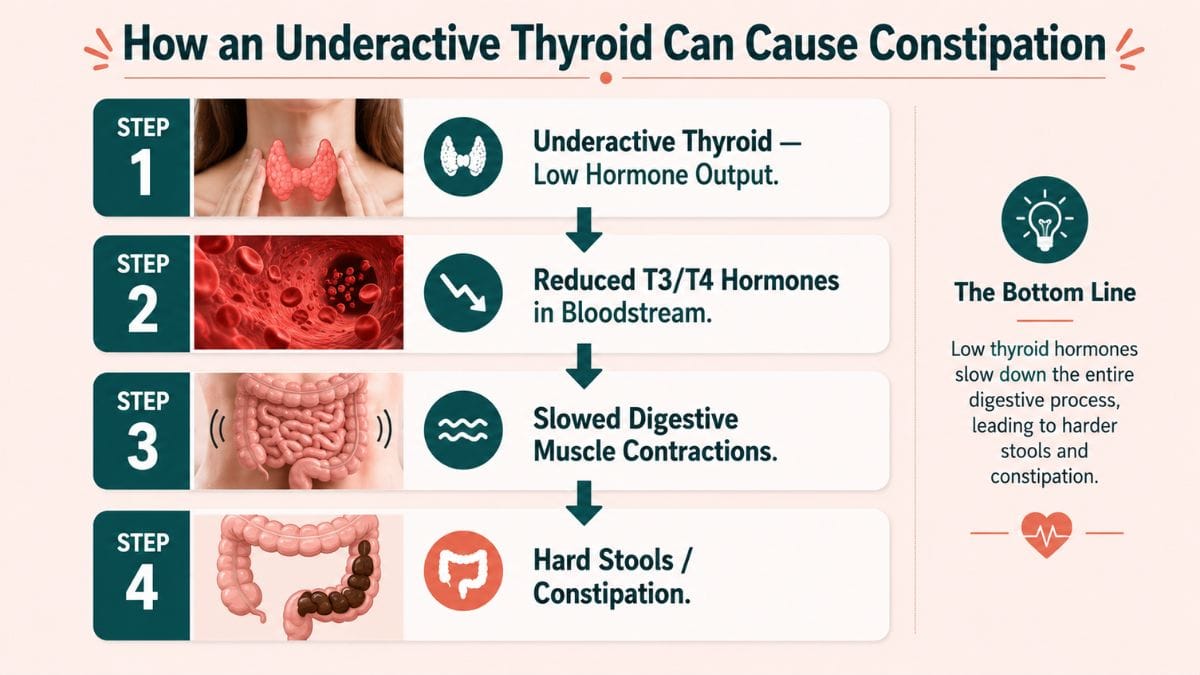
Many older adults have this condition without knowing it. Hypothyroidism [underactive thyroid, a condition that reduces hormone output and slows the entire body including the gut] is frequently associated with constipation.
Fatigue, cold sensitivity, and dry skin are classic signs that often get dismissed as normal aging.
Even when those signs point toward the thyroid, constipation rarely gets mentioned alongside them. That keeps many people looking for a diet fix to a hormonal problem.
Your doctor can identify this with a blood test measuring a hormone called TSH [thyroid-stimulating hormone, the marker used to detect whether the thyroid is underproducing].
Treatment for an underactive thyroid may resolve the constipation.
The fourth trigger is the most counterintuitive, and it has nothing to do with what you’re eating or drinking.
Trigger 4: Your Pelvic Floor Muscles Have Forgotten Their Job
If you’ve ever strained hard and felt physically blocked from the inside, this trigger may explain why. What you’re feeling is real and has a name.
When you try to go, the muscles around the rectum are supposed to relax and open. Pelvic floor dyssynergia [a condition where those muscles contract and tighten during straining instead of relaxing] is what happens when they don’t.
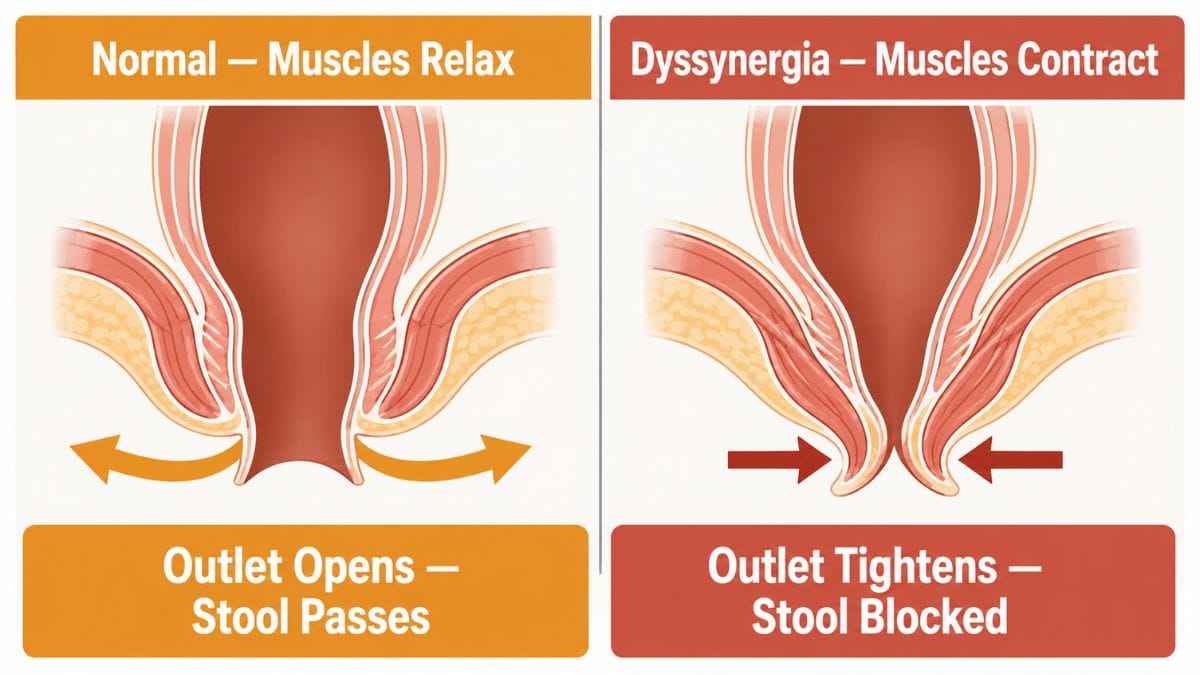
You might be among the up to half of people with long-term constipation who also have pelvic floor dysfunction.
More fiber and water won’t fix a muscle coordination problem. This is not a diet issue, and laxatives won’t change how those muscles behave.
Your best option here is a referral to a pelvic floor physical therapist. Biofeedback therapy has been shown in a controlled trial to provide sustained improvement for this condition.
That same trial found that diet, exercise, and laxatives were largely ineffective for the same group.
Ask your doctor for a referral to a pelvic floor physical therapist. They can evaluate whether this is behind your constipation and work on correcting the muscle coordination.
The last section gives you the exact questions to bring to that appointment and every other one that matters.
How to Tell Your Doctor What’s Going On
Most older adults have been told that senior constipation is just part of aging. It isn’t, and there are specific questions that prove it.
Four specific causes means four specific tests. Your doctor may not think to check all of them without prompting.

The appointment goes better with these four questions prepared:
- Medications: Can you review my full medication list for any drugs known to cause or worsen constipation?
- Hydration: Based on my age and health conditions, what should my daily fluid target be?
- Thyroid: Can we add a TSH test to my next bloodwork to rule out hypothyroidism?
- Pelvic floor: Would a referral to a pelvic floor physical therapist make sense for what I’m experiencing?
You don’t have to know which trigger applies before you walk in. Asking about all four takes less than five minutes.
If your doctor tells you constipation is just part of aging, it’s reasonable to ask which of these specific causes was ruled out.
Ask your doctor to do a full medication review and a basic thyroid and hydration check at your next appointment.
If you’ve been constipated for more than a few weeks and nothing has helped, ask whether a gastroenterology referral makes sense.
Covering all four triggers takes one appointment, as long as you come in prepared.
Conclusion
Book an appointment with your doctor this week and bring the four questions from the section above. Ask your doctor to do a full medication review and a basic thyroid and hydration check at your next appointment.
If pelvic floor dysfunction looks relevant, ask for a specialist referral. Senior constipation is often a medical problem with a medical solution.
Finding the right one starts with asking the right questions.