

Most of us have done it. We brush off a forgotten name or a lost word as just part of getting older. And for a long time, that reassurance feels reasonable. But in my work with adults in their 50s and 60s, I have learned to look past the surface explanation.
Sometimes what looks like ordinary forgetfulness carries a quieter, more serious story underneath. That story runs through the blood vessels feeding the brain, not just the brain cells themselves. The research connecting low omega-3 levels to stroke risk is growing and increasingly specific. It is time that adults over 50 started paying attention to what the science is actually saying.
The Forgetfulness We Get Wrong
The medical community has long separated two categories of age-related brain change. The first is normal cognitive aging: slower recall, the occasional tip-of-the-tongue moment, a little more time to process new information. These are real, but they are not dangerous.
The second category is different. It involves small but meaningful failures in how blood reaches and nourishes the brain.
Even a gradual reduction in blood flow to the brain can produce symptoms that look almost identical to normal aging. Word-finding gaps that last a beat too long. A moment of spatial confusion that feels out of place.
Separating early cerebrovascular changes from routine cognitive aging is a genuine clinical challenge. The National Institute on Aging notes it is not as simple as it looks. Attention that slips mid-conversation deserves more than a shrug.
What makes this harder is that most adults never connect these signals to their cardiovascular system. They see a brain symptom and think: memory. They rarely think: arteries. But the brain is one of the most blood-hungry organs in the body. The quality of the vessels feeding it shapes everything about how it functions after 50.

In my conversations with adults in their late 50s, one pattern comes up more than almost any other. People notice a change in how they feel mentally. They chalk it up to stress or poor sleep. Nutrition, and specifically omega-3 intake, is almost never part of that conversation. That is the gap this article is here to close.
What Omega-3 Deficiency Does to the Aging Brain and Vessels
DHA, or docosahexaenoic acid, makes up about 30 to 40 percent of the fatty acids in brain gray matter. Research from the National Institutes of Health identifies this ratio as foundational to brain cell function. Your brain neurons depend on an adequate supply of this specific omega-3.
When DHA levels fall, neuronal membranes become less flexible. Signals between brain cells slow. Over time, that has consequences for both cognition and vascular function.
EPA, the other key omega-3, acts on blood vessel walls. It reduces the low-grade inflammation that builds silently in arteries over years. The American Heart Association links chronic vascular inflammation to atherosclerosis, the artery-hardening process that raises stroke risk. Without enough EPA, that inflammatory process faces less resistance.
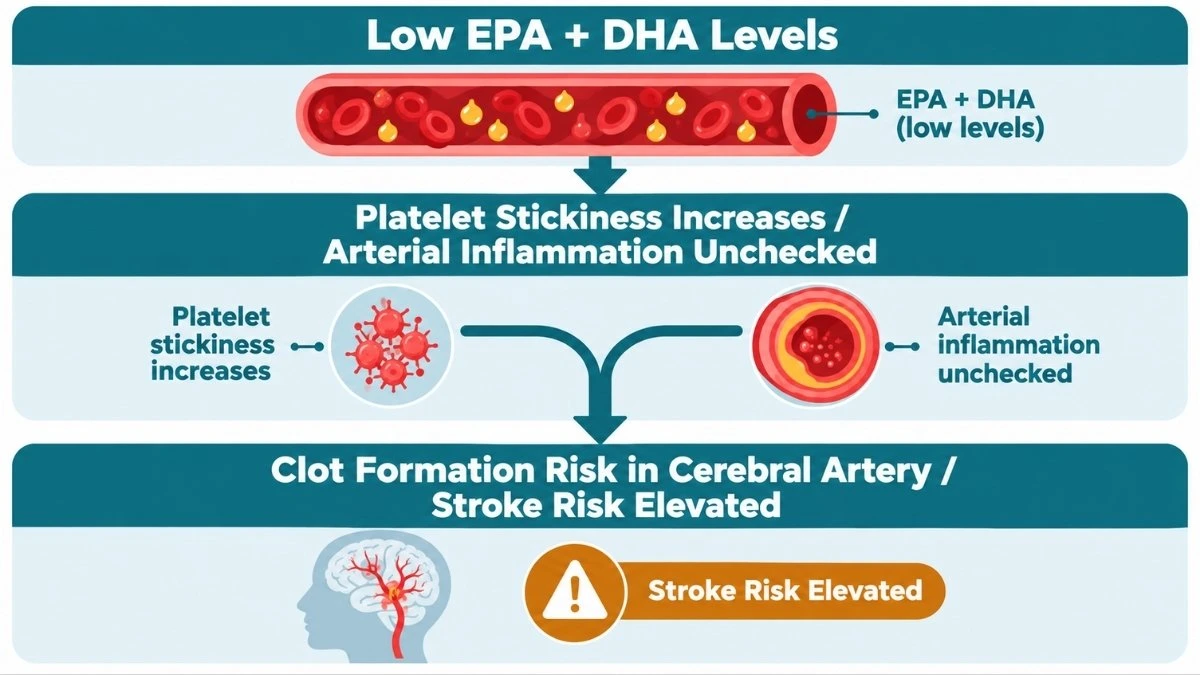
One of the more direct mechanisms involves platelets. Platelets are the small blood cells that form clots. Research published in Prostaglandins, Leukotrienes and Essential Fatty Acids has shown that omega-3 deficiency makes platelets stickier, meaning they cluster more readily. Stickier platelets raise the risk of a clot forming in a cerebral artery. That is the core mechanism behind ischemic stroke.
Omega-3s also help regulate blood pressure and lower triglyceride levels. Both of these are independent stroke risk factors. When omega-3 intake is low, these protective effects disappear quietly.
This effect compounds with age, since aging reduces vascular elasticity and raises the baseline risk of arterial events. The result is a cardiovascular environment that becomes harder on the brain over time.
What the Research Actually Shows
The VITAL trial, published in the New England Journal of Medicine in 2019, tracked over 25,000 adults for several years.
It found that omega-3 supplementation reduced the risk of major cardiovascular events. The benefit was largest in participants who ate little or no fish. That pattern points to baseline deficiency as a key variable.
One of the most useful tools from recent research is the Omega-3 Index. Researchers at the Fatty Acid Research Institute developed and validated it. The test measures the percentage of EPA and DHA in red blood cell membranes.
Studies have consistently linked a low Omega-3 Index, below 4 percent, to higher cardiovascular and stroke risk. An index above 8 percent links to meaningful cardiovascular protection.
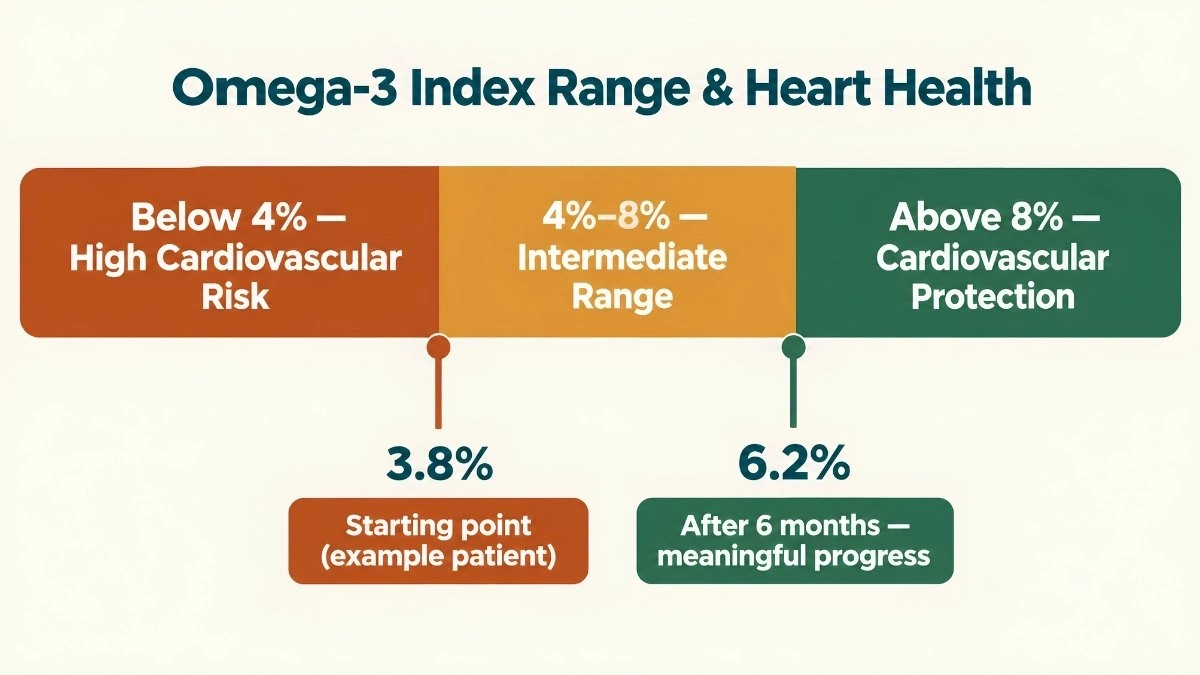
A 62-year-old teacher I worked with described exactly this gap. She had a family history of stroke and ate fish once every two weeks. She took no omega-3 supplements. She had never heard of the Omega-3 Index.
Her test came back at 3.8 percent. She had no idea. Within six months of dietary changes and a standard fish oil supplement, her index reached 6.2 percent. Her cardiologist called that progress meaningful.

It helps to be precise about stroke type here. About 87 percent of all strokes are ischemic, according to the Centers for Disease Control and Prevention. In ischemic stroke, clots block blood flow to the brain. Omega-3s protect against this type.
Hemorrhagic strokes involve a vessel rupture. They are a different mechanism. Very high-dose omega-3 supplementation may carry some risk there, which is why physician guidance matters before dramatically increasing intake.
The REDUCE-IT trial showed that a pharmaceutical omega-3 called icosapentaenoic acid reduced cardiovascular events in people with elevated triglycerides. But the dose was prescription-grade, far above what food or standard supplements provide.
The STRENGTH trial, using a different high-dose formulation, did not show the same benefit. I share this with patients so they understand that food-sourced omega-3 and pharmaceutical intervention are not the same conversation.
Who Is Most at Risk After 50
Dietary patterns are the most predictable predictor of omega-3 status. Adults who eat fatty fish fewer than once a week tend to have the lowest Omega-3 Index scores. Fatty fish includes salmon, mackerel, sardines, and herring.
Research published in the journal Nutrients found that Western-style diets push the ratio of omega-6 to omega-3 to 15-to-1 or higher. The ideal ratio is closer to 4-to-1. That gap creates a persistent pro-inflammatory environment in the body.
Geography matters too. Adults in landlocked regions without regular access to fatty fish show lower omega-3 levels on average.

This is not a small difference. Population studies have recorded Omega-3 Index scores below 4 percent across large segments of North American and European adults. High reliance on corn or soybean oils in cooking makes this worse.
Several health conditions compound the risk. High blood pressure, type 2 diabetes, atrial fibrillation, and elevated triglycerides are each independent stroke risk factors. They are also conditions tied to poor omega-3 metabolism. Adults managing any of these conditions are dealing with a double vulnerability.
There is also an age-specific factor that most people are not told about. After 50, the body becomes less efficient at converting plant-based omega-3. The plant form, called ALA, is found in flaxseed and walnuts.
The body must convert ALA into DHA and EPA before it can use it. That conversion rate drops with age. What felt adequate at 35 may not be enough at 60.
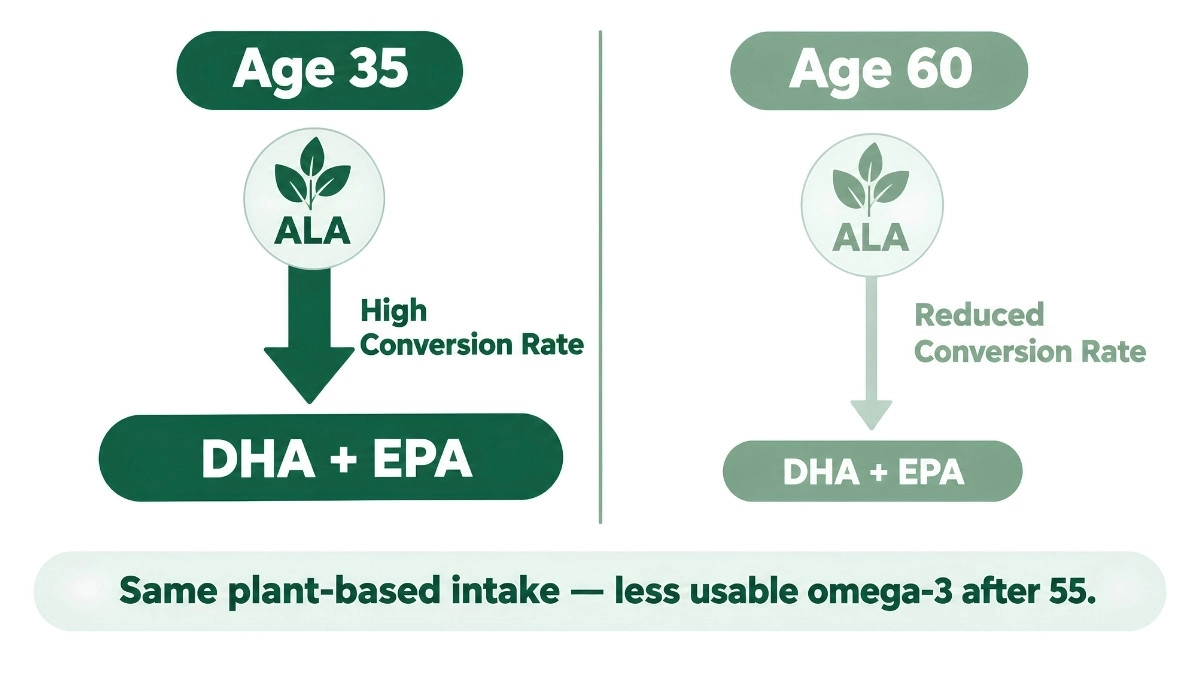
In practice, a flaxseed smoothie is not a substitute for a fish dinner or an algae capsule after 55. Most supplement labels do not explain this distinction clearly, which is why adults over 50 often end up with the wrong product.
Preformed DHA and EPA from fatty fish or algae-based supplements become more important, not optional.
If your fish intake is low and you are not supplementing, bring up the Omega-3 Index test at your next appointment. It takes one blood draw and gives a precise starting point.
What You Can Do and When to Talk to Your Doctor
Before adjusting your supplement routine, speak with your doctor, especially if you take blood thinners, blood pressure medications, or any anticoagulant therapy. The guidance below is evidence-informed but cannot replace a personalized clinical assessment.
The most bioavailable source of EPA and DHA is fatty fish. Salmon, mackerel, sardines, anchovies, and herring eaten two to three times per week provide consistent levels that most research considers protective. For most adults over 50, this is the most direct dietary change available.

For those who do not eat fish, algae-based omega-3 supplements are the most direct plant-derived source of preformed DHA and EPA. Flaxseed oil is often recommended, but it provides ALA only. Given the conversion problem described above, algae oil is a better fit for older adults who avoid fish.
The American Heart Association recommends 1 gram of combined EPA and DHA per day for adults with existing heart disease. For those with elevated triglycerides, some guidelines suggest 2 to 4 grams, but that range requires physician oversight. Do not increase your dose without that conversation first.
One group needs particular attention: anyone taking blood-thinning medications such as warfarin, aspirin, or newer anticoagulants. Omega-3s have a mild blood-thinning effect. At higher doses, this can interact with anticoagulant therapy in ways that require clinical monitoring. This is not a reason to avoid omega-3s. It is a reason to have the conversation with your prescribing physician.
The Omega-3 Index test deserves a specific mention. Unlike guessing based on diet alone, it gives a precise, personalized baseline. It is increasingly available through direct-to-consumer lab services and through primary care. Knowing your number removes the guesswork.

One final distinction is worth making. Sudden confusion, difficulty speaking, facial drooping, or severe headache are acute stroke symptoms. Call emergency services immediately if these occur. This article addresses long-term risk reduction, not emergency response. Those are two very different conversations.
Conclusion
Your brain after 50 deserves more than reassurance. If your fish intake is low or you have never tested your omega-3 levels, one conversation with your doctor can change that. Ask about an Omega-3 Index test. It is one blood draw. It gives you a real number and a real place to start.