
You used to fall asleep without thinking about it. Now you lie there, watch the clock, or wake at three in the morning and can’t get back down.
Adults over 50 who are sleeping worse than they used to and want to fix it without medication are often given the same sleep hygiene tips that anyone might find in a general wellness article, and those tips frequently don’t work because they ignore the specific biology that changes after midlife.
This article explains what those changes are and gives you timed, practical sleep hygiene practices that match them. By the end, you’ll know what to do, when to do it, and why the order actually matters.
Why Sleep Changes After 50 (and Why Generic Advice Often Fails)
You didn’t develop bad habits. Your brain changed. After 50, the body handles sleep differently in three concrete ways, and most sleep tips are written as if none of them happened.
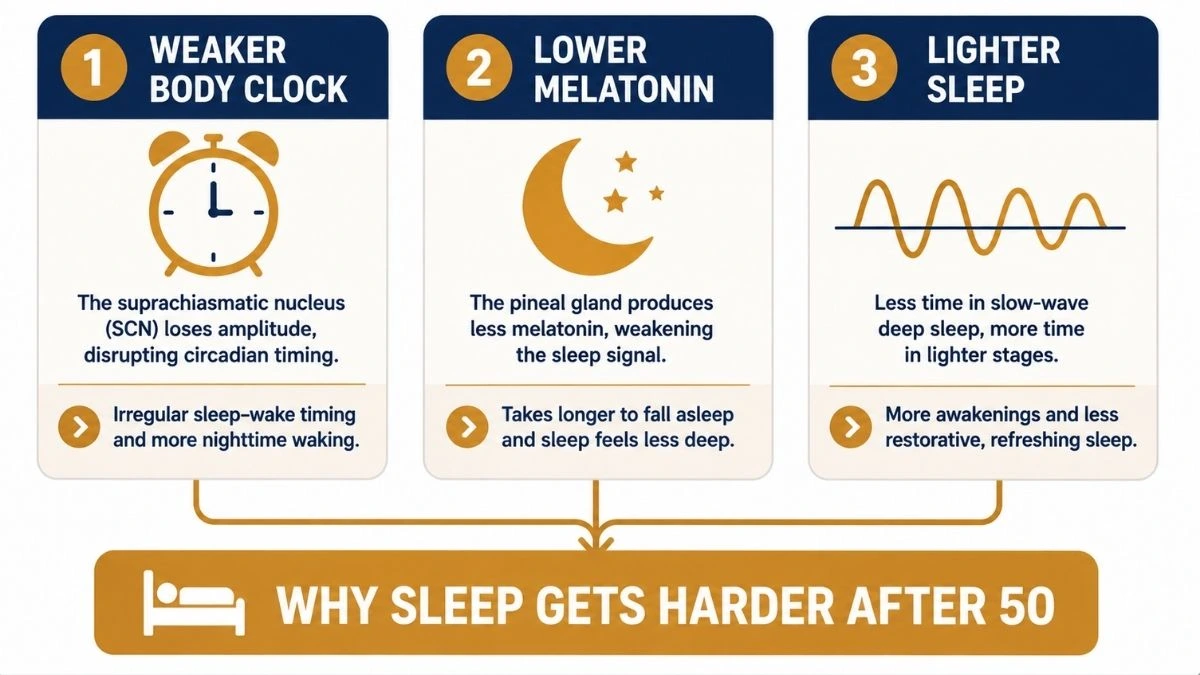
The internal clock weakens. The suprachiasmatic nucleus [a cluster of nerve cells in the brain that acts as the body’s internal 24-hour clock] loses strength with age. Its daily rhythm flattens, shifting sleep timing earlier and making the clock easier to disrupt.
This is why many adults over 50 feel tired at eight in the evening and then wake before five in the morning, even when they went to bed late.
Melatonin output drops. The pineal gland [a small gland in the brain that releases melatonin, the hormone that signals darkness and promotes sleep] produces less melatonin as people age.
This is associated with increased sleep disruption and circadian instability. Less melatonin means a weaker sleep signal, which makes it harder to fall and stay asleep.
Sleep becomes lighter. Older adults spend more time in the lighter sleep stages and less time in deep, slow-wave sleep. This is why small sounds or a full bladder that once went unnoticed can now wake you completely.
A systematic review and meta-analysis covering 71,607 community-dwelling adults aged 60 and over found that 45% had measurable sleep disturbances, rising to 48% in those aged 70 and older.
These changes aren’t a character flaw. They’re predictable biology. The section that follows shows where to start working with them, beginning with the sleep hygiene practices that address these changes in sequence.
Talk to your doctor before making changes to your sleep routine if you’re managing a chronic condition, take prescription medications, or have cardiovascular concerns, since some of the practices below may interact with existing treatments.
1- The Morning Anchor: Set Your Night by What You Do at Dawn
Most people focus on what they do at bedtime. The research points somewhere else.
Wake time drives everything. Waking at the same time every day, including weekends, is the single most controllable anchor for your body’s sleep-wake rhythm.
It works by allowing adenosine [a chemical that builds up in the brain while you’re awake and creates sleep pressure; the longer you’re awake, the more accumulates] to accumulate over a consistent number of hours, so you feel genuinely sleepy at a predictable time at night. Skip it one morning and your night shifts.
This is where the body after 50 needs something specific. The body after 50 does not just sleep less well; it needs the same habits applied in the right order at the right time of day, because a warm room that helps a 30-year-old relax can actively delay sleep in someone whose core temperature regulation has changed.
Morning light reinforces the anchor. After waking, open the curtains or step outside for 10 to 15 minutes. Natural light entering the eyes signals the suprachiasmatic nucleus and stabilizes the circadian phase.

Research on aging and circadian function finds that timed light exposure is one of the most reliable ways to counteract the amplitude reduction that comes with age. You don’t need a special lamp. Daylight through a window on a clear morning is sufficient.
Research comparing older adults’ sleep timing to their melatonin rhythms shows that older adults wake at an earlier circadian phase than younger adults, which means the morning window is when the clock is most responsive to reinforcement.
The Morning Anchor
Four rules that lock your circadian clock
and rebuild your sleep from the ground up.
- Rule 01 Same Wake Time, Every Day
Set your anchor: wake at the exact same time all seven days. Weekends included. No exceptions. Consistency is the protocol.
- Rule 02 Light in Your Eyes Within 15 Min
Step outside immediately. 10 minutes of natural light sets your cortisol peak and signals your brain that the day has begun.
- Rule 03 Guard Your Sleep Pressure
No naps before early afternoon. If needed, cap any nap at 30 minutes maximum — longer naps bleed the sleep drive you need for the night.
- Rule 04 Hold the Anchor After a Bad Night
Never adjust your wake time to compensate. One rough night fixed by sleeping in resets the clock in the wrong direction.
What you do in the morning anchors the clock; the afternoon is where most people unknowingly cut into it.
2- What to Cut and When: Caffeine and Alcohol After 50
You probably already know caffeine and alcohol can affect sleep. What most advice leaves out is exactly when to cut them off, and why that cutoff is earlier after 50.
Caffeine stays in your system longer than you think. A 2013 study published in the Journal of Clinical Sleep Medicine found that a moderate dose of caffeine taken six hours before bedtime still significantly disrupted sleep compared to placebo.
A 2023 systematic review and meta-analysis found caffeine reduced total sleep time by 45 minutes on average, cut sleep efficiency by 7%, and added nine minutes to how long it took to fall asleep.

The same review noted that the sleep of older adults may be more sensitive to caffeine than that of younger adults.
For most adults over 50, a cutoff of around noon may be a reasonable target, given findings that caffeine taken six hours before bedtime still disrupts sleep. If you’re sensitive to caffeine, move it earlier still.
Alcohol is not a sleep aid. It may help you fall asleep faster, but it suppresses REM sleep [the sleep stage associated with memory consolidation and emotional regulation, which happens mainly in the second half of the night] and increases waking in the hours after midnight.
Because older adults already spend more time in lighter sleep stages, research suggests alcohol’s second-half-of-the-night effects may be especially disruptive for this age group.
Quick guide to cutoffs:
- Last caffeine: by noon if you sleep around 10 to 11 p.m.
- Last alcohol: at least three hours before bed, and one drink maximum
These are the chemistry guardrails. The next section covers what to do in the evening with your body temperature.
3- Use Your Body Temperature to Fall Asleep Faster
Your body has to cool down to fall asleep. Most people don’t know they can help it do that.
The temperature drop is the trigger. Your body needs to cool down before it can fall asleep, and the drop is larger than most people realize. Core body temperature falls by roughly half a degree to one degree Fahrenheit in the hour before sleep.
This drop is what signals the body to initiate sleep. After 50, thermoregulation [the body’s process of maintaining its own internal temperature] becomes less efficient, which can slow or reduce this natural cooling.
Bedroom temperature matters more than most people realize. A longitudinal study using wearable sleep monitors and environmental sensors in 1,094 community-dwelling older adults with a mean age of 72 found that higher bedroom nighttime temperatures were associated with shorter sleep duration, lower sleep efficiency, and more restlessness.
A warm bath or shower one to two hours before bed can help.
Warm water draws blood toward the skin surface and hands and feet, which then releases that heat outward, and research suggests this process may cause core temperature to fall faster than it would on its own.
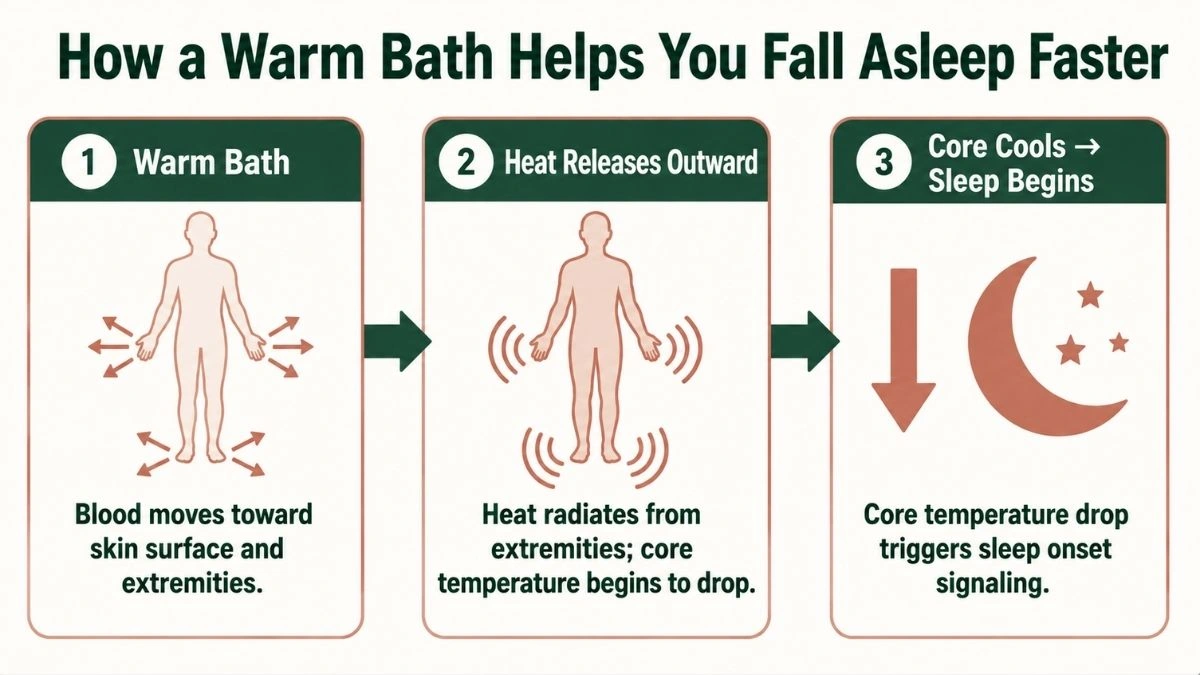
Hot-water bathing at the right time before bed appears to help. A longitudinal study of 1,094 older adults with a mean age of 72 years found that hot-water bathing in the window of one to three hours before bedtime was significantly associated with shorter sleep onset latency and a higher heat-loss gradient compared with no bathing.
A 2019 systematic review and meta-analysis of 17 studies found that a warm bath or shower at 40 to 42.5 degrees Celsius, taken one to two hours before bedtime for as little as 10 minutes, was associated with improved sleep efficiency and shorter time to fall asleep.
Earlier research in elderly adults with insomnia also found that a warm bath in the evening was associated with increased slow-wave sleep, the deepest and most restorative stage.
Keep your bedroom cool. Keeping your bedroom cool enough for a light blanket is a reasonable starting point based on what temperature research shows matters for sleep onset.
Your bedroom’s temperature is a lever. The next section covers a behavioral one.
4- Train Your Brain to Sleep When You Get Into Bed
If you watch TV in bed, scroll your phone in bed, or lie there anxious and awake for long stretches, your brain is learning that bed is a place for wakefulness. You can undo that.
There is a specific, tested technique for fixing that learned association. Stimulus control [a behavioral technique that rebuilds the mental link between bed and sleep by removing all non-sleep activities from the bed] is the behavioral approach with the strongest evidence for improving total sleep time.
A 2021 American Academy of Sleep Medicine clinical practice guideline gives it a conditional recommendation as a single-component therapy for chronic insomnia in adults.
A 2024 network meta-analysis covering 80 studies and 15,351 participants found that stimulus control therapy was associated with significant improvements in objective total sleep time.
The rules are specific:
- Go to bed only when you feel genuinely sleepy, not just tired or ready for the day to end
- If you’ve been awake for more than 20 minutes, get up and go to a different room until you feel sleepy
- Use bed only for sleep and sex, nothing else
- Wake at your anchor time every morning regardless of how much you slept
The counterintuitive part is rule two. Getting out of bed when you can’t sleep feels wrong, but staying in bed while awake deepens the learned association between bed and wakefulness. It makes the next night harder.
Older adults specifically have been studied on this. A systematic review of behavioral insomnia therapies in older adults over 60 found that both stimulus control and sleep restriction, used as individual components, brought about significant improvements in sleep quality.
These practices work for most people most of the time. The next section is honest about when they don’t.
When Sleep Hygiene Is Not Enough
Here’s something most sleep hygiene articles won’t tell you: the American Academy of Sleep Medicine recommends against using sleep hygiene alone as a treatment for chronic insomnia.
That’s not a reason to skip the habits in this article. Sleep hygiene lowers the load on your sleep system and removes common barriers. But if you’ve been struggling with sleep for three months or more, wake feeling unrested most days, or find that daytime function is consistently impaired, sleep hygiene on its own is unlikely to be enough.
CBT-I [cognitive behavioral therapy for insomnia, a structured program that combines stimulus control, sleep restriction, and work on unhelpful thoughts about sleep, typically delivered over six to eight sessions] is the first-line non-drug treatment for chronic insomnia.

The AASM gives it a strong recommendation based on evidence from nearly 50 studies. It is also available digitally.
A randomized controlled trial of a tailored digital CBT-I program in 311 adults aged 55 to 95 found significant improvement in insomnia severity compared with patient education at post-treatment, six-month follow-up, and 12-month follow-up.
When to see a doctor:
- Sleep trouble has lasted three months or more
- You wake gasping, snoring loudly, or your partner reports breathing pauses during sleep (possible sleep apnea)
- Daytime impairment is severe enough to affect your work, driving, or daily function
- You rely on alcohol or medication to fall asleep most nights
The goal is not to simply practice more habits. The goal is to sleep.
Conclusion
Start tomorrow morning: wake at the same time, open the curtains, and get natural light in your eyes for 10 minutes before you do anything else. Pick one practice from this article tonight and do it for two weeks straight before adding a second. Adding too many changes at once makes it impossible to know what’s working. These sleep hygiene practices work with your biology, one step at a time.