
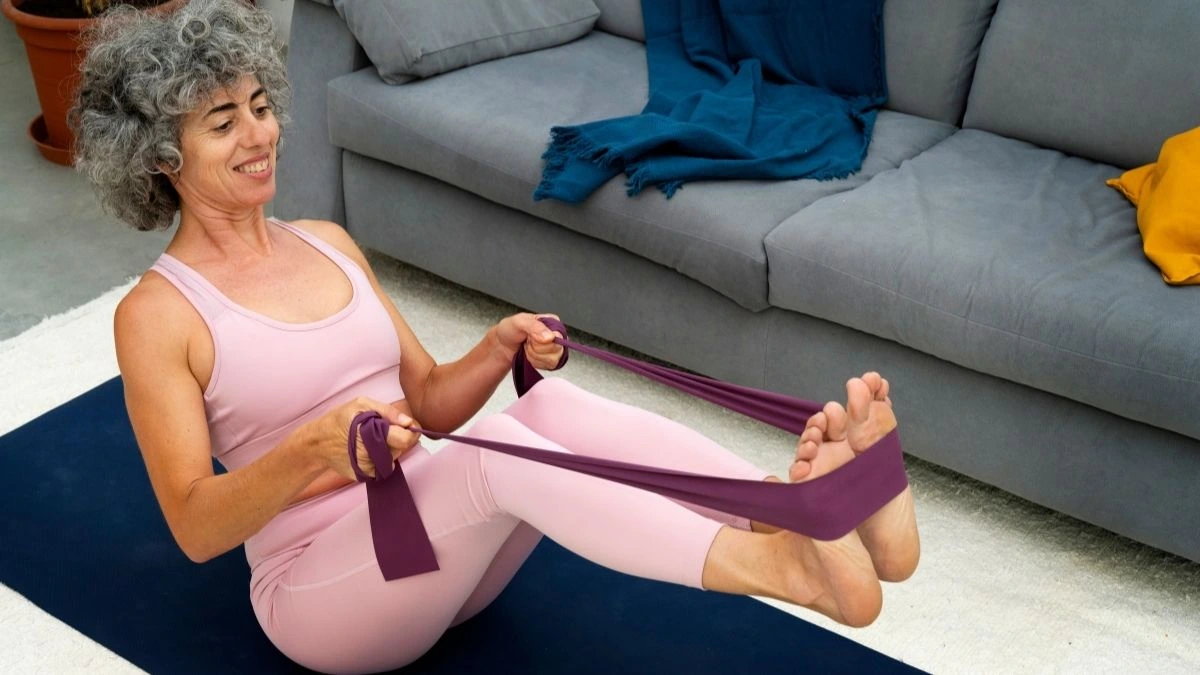
Getting up from a chair should not be a project. For adults 60 and older who want to keep their strength and avoid falls, the gap between where you are and where you want to be is smaller than you think.
This article solves a real problem: older adults who want to stay strong and independent do not know how to start safe, effective strength training at home without heavy equipment.
Resistance band exercises for seniors are one of the safest and most accessible ways to build that strength back, and you don’t need a gym or anything more than a band that costs less than a pizza.
By the end of this guide, you’ll have a full starter routine you can do at home, built around the exact movements that matter most in daily life.
Why Your Muscles Need Work (and What Happens When They Don’t)
You’ve probably noticed some things getting harder. Getting up from a low seat. Carrying a bag of groceries from the car. Climbing a flight of stairs without gripping the rail. This isn’t laziness.
It’s what happens when resistance band exercises for seniors are not part of your routine, and your muscles quietly shrink over time without a regular reason to stay strong.
The clinical term for this is sarcopenia [the gradual, age-related loss of muscle mass and strength that makes daily tasks harder and raises the risk of falls]. Large population studies have found that sarcopenia affects over 20% of adults aged 60 to 70, and approaches 50% of those over 75.
Here’s what makes it dangerous: muscle loss changes how well you can catch yourself when you stumble.
The CDC reports that more than 14 million adults ages 65 and older, one in four, fall each year in the United States. Falls are the leading cause of injury-related death in this age group.

The good news is that muscle responds to training at any age. Your body has not crossed a line where effort stops working.
Research suggests that resistance training, done consistently and safely, may help slow and even reverse muscle loss in older adults. The question is not whether training works for your age group. It’s which training is the safest place to start.
That answer comes in the next section.
The One Thing That Makes Bands Safer Than Weights for Older Joints
Most people assume that a lighter dumbbell is a safer dumbbell. That’s partly true. But there’s a loading principle that changes the picture entirely when it comes to older joints.
A resistance band gets easier to pull as your joint reaches the position where it is most likely to get hurt, which is the opposite of what a dumbbell does.
This property is called accommodating resistance [a loading pattern in which the force increases as the muscle grows stronger through a movement, and decreases where the joint is most at risk].
When you curl a dumbbell, the weight is heaviest right where your elbow joint is under the most stress. When you use a band, the tension is lightest at that same point. As you complete the movement and the muscle is strongest, the band tension rises.
For older shoulders, knees, and hips, this matters a great deal. The National Strength and Conditioning Association’s position statement on resistance training for older adults endorses elastic bands as a safe and effective training tool for this population.

Bands also offer three practical advantages over free weights:
- No dropping risk. A band that slips does not fall on a foot or a floor.
- Seated use. Many band exercises can be done from a chair, which removes balance as a barrier.
- Adjustable starting point. Shortening the band increases resistance. Lengthening it decreases it. No need to buy a full set of weights.
The exercises in the next three sections are built around this principle. Each movement is chosen because a band makes it safer than its free-weight equivalent at the exact moment your joint needs protection most.
Talk to your doctor before starting any new exercise program if you have a heart condition, joint replacement, osteoporosis, or a condition that affects your balance.
Moves That Help You Stand Up and Sit Down Without Struggle
Standing up from a chair is not a simple task. It requires your thigh muscles, hip muscles, and core to work together in a single controlled motion. When those muscles weaken, you’ll notice yourself pushing off with your hands, rocking forward to build momentum, or avoiding low chairs entirely.
A 2025 meta-analysis of 25 randomized controlled trials involving 1,318 older adults found that elastic band training significantly improved performance on the chair stand test, a standard measure of lower-body strength and fall risk.
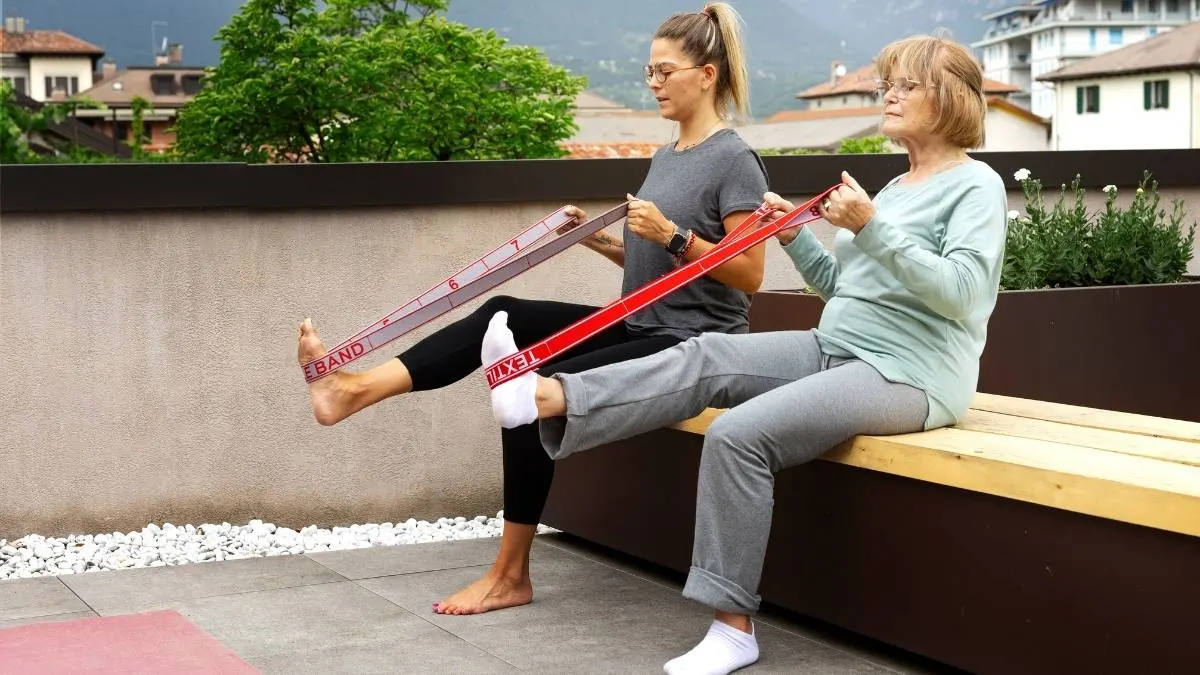
These two exercises directly strengthen the muscles the chair stand test measures.
Exercise 1: Sit-to-Stand with Band
- Sit near the front edge of a sturdy chair. Loop the band across both thighs, just above the knees, and hold the ends with both hands at your sides.
- Lean slightly forward at the hips, keeping your back straight.
- Press through your heels and stand up slowly. The band will add resistance as you rise.
- Lower yourself back down slowly. Do not drop into the seat.
- Do two sets of eight to 10 repetitions.
Exercise 2: Seated Leg Press with Band
- Sit tall in a chair. Loop the band around one foot and hold both ends in your hands.
- Press your foot forward against the band until your leg is nearly straight. Hold for one second.
- Slowly return. Do 10 repetitions per leg, two sets.
Safety tip: If standing up from the chair feels unsafe without using your hands, keep one hand lightly on the armrest during the first few sessions.
These two exercises build the exact strength needed to rise from a seat without struggle. The next section adds the upper body movements you need to carry things safely.
Moves That Help You Carry, Reach, and Push in Daily Life
Think about how many tasks involve pulling, lifting, or reaching. Carrying groceries. Pulling open a heavy door. Lifting a bag into an overhead compartment.
These movements depend on the muscles of your back, shoulders, and arms, all of which are directly trainable with a resistance band.
A 2025 meta-analysis found that elastic band training significantly improved performance on the leg extension and functional reach tests in older adults, suggesting the benefits extend to both upper and lower body function.
Exercise 3: Seated Row
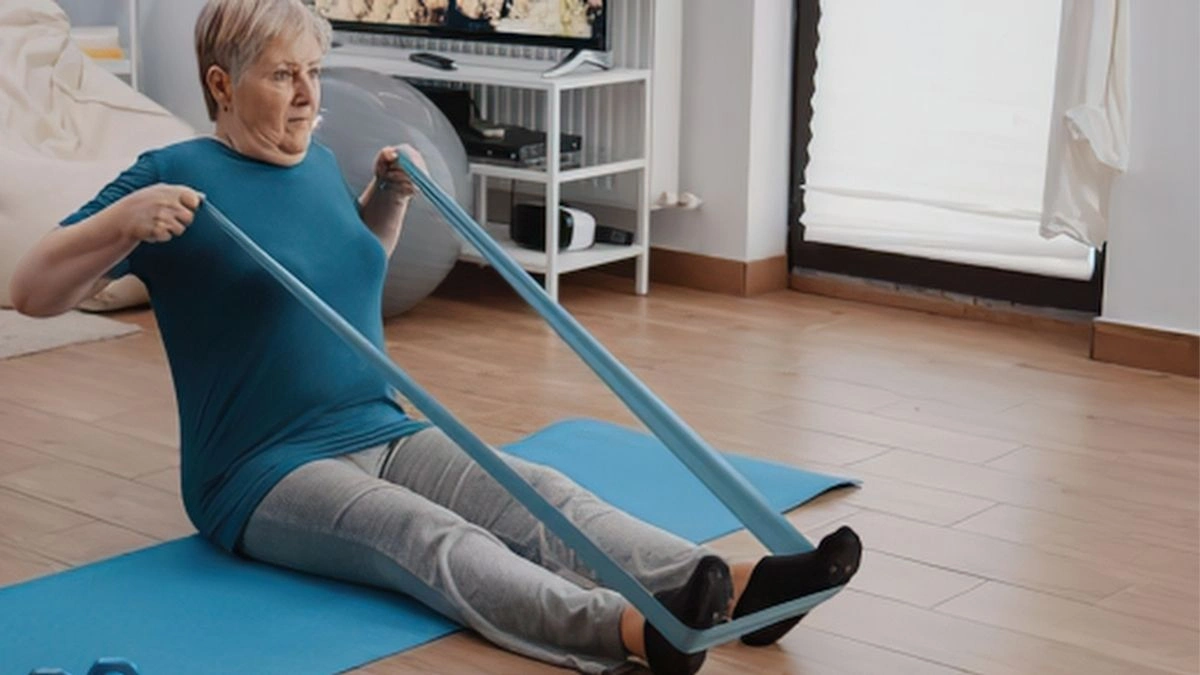
- Sit tall in a chair. Loop the band around both feet and hold one end in each hand.
- Start with arms extended and elbows slightly bent.
- Pull both hands toward your lower ribs, squeezing your shoulder blades together.
- Hold for one second. Return slowly.
- Do two sets of 10 repetitions.
Exercise 4: Bicep Curl
- Stand on the center of the band with feet shoulder-width apart. Hold one end in each hand, palms facing forward.
- Keeping your elbows at your sides, curl both hands toward your shoulders.
- Lower slowly. Do not swing the arms.
- Do two sets of 10 repetitions. Hold a chair back with one hand if you need balance support.
Exercise 5: Standing Overhead Press
- Stand on the band with feet hip-width apart. Hold one end in each hand at shoulder height, palms facing forward.
- Press both hands straight up until your arms are nearly extended.
- Lower slowly. Do two sets of eight repetitions.
Strong shoulders and a strong back make carrying and reaching feel effortless again. The final exercise section addresses something that affects how safe you feel outdoors.
Moves That Help You Walk Steadily and Climb Stairs Without Fear
That feeling of hesitation at the top of a staircase, the slight grip on the rail before you trust your first step down, usually comes from weak hip muscles.
The gluteus medius [the muscle on the outer side of the hip that keeps your pelvis level when one foot lifts off the ground] is responsible for your stability every time you take a step. Weakness here can make every step feel less steady than it should.
A review of 155 studies published between 2004 and 2024 found that strength and balance training is associated with improvements in postural control, gait stability, and neuromuscular coordination in community-dwelling older adults.
These two exercises target exactly the muscles that control your gait.
Exercise 6: Standing Hip Abduction
- Stand behind a sturdy chair and hold the back lightly for balance.
- Loop the band just above both ankles.
- Slowly lift your right leg out to the side, keeping your body upright and your toes pointing forward.
- Hold for two seconds. Lower slowly.
- Do 10 repetitions per side, two sets.
Exercise 7: Calf Raise with Band
- Stand on the center of the band with feet hip-width apart. Hold the ends at your sides or cross them for more resistance.
- Rise slowly onto the balls of both feet.
- Hold for one second at the top. Lower slowly.
- Do two sets of 12 repetitions. Use a chair for balance if needed.
Steady hips and strong calves change how you feel on uneven ground, on stairs, and on any surface that would have made you hesitate before. The last section puts all of this into a real weekly schedule.
How to Start Your First Week of Resistance Band Exercises Safely
The most common mistake people make when starting resistance band exercises for seniors is doing too much too fast and then stopping entirely. The second most common mistake is doing too little and wondering why nothing changes.
Start here. The ACSM recommends that adults perform resistance exercises for the major muscle groups on at least two days per week, with at least 48 hours between sessions that work the same muscles.
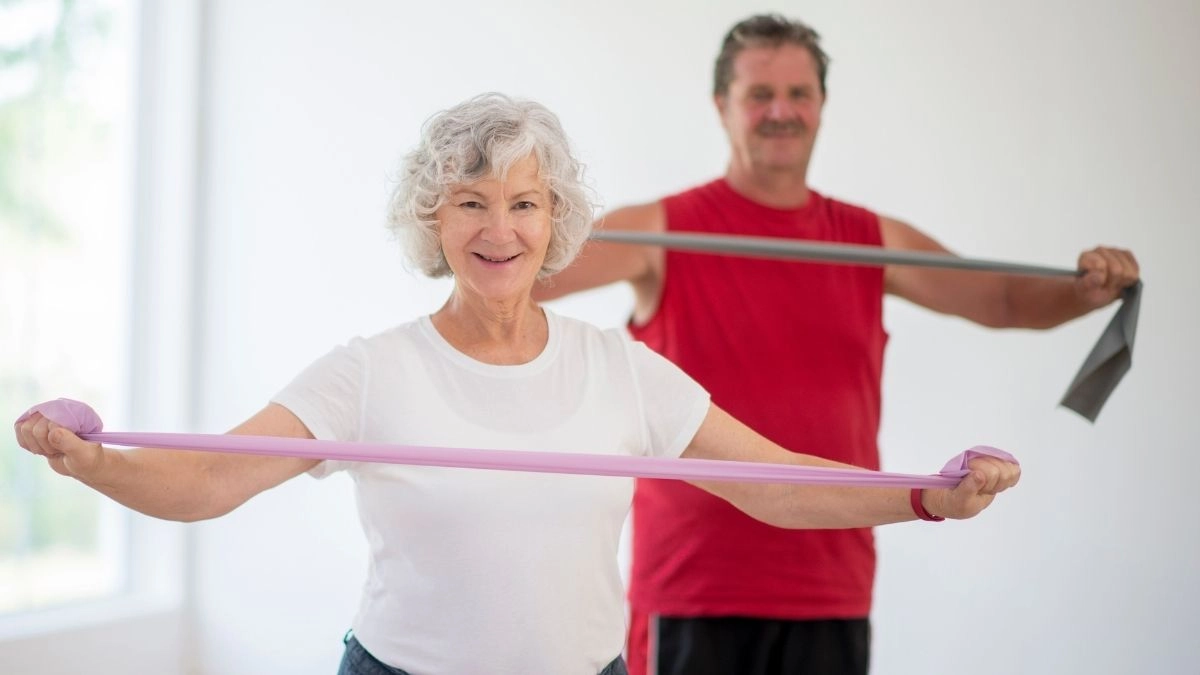
A practical first-week schedule looks like this:
- Day 1 (Monday): Sit-to-stand, seated row, and hip abduction. Two sets each.
- Day 2 (Wednesday): Seated leg press, bicep curl, overhead press, and calf raise. Two sets each.
- Day 3 (Friday): Repeat Day 1.
Each session takes about 15 to 20 minutes. Rest one to two minutes between sets.
How do you know if your band is the right resistance?
- Too light: You could do 20 repetitions easily and still feel nothing.
- Right: The last two or three repetitions of each set are genuinely hard, but your form stays clean.
- Too heavy: Your form breaks down before you finish the set, or you feel joint pain.
Stop and rest if you feel:
- Sharp pain in any joint
- Dizziness or shortness of breath
- A pulling sensation that feels like more than muscle fatigue
Research with older adults shows that muscle strength improvements can become measurable within four to eight weeks of consistent training. Not a dramatic change. Just tasks that felt hard starting to feel manageable.
Conclusion
Pick up your resistance band this week and do one set of sit-to-stands. That’s the first step. Do your first 10-minute resistance band session at home this week, and repeat it three times before the following Sunday.
The strength you’re working to protect is still there. Resistance band exercises for seniors exist precisely because the body responds to consistent, safe effort at every age. Start small. Stay steady. The goal isn’t a transformation. It’s a Tuesday where getting off the couch feels like nothing at all.