
You’ve probably spent real time and maybe real money trying to keep your brain sharp. Most people trying to protect their brain health are spending time on activities that research does not yet clearly support, while missing simpler ones that have stronger evidence behind them.
This article is for adults over 40 who want clear answers about mental exercises for brain health, not just a feeling that they’re doing something.
It covers what peer-reviewed research actually says about which mental exercises are worth your time, where the evidence is strong, and where it is thinner than the marketing implies.
By the end, you’ll know which activities show the most consistent links to brain health and where to start this week.
What “Mental Exercise” Actually Means to Your Brain
You clicked because you want to know what actually works. Here is the direct answer: research on mental exercises for brain health points most consistently to activities that are physically demanding, socially complex, or involve learning something genuinely new over time.¹ Puzzle apps are not at the top of that list.
When researchers study mental exercises and brain health, two concepts come up repeatedly.
Neuroplasticity defined: Your brain responds to demands placed on it. Neuroplasticity [the brain’s ability to form and strengthen connections between neurons in response to learning and experience] is not a fixed trait.
It continues into older age, though the degree of change and the conditions that drive it are still being studied.
Cognitive reserve explained: The second concept is cognitive reserve [the brain’s capacity to keep functioning well despite age-related physical changes, by drawing on a wider set of learned skills and alternate neural pathways].
Research suggests people who build more cognitive reserve over a lifetime may show symptoms of decline later, even when brain-scan findings are similar to those who decline faster.²
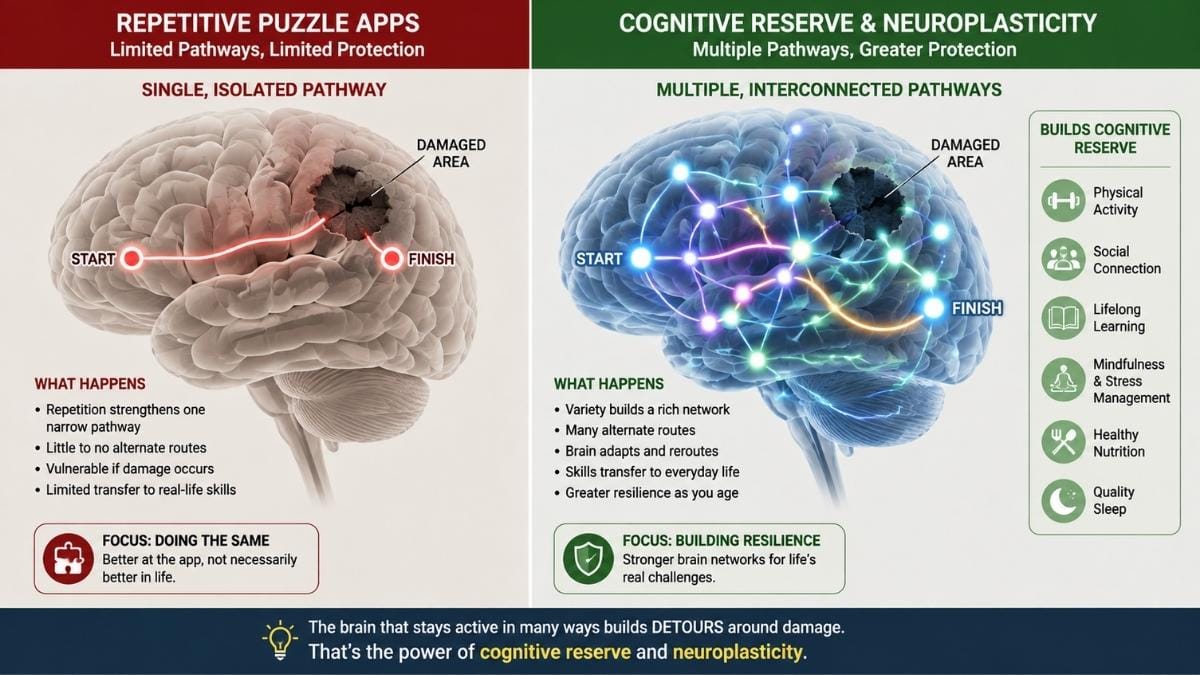
What builds cognitive reserve? Sustained, genuinely challenging activity, over years, not weeks. The next section explains why the most advertised mental exercises don’t necessarily fit that description.
Why Brain-Training Apps Have a Complicated Record
You’ve seen the ads. They promise sharper memory, faster thinking, and lower risk of decline. The research behind those claims is more complicated than the marketing suggests.
Here is what studies consistently find.
Near transfer is real. When people practice specific tasks on a brain-training app, they get better at those tasks.³ Practice a speed-matching game long enough, and your speed-matching score goes up.
What researchers call far transfer [improvement on untrained tasks that reflects a genuine gain in general thinking ability, not just familiarity with one game] is where the evidence falls apart.
A study of 11,430 adults, published in Nature, found that although participants improved on the specific tasks they practiced, no evidence emerged of transfer to untrained cognitive tasks, even closely related ones.³
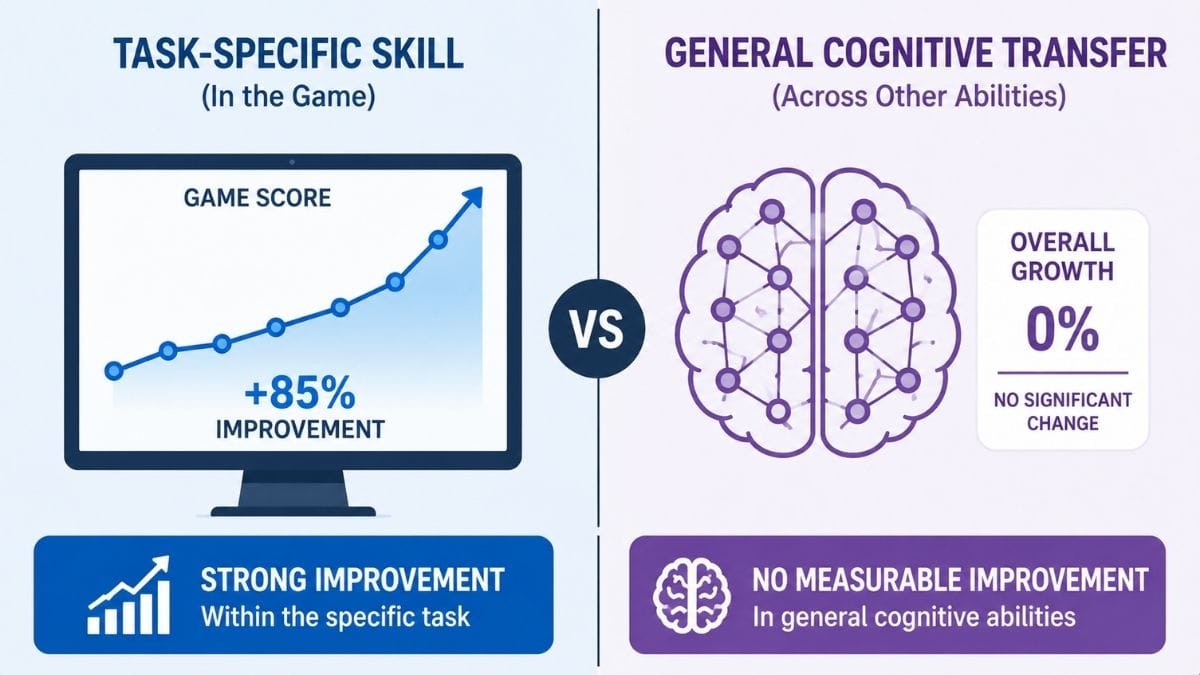
A 2023 review in Perspectives on Psychological Science, covering decades of cognitive training research, concluded that the overall effect of far transfer is effectively zero.⁴
The mental exercises with the most research support are mostly free, mostly social, and mostly not sold anywhere. That is the part the marketing rarely mentions.
This does not mean mental activity is useless. It means repetitive, single-skill app practice is probably not the general brain workout it is advertised to be. The next section covers what the evidence does support.
Free Mental Exercises for Brain Health With Real Research Support
If you’re looking for mental exercises with real research behind them, you don’t need to spend anything. The most consistent evidence points to activities that have been available forever.
Aerobic exercise leads the research. A randomized controlled trial of 120 older adults found that aerobic exercise training increased the size of the anterior hippocampus [a region deep in the brain involved in forming and retrieving memories].⁵
The hippocampus is one of the first regions affected by Alzheimer’s disease and tends to shrink with normal aging.⁵ The control group, which did stretching only, showed a small decline in hippocampal volume over the same period.⁵

Twelve randomized controlled trials covering 646 adults classified with cognitive frailty or mild cognitive impairment were analyzed in a 2023 systematic review, which found that exercise was associated with improvements in global cognition and executive function.⁶
A separate long-term study reported in 2026 by Johns Hopkins Medicine found that cognitive speed training, specifically a protocol targeting visual processing and divided attention, was linked to lower dementia incidence for up to 20 years in adults older than 55.⁷
This was a research-designed protocol, not a commercial app.
Talk to your doctor before starting a new exercise program if you are managing a chronic condition, taking medication, or have any cardiac or orthopedic concerns.
What counts as aerobic exercise for brain health:
- Brisk walking, four to five times per week
- Swimming or cycling at moderate intensity
- Dancing, which adds coordination and social components
- Any sustained activity that raises your heart rate for at least 20 to 30 minutes

These are not exotic interventions. They are already known to benefit the heart, sleep, and mood. What learning a genuinely new skill adds to that picture is where the next section goes.
Learning a New Skill: What the Evidence Shows
Repeating a task you’ve already mastered is probably not giving your brain the challenge it needs.
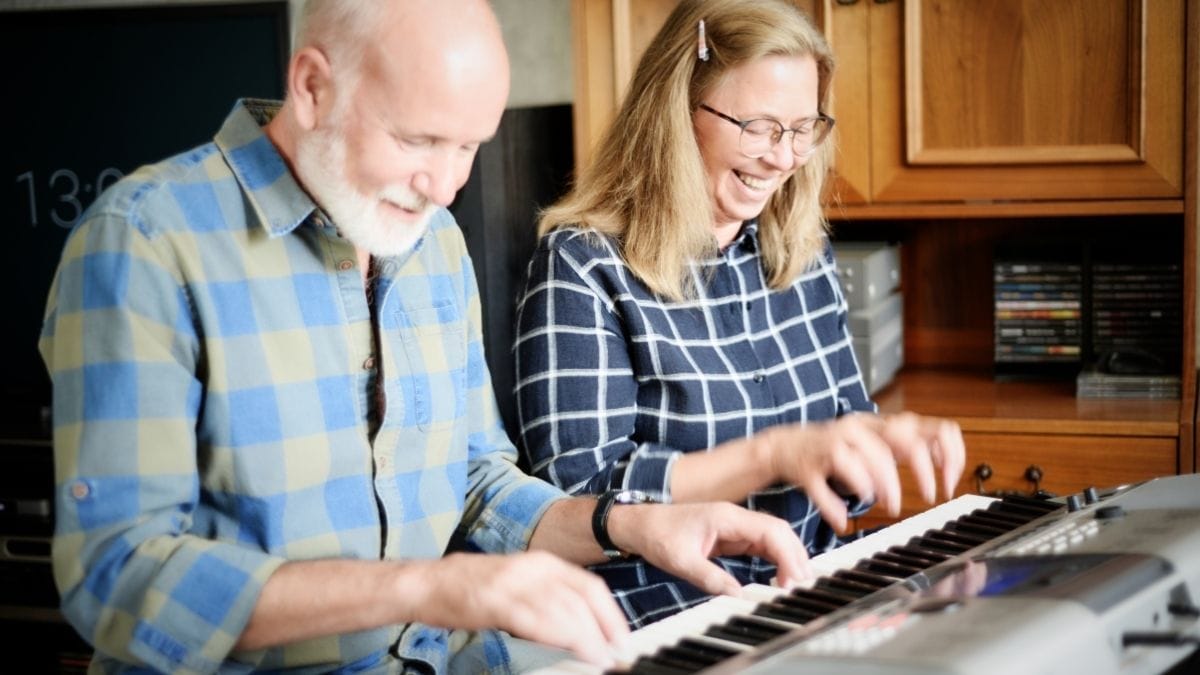
When you learn a musical instrument, a new language, or a craft requiring precise coordination, your brain faces problems it has never encountered. Each session brings new demands. The challenge keeps growing.
Researchers believe this kind of sustained, escalating mental effort is more likely to build cognitive reserve [the brain’s capacity to compensate for decline by using wider networks of neural pathways] than repeating a task you have already mastered.⁸
Musical training and brain reserve: A 2025 study published in PLOS Biology found that older adults with long-term musical training showed brain activity patterns during speech perception that more closely resembled those of younger adults than non-musicians did.
The researchers attributed this to enhanced cognitive reserve.⁸ Because this was an observational study comparing musicians to non-musicians, it shows an association, not a confirmed cause-and-effect relationship.
Learning new languages for brain health: A 2025 review found that new language acquisition in previously monolingual older adults was linked to improved cognitive control, better performance on specific attention tasks, and functional neuroplasticity in brain areas involved in cognitive control.⁹
Effect size appeared to depend on the intensity and duration of engagement, not just whether someone started learning.⁹
Second language learning appears to promote neuroplasticity in aging, according to a 2021 systematic review, though that review also noted the evidence base is still developing.¹⁰
The other piece most people underestimate has nothing to do with an app, an instrument, or a language class.
How Social Interaction Trains Your Brain
Most articles about brain exercises treat socializing as a lifestyle bonus. The research suggests it deserves a more serious place in the conversation.
A 2023 review published in Nature Aging examined evidence from multiple longitudinal studies and found that greater social participation in midlife and late life is associated with 30 to 50 percent lower subsequent dementia risk.¹¹
The authors noted that some of this association may not be causal, since people who are healthier may also participate more socially. But the consistency and size of the finding across many studies is notable.
More direct evidence comes from a NIH-funded randomized controlled trial called I-CONECT.
Socially isolated older adults with MCI [mild cognitive impairment, a level of memory and thinking difficulty greater than normal aging but not yet severe enough to be called dementia] or normal cognition were given structured conversational interactions via video.
Those who received these interactions showed significant improvement in global cognitive function, with an effect size of 0.73, and in memory function, compared to a control group.¹² These gains held at both six-month and twelve-month follow-up points.¹²

A 2022 meta-analysis of 40 publications from 32 longitudinal studies found that high social engagement was associated with a 19 percent lower risk of dementia compared to low social engagement (relative risk = 0.81, 95% CI = 0.74 to 0.89).¹³
Why does conversation tax the brain so heavily? A real back-and-forth exchange asks you to track what was said, remember earlier points, read tone and intent, choose words in real time, and respond to thoughts you cannot predict.
Social interaction may be among the most cognitively complex everyday activities most people do without thinking of it as exercise.
What to actually do with all of this, starting this week, is the part that’s still missing.
What to Do This Week: A Plain-Language Starting Point
You’ve made it this far, which means you’re ready for a plain answer about what to actually do. None of this research proves that any specific activity will prevent cognitive decline in any one person. What it shows is that certain activities appear consistently in studies that find lower rates of decline and better cognitive function in older adults.
Three directions the evidence points most clearly:
- Move regularly. Aerobic activity at moderate intensity appears in more positive brain health studies than any other single behavior. Consistency matters more than intensity.
- Learn something genuinely hard. Pick something that will still challenge you a year from now. An instrument, a language, a craft requiring real coordination.
- Stay in real conversations. Not passive scrolling. Active, back-and-forth exchanges with people whose responses you cannot predict. Clubs, classes, volunteer work, and regular calls all count.

The honest word on brain-training apps: the research does not support them as substitutes for the above. If you enjoy them, they are probably not harmful. But they should not replace evidence-linked activities.
Pick one of these activities today and do it for 20 minutes. Then put it on your calendar so it happens again. That is not a complex plan. It is a start.
Conclusion
The single most useful thing you can do today is pick one activity and do it. Choose one specific mental exercise from this article, do it for 20 minutes, and schedule it into your week before you close this tab. Consistency with one real activity is worth more than uncertainty across ten. Cognitive decline prevention is not a product you buy. It is a practice you keep.
References
- National Institute on Aging. Cognitive Health and Older Adults. NIH. Updated 2017. https://www.nia.nih.gov/health/brain-health/cognitive-health-and-older-adults
Population: Older adults generally; review of existing research. - National Institute on Aging. Cognitive Health and Older Adults. NIH. Updated 2017. https://www.nia.nih.gov/health/brain-health/cognitive-health-and-older-adults
Population: Older adults generally; review of existing research. (Cognitive reserve framing confirmed.) - Owen AM, Hampshire A, Grahn JA, et al. Putting brain training to the test. Nature. 2010;465:775-778. https://pubmed.ncbi.nlm.nih.gov/20407435/
Population: 11,430 general adult participants in an online study. - Sala G, Gobet F, Trinchero M, Nichols E. Cognitive Training: A Field in Search of a Phenomenon. Perspectives on Psychological Science. 2023;18(1):125-141. https://pubmed.ncbi.nlm.nih.gov/35939827/
Population: Meta-analysis covering diverse adult populations across published cognitive training literature. - Erickson KI, Voss MW, Prakash RS, et al. Exercise training increases size of hippocampus and improves memory. Proceedings of the National Academy of Sciences USA. 2011;108(7):3017-3022. https://pubmed.ncbi.nlm.nih.gov/21282661/
Population: 120 older adults, mean age approximately 67 years. - Karamacoska D, Butt A, Leung I, et al. Brain function effects of exercise interventions for cognitive decline: a systematic review and meta-analysis. Frontiers in Neuroscience. 2023. https://pmc.ncbi.nlm.nih.gov/articles/PMC10228832/
Population: 646 adults classified with cognitive frailty, mild cognitive impairment, or vascular cognitive impairment. - Johns Hopkins Medicine. Cognitive Speed Training Linked to Lower Dementia Incidence Up To 20 Years Later. 2026. https://www.hopkinsmedicine.org/news/newsroom/news-releases/2026/02/cognitive-speed-training-linked-to-lower-dementia-incidence-up-to-20-years-later
Population: Adults older than age 55. - Alain C, Du Y. Musical training, cognitive reserve, and brain aging. PLOS Biology. 2025. Reported via EurekAlert. https://www.eurekalert.org/news-releases/1090252
Population: Older adult musicians compared to non-musicians; observational design. Causation not confirmed. - Ghazi Saidi L. Enhancing Cognitive Health in Aging through New Language Acquisition: Insights from Behavioral and Neuroimaging Studies. Alzheimer’s and Dementia (abstract). 2025. https://www.ncbi.nlm.nih.gov/pmc/articles/PMC11709712/
Population: Monolingual older adults learning a new language. - Ware C, Dautricourt S, Gonneaud J, Chételat G. Does Second Language Learning Promote Neuroplasticity in Aging? A Systematic Review of Cognitive and Neuroimaging Studies. Frontiers in Aging Neuroscience. 2021. https://www.ncbi.nlm.nih.gov/pmc/articles/PMC8633567/
Population: Older adults; systematic review. - Sommerlad A, Livingston G. Social participation and risk of developing dementia. Nature Aging. 2023. https://www.nature.com/articles/s43587-023-00387-0
Population: Adults in midlife and late life; review of observational longitudinal studies. - Dodge H, Wu CY, Yu K, et al. I-CONECT results: Enhancing Social Interactions Improves Cognitive Function in Socially Isolated Participants. Innovation in Aging (conference abstract). 2022. NIH-funded randomized controlled trial. https://www.ncbi.nlm.nih.gov/pmc/articles/PMC9766228/
Population: Socially isolated older adults with MCI or normal cognition. - Zheng F, Qi H, Zhao J, et al. Association between social integration and risk of dementia: A systematic review and meta-analysis of longitudinal studies. Ageing Research Reviews. 2022. https://pubmed.ncbi.nlm.nih.gov/36307921/
Population: Adults in longitudinal cohort studies; meta-analysis of 40 publications from 32 studies.